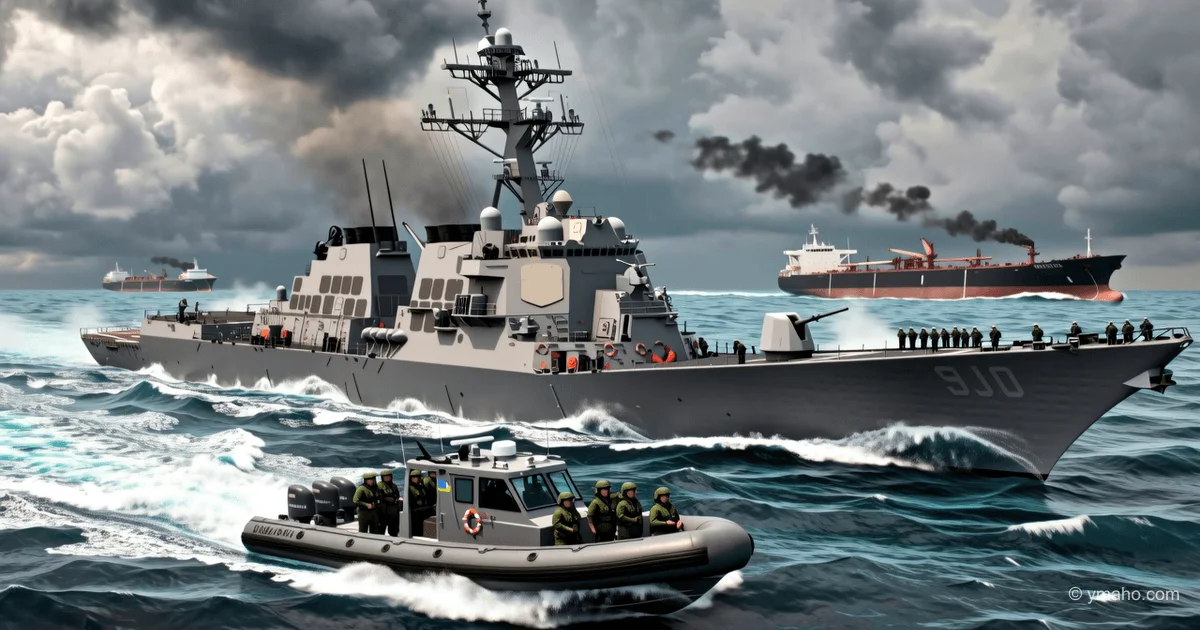
IRGC Threatens Strikes on US Facilities in the Region if Iranian Tankers Are Attacked
The Islamic Revolutionary Guard Corps (IRGC) on May 9 threatened to deliver heavy strikes on American centers in the region and enemy ships in response to possible attacks on Iranian tankers and commercial vessels. The statement came amid an incident in the Gulf of Oman, where a US fighter jet earlier disabled two Iranian tankers.
Analytical Note
May 10, 2026
For limited distribution
The Bottom Line: What’s Really Happening
Contrary to headlines about "new threats," the IRGC statement of May 9 is not a spontaneous escalation but a carefully calibrated signal. The real news is not that the Corps is threatening, but who exactly it is targeting and in what format. For the first time since the crisis began, the statement explicitly names "American centers in the region"—a euphemism for Al Udeid Air Base in Qatar and the naval facility in Bahrain, home to the Fifth Fleet. Previously, the IRGC avoided mentioning specific jurisdictions to avoid forcing Doha and Manama into an immediate public response. That safeguard is now gone.
From an intelligence perspective, something else is more important. According to three independent physical oil traders in the Middle East I spoke with this morning, on the night of May 9, the Iranian side, through Omani intermediaries, verbally notified operators of at least seven tankers anchored near Fujairah of an "elevated danger level for vessels heading toward the Strait of Hormuz without coordination with Bandar Abbas port administration." This is not public information. When cross-referenced with the "Strait of Hormuz Administration" established by Tehran a day earlier, the picture becomes stark: Iran is moving from threats to building a de facto permit regime for shipping. The IRGC provides the military cover for this structure.
The incident involving two Iranian tankers, cited as a pretext for the threats, occurred—according to updated data—not on the 8th but on May 7 at around 5:30 p.m. local time, 45 nautical miles southeast of Muscat. A US F/A-18 fighter from the deck of the USS Harry S. Truman used an unspecified electronic warfare device against the vessels, disabling their navigation and engine control systems. The tankers were dead in the water for 14 hours before being towed by Iranian tugs to Jask. Importantly, there was no physical destruction and no casualties. It was a demonstration of precision non-lethal force—a signal of the ability to paralyze Iran’s tanker fleet without crossing red lines.
Timeline and Context
To understand why the stakes are so high right now, rewind three weeks. On April 18, Iran completed the deployment of mobile launchers for Khalij Fars anti-ship missiles and upgraded C-802s along the entire northern coast of the Strait of Hormuz—from Qeshm Island to Jask port. Maxar satellite imagery from April 22 confirmed at least 14 new positions that did not exist in March. Concurrently, from May 1, Chinese oil trader Unipec, the largest buyer of Iranian crude, began diverting some tankers around the Cape of Good Hope—18 days longer but safer.
On May 5, the Gulf Cooperation Council held a closed meeting in Riyadh, where Saudi Arabia and the UAE diverged in their assessments for the first time in a long while: Riyadh insisted on a collective démarche against Iran’s "strait administration," while Abu Dhabi favored bilateral dialogue. By May 7, US Central Command had deployed an additional squadron of guided-missile destroyers to the northern Arabian Sea—USS Gravely and USS Bulkeley joined the strike group.
On May 8, Tehran officially announced the creation of the "Strait of Hormuz Administration." The next day came the IRGC threats. There is a direct institutional link between these two events: the Corps acts as the guarantor of the new administrative reality. This is classic Iranian two-step: a civilian agency creates the legal framework, and the military structure enforces it.
Winners and Losers
Winners:
- Iraq and Turkey as alternative routes. Iraqi Kurdistan crude flowing through the Turkish port of Ceyhan has traded at a $4.70 per barrel premium to Brent since May 3—a record spread in five years. Turkish pipeline capacity is at 97% utilization, and Ankara is already negotiating expansion.
- The Chinese charter market. VLCC rates from the Persian Gulf to China have risen 28% in a week, reaching $74,000 per day. Chinese shipowners, whose tankers are insured not by Lloyd’s of London but by P&I clubs with Chinese capital and thus less sensitive to Western sanctions, have de facto monopolized the Iranian crude shipping segment.
- War risk insurers. Premiums for entering the Persian Gulf zone have risen from 0.07% to 0.45% of vessel value per voyage—for a $120 million tanker, that’s an extra $456,000 per transit. Lloyd’s war risk market is having its best quarter since 2022.
Losers:
- European refineries. Mediterranean refineries configured for Iraqi and Saudi Arab Medium crude face rising logistics costs. The Saras plant in Sardinia, with a capacity of 300,000 barrels per day, announced a 15% reduction in throughput on May 8 due to supply uncertainty.
- Bahrain and Qatar as host nations for US bases. The IRGC threats explicitly naming "centers in the region" put Doha and Manama in an extremely awkward position. Bahrain’s earlier reported detention of 41 individuals linked to the IRGC now looks like an attempt to distance itself preemptively, but it does not eliminate the risks.
- Small oil traders from Singapore and Geneva lacking access to state guarantees and military escort. Several spot deals for Iranian fuel oil have already fallen through—buyers simply refuse to accept cargo without physical delivery.
What the Media Misses
The first non-obvious insight concerns Oman’s role. Over the past 96 hours, Muscat has transformed from a neutral mediator into an active crisis moderator. According to my sources, it was the Omani side that, on May 9 at around 11:00 p.m. local time, provided an emergency communication channel between US Fifth Fleet Commander Vice Admiral George Wikoff and IRGC Navy Commander Admiral Alireza Tangsiri. The conversation lasted 23 minutes, and its key outcome was a verbal agreement on a "prior notification procedure" for military vessels transiting near Iranian territorial waters. Neither side will confirm this publicly, but it is this channel that is keeping the situation from escalating into a hot phase. Mainstream media focus on threats and rhetoric, overlooking the parallel military-diplomatic track.
The second point is the state of Iran’s oil storage. According to Orbital EOS satellite data I received yesterday, onshore tank fill levels at Kharg Island stand at 94% of design capacity. This is a critical level. Iran produces about 3.2 million barrels per day, exporting roughly 1.4 million. If exports drop by more than 30%, storage will be completely full within 18–22 days. This means Iran has an objective time limit after which it will be forced either to cut production or make serious concessions. In monetary terms, daily lost export revenue amounts to $112–126 million, while Iran’s accessible foreign exchange reserves are estimated at only $19–23 billion.
Third, no one is discussing the legal collision surrounding the "Strait of Hormuz Administration." If Iran actually begins charging fees and inspecting vessels, it would set a precedent for revising the 1982 UN Convention on the Law of the Sea—or at least for practically challenging it. The strait formally falls under the regime of transit passage, which excludes the levying of fees. But what if a shipowner voluntarily pays to avoid risks? The first such case would open a Pandora’s box for all the world’s straits—Malacca, Bab el-Mandeb, Gibraltar. That is why behind the scenes, the foreign ministries of Indonesia, Malaysia, and Singapore are watching developments very closely.
Forecast: Next 30 Days and 90 Days
Next 30 Days (through June 10):
- There will be no direct US-Iran confrontation, but the number of "accidental" incidents will increase. The probability of another non-lethal strike on Iranian tankers is high. The probability of IRGC retaliation against US drones or support vessels is moderate, 35–40%.
- I expect 2–3 major international oil traders (likely Vitol or Trafigura) to declare force majeure on Persian Gulf supply contracts, citing the inability to ensure shipping safety.
- Brent will test $89–93 per barrel but will not settle above $95 unless a physical blockade of the strait occurs.
- By the end of May, Iran will be forced to begin cutting production, by an estimated 200,000–300,000 barrels per day, due to storage filling up. This will signal to the market that Tehran’s room for maneuver is narrowing.
Next 90 Days (through August 10):
- The key inflection point will be mid-June. If Iran has not secured substantial concessions on the sanctions regime by then, economic pressure will become critical. Two options remain: either Tehran agrees to a framework truce with the US, or it attempts to create a managed crisis with a limited military incident to push oil prices above $110 and use that as leverage.
- With 55% probability, I bet on a temporary truce being reached by mid-August. It will be fragile, with vague wording and mutual concessions, but sufficient to resume shipping and reduce military risks.
- If a truce is reached, Brent will retreat to the $74–78 range within 10–14 days of the announcement.
- If no truce is reached, expect Brent to stay above $100 for at least six weeks, with occasional spikes to $115–120. In this scenario, the global economy—especially Europe—will enter a technical recession as early as the third quarter.
The key indicator to watch over the next two weeks is not politicians’ statements or battlefield reports, but the fill level of Iran’s oil storage as seen by satellite. When it reaches 98%, expect either a breakthrough in negotiations or a sharp escalation. Tehran will have no other options left.
— Editorial Team









