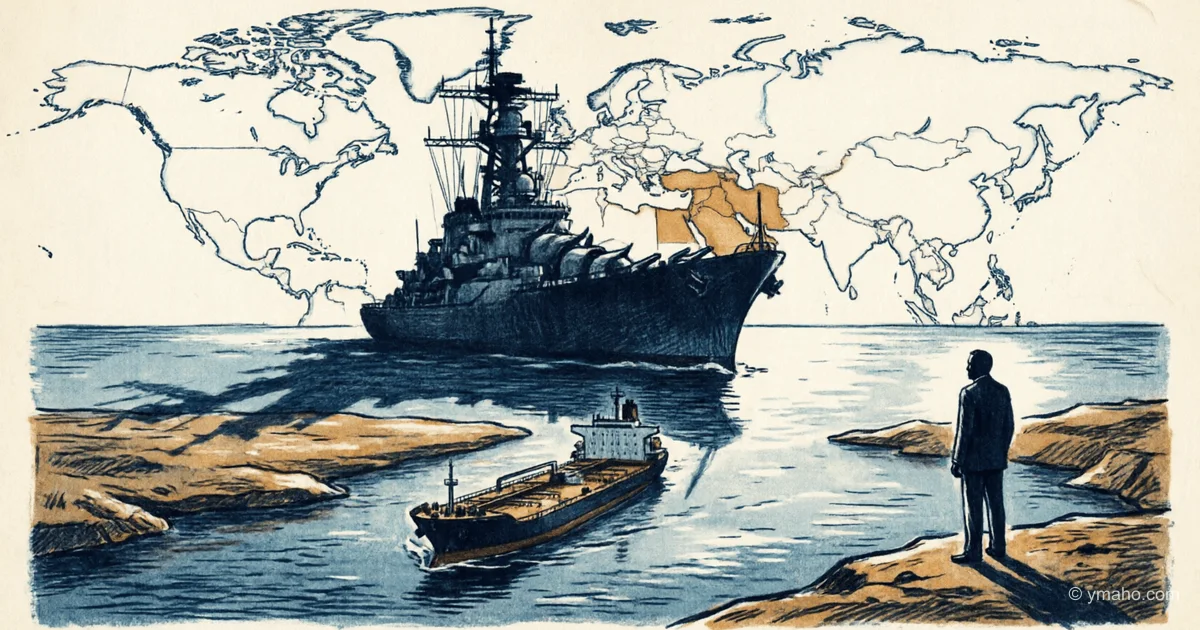
IRGC Threatens US with War Spreading Beyond Region if New Attacks Occur
The Islamic Revolutionary Guard Corps stated that if the US resumes aggression, the retaliatory strike will be delivered "in places you can hardly imagine," and the war will extend beyond the Middle East.
The statement by the Islamic Revolutionary Guard Corps (IRGC) on May 20 is not a rhetorical figure of speech or an ordinary threat in the series of Middle Eastern exchanges. It is an official doctrinal directive backed by a specific operational plan to escalate the conflict to a global level. While political commentators speculate about the timing of a deal, energy market analysts and Lloyd's insurance syndicates are already recalculating risk premiums for routes that were considered absolutely safe for decades.
The Essence: What Is Really Happening
The IRGC stated that if aggression is repeated, "the regional war will extend beyond the region" and strikes will be delivered "in places you can hardly imagine." This is a direct escalation from previous threats. Previously, Iran threatened strikes on Gulf states hosting US bases and Israel. Now, Western interests outside the Middle East are officially included in the target perimeter.
What changed? Six weeks have passed since the suspension of Operation Epic Fury and the ceasefire. Negotiations have stalled. Iran demands control over the Strait of Hormuz, compensation for damage from bombings, lifting of sanctions, and withdrawal of US troops from the region. Trump demands the surrender of the nuclear program and unconditional opening of the strait. Against this backdrop, Iran's military command has shifted from defense to developing an asymmetric response.
Timeline and Context
On May 19, Trump told journalists he was "an hour away from a decision" to resume bombings but postponed the strike for diplomacy. The next day, he repeated: either a deal or "we'll do something not very pleasant." It was in response to this direct threat that the IRGC published its statement.
This is a classic escalation spiral. The timeline of recent weeks looks like this:
- May 18–19: Trump twice publicly mentions the proximity of a military solution
- May 20: Iran, through the IRGC, announces the expansion of the geography of retaliatory targets
- May 20: US Navy detains Iranian tanker M/T Celestial Sea in the Gulf of Oman
- May 20: IRGC claims 26 vessels passed through the strait under its coordination — a demonstration of control
Each step by one side provokes a response from the other. Iran's demands for compensation ($75 billion by unofficial estimates), which Trump previously rejected, are now supplemented by the threat of global war expansion.
Who Wins and Who Loses
Winners:
- Insurance syndicates. War risk premiums for tankers transiting the Bab el-Mandeb Strait have surged 340% compared to pre-war levels. The threat of war spreading beyond the region means premiums will soon rise for vessels not even entering the Persian Gulf.
- China and South Korea as "friendly" countries. On May 20, two Chinese supertankers carrying 4 million barrels of oil passed through Hormuz, and the South Korean Universal Winner with 2 million barrels of Kuwaiti oil began transit after coordination with the IRGC. This creates a two-tier system of oil access: "Iran's friends" get crude, others pay a premium.
Losers:
- European refineries. Each day of transit delay through Hormuz costs $18 million in additional expenses for alternative routes.
- Indian importers. The country is not on the "friendly" list, and its tankers are idle.
- Emirati ports. The transit hub of Jebel Ali loses up to $4.5 million daily due to shipping collapse.
What the Media Isn't Saying
The IRGC's statement about "places you can hardly imagine" is not an abstract threat. On May 16, the US Department of Justice unsealed a criminal case against a senior commander of Kata'ib Hezbollah, an Iraqi militia controlled by Iran. The indictment states that the defendant helped plan attacks on US, European, and Canadian territory after the war began in February. This means Iranian proxy networks are activated worldwide, and the IRGC threat is not a hypothetical scenario but a statement of an already deployed operation.
Another layer — on May 19, Bloomberg reported that the UAE tried to persuade Saudi Arabia and Qatar to join a coordinated strike on Iran. Riyadh and Doha refused, stating that "this is not their war." This rift in the Gulf means the IRGC knows there is no united front against Iran and can escalate selectively — against the UAE and Bahrain as "active partners of aggression." This is precisely what creates the ground for war spreading beyond the region: if US bases in Europe are used to supply operations, they become legitimate targets in Iranian doctrine.
Forecast: Next 30 Days and 90 Days
30 days. The sides will remain in a clinch. A deal is unlikely until the US midterm elections in November — Trump needs leverage, not capitulation. Brent oil will stay in the $105–115 per barrel range. Iran will continue to selectively allow "friendly" countries' vessels through the strait, deepening the split in global trade. The probability of isolated incidents with attacks on Western targets in Southeast Asia or Latin America is above 30%.
90 days. If no deal is reached by the end of June, a new round of blockade will begin. Iran could activate proxies near the Bab el-Mandeb Strait, effectively doubling the strain on global logistics. Oil prices will test the $120 mark. The Trump administration, losing support due to rising gasoline prices, will be forced either to make concessions or engage in limited escalation. However, restoring oil flows, even in the event of peace, will take months.
Editorial Forecast
Asset: Dutch TTF Natural Gas Futures
Direction: Up in the next 24–72 hours. The IRGC threat to expand the conflict's geography increases the risk premium across all energy assets, and the EU gas market is most vulnerable due to competition with Asia for spot LNG supplies.
Key Levels: If it consolidates above €47/MWh, target is €52. Support at €44.
Confidence Level: Medium. The IRGC statement is already priced in, but any confirmation of an "attack outside the region" will trigger a sharp 5–7% intraday spike.
Main Risk: If Trump announces a specific timeline for a deal with Iran, the risk premium will collapse, and TTF will drop below €43 in a single session.
Editorial opinion, not investment advice.
— Editorial Team









