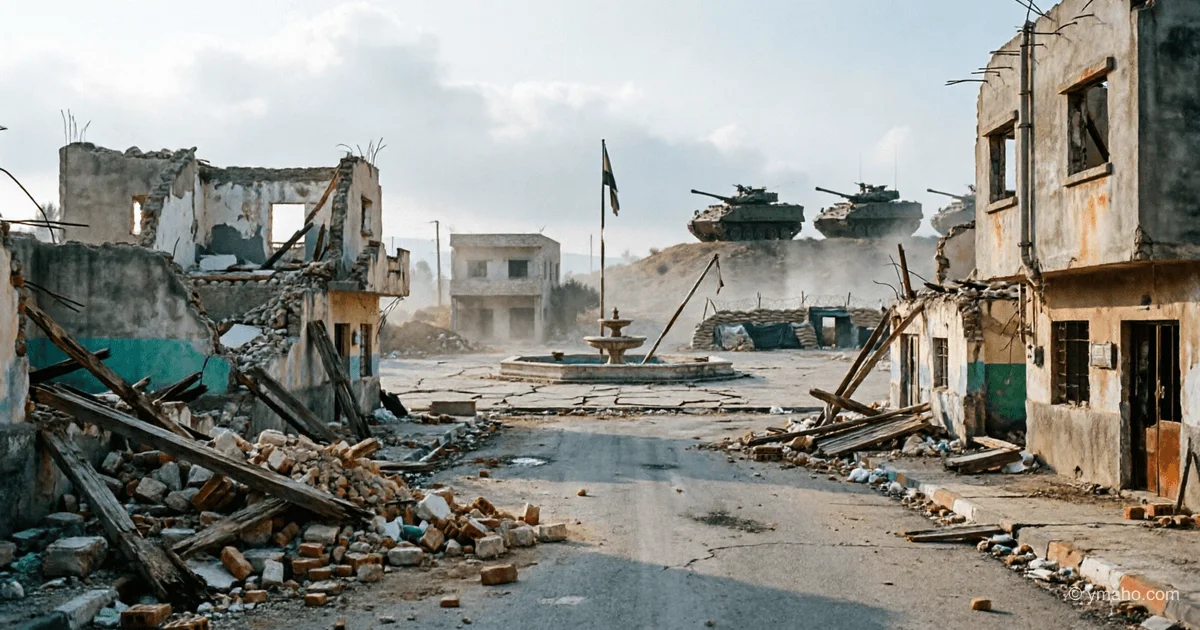
Israel Resumes Large-Scale Bombing of Lebanon
Despite a formal ceasefire, the Israeli army is striking Hezbollah targets in Lebanon. In response, Hezbollah attacks Israeli troops in border areas, with both sides suffering casualties.
Israel and Lebanon on the Brink of Ceasefire Collapse: Escalation, Casualties, and Diplomatic Stalemate
Introduction
The ceasefire between Israel and Lebanon, formally in effect since April 17, has become a fiction. Despite repeated extensions—first for ten days, then for another three weeks—hostilities have not only continued but have taken on the character of a protracted war of attrition. As of early May 2026, the Israel Defense Forces have struck approximately 500 targets in southern Lebanon, while the Lebanese movement Hezbollah has carried out a series of attacks on Israeli positions, including the use of swarms of kamikaze drones. Civilian deaths, the destruction of entire villages, and the lack of diplomatic prospects have pushed the region to the brink of a full-scale resumption of conflict.
Event Details and Timeline
The latest escalation is the logical outcome of the collapse of the April agreements. According to Israeli Army Radio, since the ceasefire took effect, Israeli aircraft have struck approximately 500 targets in southern Lebanon and one target in the Beqaa Valley. In the past 24 hours alone, the IDF attacked about 15 Hezbollah targets, including military structures, surveillance equipment, and assembly points. Before the strikes, the Israeli military issued evacuation warnings to residents of nine southern villages, demanding they immediately leave their homes and move at least one kilometer inland.
The scale of the strikes is confirmed by data from the Lebanese Ministry of Health. On May 4, the ministry reported that 17 people had been killed in Israeli raids and artillery shelling over the past 24 hours. The total number of casualties since the escalation began on March 2, 2026, has reached 2,696 dead and 8,264 wounded. These figures include both Hezbollah fighters and civilians killed in the systematic destruction of residential areas in border communities.
Hezbollah, for its part, has demonstrated the ability to deliver painful strikes. On May 5, the movement announced it had carried out 11 "qualitative military operations" against Israeli forces, including rocket barrages on positions in the Al-Bayada, Al-Qantara, and Aynata areas, as well as a direct clash near Hallet al-Raj north of Deir Siriane. Hezbollah's drones pose a particular danger to the Israeli army. Israeli Prime Minister Benjamin Netanyahu described the drones as the "main threat." Since the ceasefire, three Israeli soldiers have been killed by drone attacks, and on May 4, two soldiers were moderately wounded in close combat with Hezbollah fighters in southern Lebanon.
The Israeli military command insists it is acting in accordance with international law and destroying only enemy military infrastructure. However, observers note the systematic demolition of entire residential blocks. As Hassan Sweidan, a resident of a neighboring village, recounted, "They destroyed it gradually until they reached the central square, and now there are no houses left." Lebanese authorities and UN peacekeepers have been unable to conduct a detailed survey of the affected areas due to security concerns.
Impact and Significance
The continuation of hostilities despite the formal ceasefire has catastrophic consequences for Lebanon and serious implications for regional stability. First, Israel is occupying territory in southern Lebanon, having advanced about 10 kilometers inland during the current offensive. The military has declared these areas a "forward defense line" and published maps of a "yellow line" beyond which Lebanese residents are forbidden to return under threat of being considered targets. This amounts to a de facto annexation of part of Lebanese territory under the guise of creating a "buffer security zone."
Second, the scale of destruction in southern Lebanon is comparable to the aftermath of a full-scale war. According to sources, the Israeli army even destroyed a football stadium in the town of Bint Jbeil, which the IDF claimed was used as a booby-trapped Hezbollah facility. The economic damage from the destruction of homes, infrastructure, and economic assets runs into billions of dollars, with no prospects for compensation or reconstruction until the conflict ends completely.
Third, the conflict is placing an increasing burden on Lebanon's healthcare system and humanitarian services, which are already overwhelmed by the country's protracted economic crisis. The steady increase of 80-90 wounded per day in recent days is placing a heavy strain on medical facilities suffering from chronic resource shortages.
On the Israeli side, official reports indicate 17 soldiers killed in southern Lebanon and two civilians killed in Hezbollah attacks. Additionally, 33 soldiers have been wounded. Although these numbers are significantly lower than Lebanese casualties, regular drone attacks create constant psychological tension in northern Israel, and the military operation requires substantial budget expenditures, estimated at least several hundred million dollars per month.
Reactions of Key Players
Hezbollah leader Naim Qassem issued a policy statement rejecting the very existence of a ceasefire in Lebanon. "There is no ceasefire in Lebanon; there is an ongoing Israeli-American aggression," he said. Qassem emphasized that Israel had committed thousands of violations of the agreement, killing hundreds of civilians and causing mass displacement. He categorically ruled out direct negotiations between Lebanon and Israel, calling them "a free concession that yields no results."
A similar position was taken by Lebanese Parliament Speaker Nabih Berri, the most influential Shia politician and an ally of Hezbollah. He stated that negotiations with Israel are impossible without an end to the war and security guarantees. Hezbollah MP Hussein Hajj Hassan told CGTN: "The reality is that there is no ceasefire. The party violating the truce is known—it is the Israeli enemy."
On the other hand, Lebanese President Joseph Aoun took a more cautious stance, trying to balance the need for a diplomatic settlement with internal pressure. He said that a third round of preparatory talks with Israel, mediated by the US, should be expected "in the coming days." At the same time, Aoun stressed that the talks must lead to the withdrawal of Israeli troops from Lebanese territory. This position reflects a deep split in Lebanon's political class between pragmatists seeking a diplomatic way out of the crisis and forces advocating continued armed resistance.
Israeli leadership, for its part, shows no readiness for de-escalation. The IDF continues daily strikes, citing the need to prevent attacks on Israeli territory and eliminate Hezbollah infrastructure. Israeli military sources acknowledge: "These figures show that there is no ceasefire in southern Lebanon."
Forecast and Conclusions
The situation in Lebanon is developing along a negative trajectory, approaching a full-scale resumption of conflict. Several factors point to a high probability of further escalation. First, neither side is observing the ceasefire: Israel continues bombing and occupying territory, while Hezbollah responds with rocket barrages and drone attacks, calling its actions a "legitimate response to aggression." Second, the diplomatic process has reached a dead end—direct negotiations are rejected by Hezbollah as capitulation, and Israel shows no willingness to compromise on the "buffer zone" issue.
Third, the position of the US, the main mediator, remains ambiguous. On one hand, Washington secured a formal ceasefire and held two rounds of US-Israeli-Lebanese consultations; on the other, as Hezbollah representatives note, "Israel's violations of the ceasefire are the result of US-Israeli agreements." Without a clear signal from Washington that continued bombing is unacceptable, the Israeli leadership is unlikely to change course.
The main conclusion from the current situation is that the declared ceasefire was doomed from the start, as it was not based on a real balance of interests. Israel is using the ceasefire as a cover for systematically destroying Hezbollah infrastructure and creating a "security zone" on Lebanese territory. Hezbollah, in turn, is proving that even under intense bombing, it retains the ability to strike Israeli territory. In these conditions, the forecast for the coming weeks is bleak: as long as there is no political will for a real, rather than declaratory, ceasefire, southern Lebanon will remain a zone of active hostilities, and the humanitarian catastrophe will worsen.
— Editorial Team









