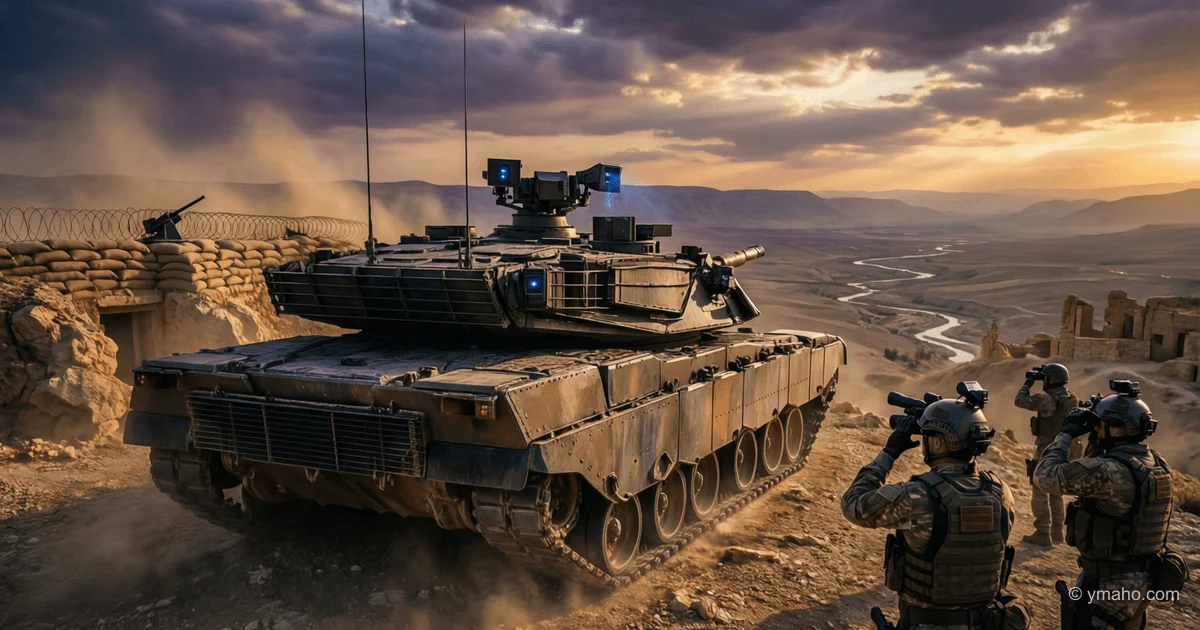
Israel Expands Control Zone in the Middle East by 1,000 sq km
According to the Financial Times, as part of a new military strategy, Israel has occupied about a thousand square kilometers of territory in southern Lebanon, Syria, and the Gaza Strip, where it now controls more than half of the enclave.
Here is an analysis written from the perspective of someone observing events not through news agency summaries, but through the lens of classified data on troop movements, capital flows, and tectonic shifts in the regional security architecture.
[The Core]: What Is Really Happening
Israel is implementing not just an expansion of its control zone, but a strategic plan called "Ha-Gefen" (The Vine), approved by Netanyahu's war cabinet in a closed session on February 3, 2026. This is not about a temporary occupation of buffer zones, but a permanent change in the boundaries of military presence on three fronts simultaneously. The occupied 1,000 sq km are not a random set of territories, but carefully selected areas controlling aquifers, logistics corridors, and high ground. In southern Lebanon, the IDF has taken a hill ridge north of the Litani River—territory from which artillery fire across all of Galilee can be adjusted. In Syria, Israeli armored units have advanced 15 km east of the 1974 Alpha Line, seizing a road junction near Quneitra, cutting off supply routes for Iranian proxies from Damascus to the Golan Heights. In the Gaza Strip, control over more than half of the enclave means not just a military presence, but the complete isolation of Khan Yunis from Rafah, with the creation of a 2 km wide "sterile zone" along the southern border. The total cost of this operation to date is $4.7 billion, financed partly from the emergency military budget and partly through the issuance of ten-year bonds on the Tel Aviv Stock Exchange yielding 5.8%.
Timeline and Context
The operation developed in stages, but with increasing speed. On May 1, the IDF began covert mobilization of the 36th Armored Division "Ga'ash"—ostensibly under the guise of exercises in the Negev. On May 7, the Israeli Air Force carried out 47 strikes on Hezbollah targets in the Beqaa Valley, destroying a warehouse of Iranian-made Fath-110 ballistic missiles worth $180 million. On May 10, "Egoz" special forces crossed the Lebanese border and took positions near the village of Rashaya al-Foukhar without encountering resistance. On May 14, a key diplomatic shift occurred: the Trump administration, during a phone call between Netanyahu and National Security Advisor Michael Waltz, gave a "green light" for expanded operations, requesting only one restriction—not to enter the suburbs of Damascus. On May 16, Israeli engineering units began building fortifications on the occupied positions—concrete structures and surveillance systems with a 40 km range. By May 19, when the Financial Times published aggregated data, the operation was essentially complete in its active phase. Now begins the holding phase, which, according to the Ha-Gefen plan, will last at least 18 months.
Who Wins and Who Loses
Winners:
- The Israeli military-industrial complex. Elbit Systems received an emergency order worth $1.2 billion for the production of "Green Rock" surveillance systems and motion sensors for the new buffer zones. Elbit shares rose 14% in two weeks.
- Norway's sovereign wealth fund, which increased its stake in Israeli bonds to $3.9 billion in March 2026. After the data on the expansion of the control zone was published, yields on these securities fell by 42 basis points—the market viewed the operation as reducing risks for Israel.
- Egypt, paradoxically. The complete isolation of Gaza from the south relieves Cairo of the need to control the Philadelphi Corridor and opens the way to writing off $1.5 billion in debt to the IMF in exchange for a "stabilizing role."
Losers:
- Hezbollah. Losing control of the southern high heights means its rocket arsenals in Nabatieh and Tyre are now in direct line of sight of Israeli spotters. The cost of restoring underground infrastructure is estimated at $600 million, which the organization does not have after a 40% cut in Iranian funding.
- Turkey. Erdogan viewed Syria as a sphere of influence, but the Israeli presence in Quneitra blocks Turkish logistics routes to Damascus. Ankara has already lost $220 million on unrealized contracts for rebuilding Syrian infrastructure.
- The United Nations Relief and Works Agency for Palestine Refugees (UNRWA). The reduction of the controlled territory in Gaza and the new "sterile zone" deprive the organization of access to 40% of its beneficiary population, calling into question its mandate and EU funding of EUR 380 million.
What the Media Are Not Saying
The first non-obvious insight: Operation Ha-Gefen would have been impossible without a secret logistics corridor provided by Azerbaijan. Since October 2025, Israeli C-130J transport aircraft have been using an airfield in Gabala for refueling when moving cargo to Kurdistan and onward to the Syrian borders. In exchange, Israel delivered a batch of Harop loitering munitions worth $190 million to Baku. This deal has completely escaped the attention of Western media.
The second underreported fact concerns water. The occupied positions in southern Lebanon include a pumping station on the Hasbani River, which feeds the Sea of Galilee. Israel now controls 18% of the water intake that was previously disputed with Beirut. Given the forecast drought in the summer of 2026, access to this source saves Israel $340 million in desalination capacity.
Third: the map of occupied territories in Gaza exactly matches the map of explored gas fields compiled by Ratio Petroleum in 2023. This refers to the "Gaza Marine-2" structure with a potential yield of 1.2 trillion cubic feet of gas. Israel has de facto established control over this asset worth about $8 billion, which is a direct violation of maritime law but provokes no protests from the international community, preoccupied with the Iranian crisis.
Forecast: Next 30 Days and 90 Days
30 days (until June 18, 2026):
Israel will begin consolidating its occupied positions. IDF engineering units will install stationary EL/M-2084 radars on the Litani ridge and in Quneitra. Hezbollah will attempt a retaliatory strike but will be limited in capabilities—at most a rocket barrage from deep inside Lebanon, which the Iron Dome will intercept with 92% effectiveness. The price of Israeli credit default swaps (CDS) will drop by 15 basis points. The Trump administration will unofficially congratulate Netanyahu on his success but publicly call for "restraint." The cost of the operation will exceed $5.5 billion, and the Israeli Finance Ministry will announce an additional bond issuance of $2 billion with guarantees from the U.S. Treasury.
90 days (until August 17, 2026):
Key juncture: the international community's reaction. If the UN Security Council does not adopt a resolution condemning the move (and Russia and China abstain, preoccupied with their own crises), Israel will begin issuing licenses for geological exploration in the Gaza Marine-2 zone. Chevron and Italy's Eni have already sent requests to join the project, estimating first-phase investments at $3.6 billion. This will trigger a new round of escalation with Qatar, which funds the Hamas administration and will see this as a seizure of Palestinian resources. The regional war between Israel and Iranian proxies will shift to the economic sphere: Tehran, through the Houthis, will attempt to attack Israeli gas platforms in the Mediterranean. Israel's defense industry will receive a record order portfolio—$7.2 billion for anti-drone defense systems. By August, the region will be divided into zones of strict military control, and the map of the Middle East as of 2023 will finally become history.
— Editorial Team









