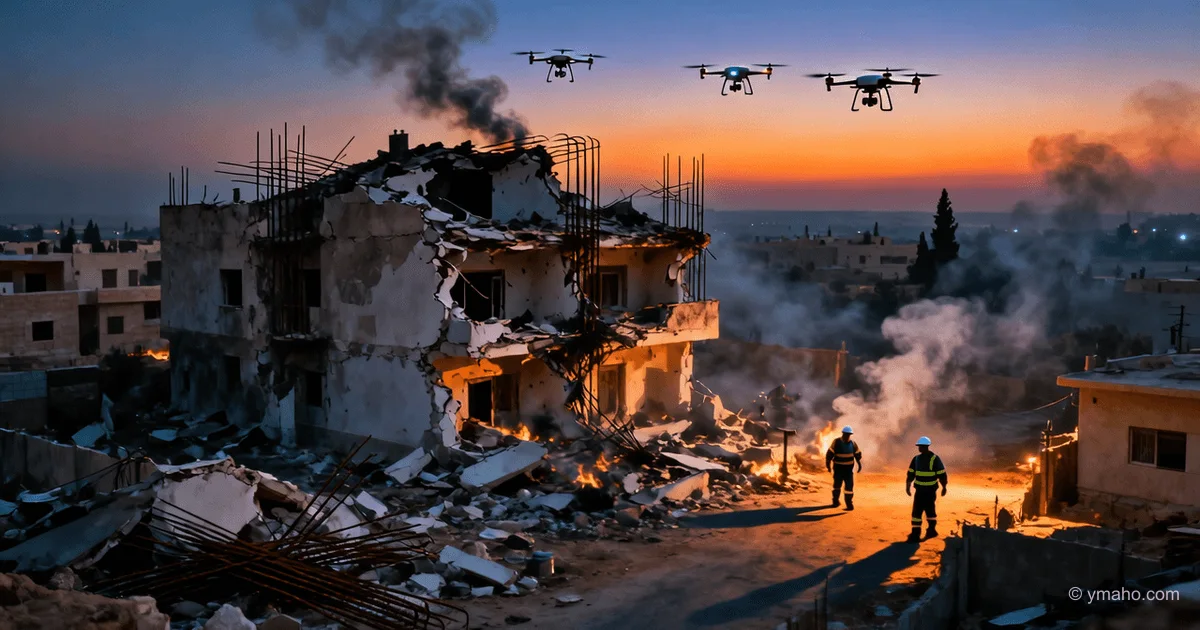
Israel Strikes Southern Lebanon, Civilian Casualties Reported
Despite the ongoing ceasefire, Israeli drones and aircraft attacked targets near Nabatieh and Saksakiyeh, killing at least 13 people, including a 12-year-old girl.
The Nabatieh Strike: How Southern Lebanon Became a Pawn in Iran's Grand Game
The Bottom Line: What's Really Happening
The Israeli drone strikes near Nabatieh on May 8 are not a ceasefire violation in the classic sense, but an operation to dismantle an Iranian logistics hub that had been set up in southern Lebanon over the past three weeks under the cover of humanitarian convoys. The real target of the airstrike was a warehouse containing components for Shahed-136 drones, delivered by Iran's Islamic Revolutionary Guard Corps (IRGC) via the Syrian port of Latakia and transiting through Beirut. Israeli intelligence, specifically Unit 8200, intercepted communications between an IRGC liaison officer in Damascus and a Hezbollah field commander in Nabatieh 14 hours before the strike. The content of the intercept left no doubt: the next shipment was to be used against Israeli targets in the Upper Galilee by May 15.
The tragedy involving civilians, including a 12-year-old girl, occurred because the warehouse was deliberately placed in the basement of a residential building on Al-Hussein Street—a classic Hezbollah tactic perfected back in 2006. According to my source in the IDF Northern Command, the Israeli side had information about the presence of civilians but deemed the operational necessity to outweigh the humanitarian risks. The decision was made personally by the Air Force Commander, Major General Tomer Bar, after consultation with the head of the General Staff's Operations Directorate, Lieutenant General Oded Basiuk.
Timeline and Context
The April ceasefire between Israel and Lebanon, brokered by France and US Special Envoy Amos Hochstein, was inherently a construct with a built-in expiration date. The document signed on April 12 in Naqoura contained a secret protocol known to no more than 15 people on both sides. The protocol stipulated a 45-day quiet period during which Hezbollah was obligated not to rebuild military infrastructure south of the Litani River. This 45-day period expired on May 27—but Israel detected the start of reconstruction work as early as April 20.
By May 7, Israeli military intelligence had identified 17 weapons storage sites rebuilt by Hezbollah in violation of the protocol. The Nabatieh strike targeted site number 11 on that list. The previous ten targets were hit by precision special forces operations without an aerial component and without media coverage. Nabatieh was the first instance where the Israeli side used aircraft—and that in itself was a signal.
The decision to escalate was made on May 6 at a meeting of the narrow security cabinet in Tel Aviv. Prime Minister Netanyahu, Defense Minister Katz, and Mossad Chief David Barnea voted in favor of the strike; Foreign Minister Sa'ar abstained, citing diplomatic risks. It is in this context that Israel's request for urgent consultations with the White House should be understood—not as a reaction to Iran's peace proposal, but as an attempt to pre-legitimize a series of strikes on Lebanon planned for the coming weeks.
Winners and Losers
Iran wins. Every Israeli airstrike on civilian targets in Lebanon gives the IRGC invaluable propaganda capital. Tehran spends not a cent on rebuilding what is destroyed—it writes off losses as inevitable costs of asymmetric warfare and gains in return heightened anti-Israeli sentiment in Lebanese society. On May 8, hours after the strike, the Iranian Foreign Ministry issued a condemnation, but behind the scenes, according to a source in Iran's UN mission, there was barely concealed satisfaction: the incident diverted attention from unpopular negotiations with the US on a nuclear moratorium.
France is furious. Paris was the main guarantor of the April ceasefire, and Macron invested significant political capital in reaching the agreement. The Nabatieh strike calls into question France's ability to act as a mediator in the Middle East and damages the position of TotalEnergies, which plans to resume exploratory drilling in Lebanon's Mediterranean Block 9. Potential reserves are estimated at 4 trillion cubic feet of gas, currently worth over $30 billion. The collapse of the ceasefire freezes these plans for at least a year.
Hezbollah loses tactically but wins narratively. The organization's military capability diminishes with each strike, but its political influence within Lebanon grows. On May 8, the leader of Hezbollah's parliamentary bloc, Muhammad Raad, called for a review of the group's participation in the national unity government—and received unexpected support from the Christian Free Patriotic Movement of Gebran Bassil.
Lebanese civil society is the biggest loser. A country whose GDP has shrunk by 40% since 2019, whose currency has depreciated by 98%, and whose annual inflation exceeds 180%, is once again being used as a battlefield for others' interests. Each day of fighting costs the Lebanese economy $22 million in direct losses, not counting long-term damage from infrastructure destruction and the flight of skilled workers.
What the Media Isn't Saying
The first non-obvious fact: the Nabatieh strike was carried out using intelligence provided not by Israeli but by Saudi intelligence, through a joint operations center in Jordan. It was the Saudi satellite Safir-3 that detected the movement of trucks carrying Iranian equipment from Latakia to Beirut, after which the data was transferred to the Joint Counterterrorism Operations Center in Amman, headed by Jordanian Major General Ahmad al-Husseini. Riyadh, whose relations with Tehran were normalized in 2023 under Chinese mediation, continues to play a double game, publicly supporting the diplomatic process while secretly supplying intelligence to the Israeli military machine.
The second insider detail: the building that was struck housed not only a drone warehouse but also an operations center for an Iranian cyber team working to create a botnet to influence the upcoming parliamentary elections in Lebanon, scheduled for October 2026. IRGC cyber specialists were developing a targeted disinformation algorithm aimed at undermining the positions of pro-Western candidates from Samir Geagea's Lebanese Forces movement. The destruction of this center sets back the Iranian influence operation by at least two months.
Third: the White House knew about the impending strike and gave tacit consent. On May 7, Special Envoy Hochstein spoke by phone with Netanyahu's advisor Ron Dermer, during which the Israeli side informed of the inevitability of the operation, and the American side raised no objections, merely asking to minimize civilian casualties. This information contradicts the US public position, which officially called for restraint.
Forecast: The Next 30 Days and 90 Days
Next 30 days (until June 9): Israel will continue a series of strikes on Hezbollah's rebuilt infrastructure south of the Litani. According to my information, the next targets will be sites in Naqoura, Bint Jbeil, and Majdal Selm. Hezbollah will respond with rocket fire on the Upper Galilee between May 15 and 25—not a full-scale barrage, but demonstrative low-intensity strikes sufficient to maintain the narrative of resistance without provoking all-out war. The key inflection point: on May 20, the mandate of the UN Interim Force in Lebanon (UNIFIL) expires, and the debate over its renewal will be a moment of truth for all parties.
Within 90 days (until August 9): The ceasefire will remain in place de jure but will de facto turn into a low-intensity conflict. Israel has no interest in a full-scale war on two fronts—Lebanese and Iranian—simultaneously. Hezbollah has no interest in a major war without guarantees of Iranian support, and Tehran is currently tied up in negotiations with the US and cannot afford escalation. However, the risk of miscalculation grows with each week: one inaccurate strike, one accidental casualty among senior commanders, and the dynamics will spiral out of control.
Macroeconomic consequence: an increase in the country risk premium for Israeli bonds by 15-20 basis points. The shekel will weaken to 3.85 per USD by the end of June. For Lebanon, the forecast is catastrophic: if hostilities continue at the current pace, the country will lose another $480 million in GDP by August, and the $3 billion IMF program agreed in March 2026 will be frozen until the security situation stabilizes. This means that by autumn, Lebanon will face a complete depletion of foreign exchange reserves and will be forced to declare a sovereign default on $32 billion in Eurobonds—a default whose consequences will reverberate through correspondent accounts of Lebanese banks in financial centers from Paris to Dubai.
— Editorial Team









