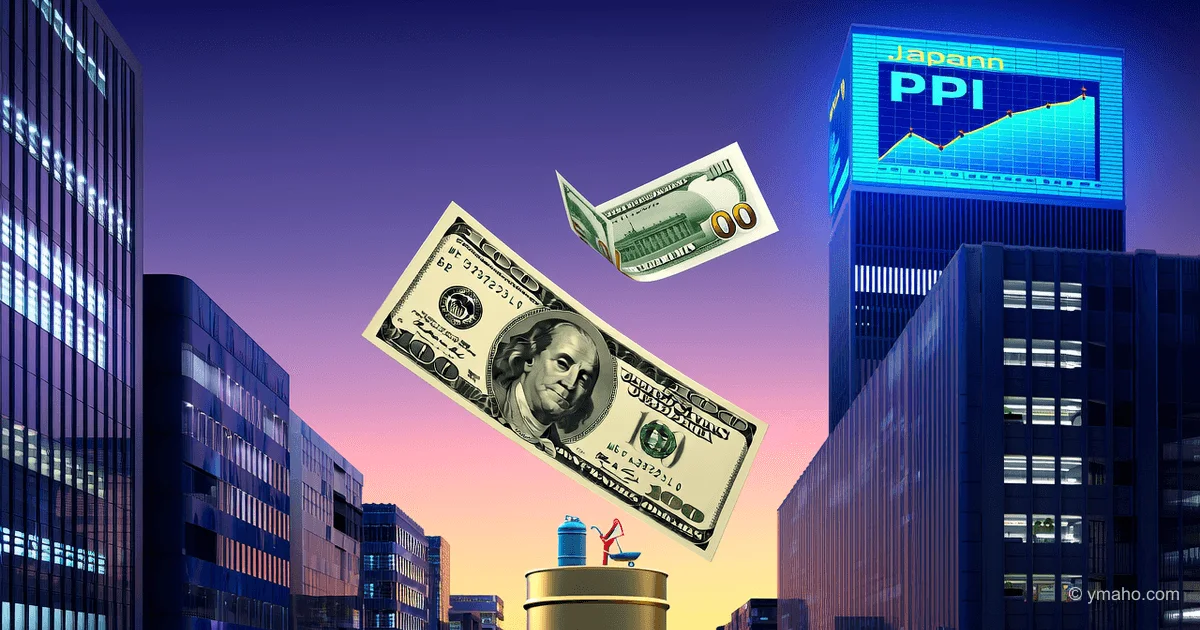
Japan's Producer Price Index Hits Three-Year High on Energy Price Surge
In April, Japan's corporate goods price index rose 4.9% year-on-year, reaching its highest level in three years, increasing pressure on the Bank of Japan amid soaring energy import costs and a weakening yen.
What is currently happening to Japan's economy is often described as "imported inflation." But that is too polite a phrasing. In reality, we are witnessing the slow strangulation of the world's third-largest economy, caught in a trap between geopolitics, the currency market, and its own monetary orthodoxy.
The Core: What Is Really Happening
The 4.9% rise in the corporate goods price index in April is not just a statistical outlier. It is a direct consequence of Japan importing about 95% of its energy and now paying for it in dollars at an exchange rate that makes every LNG cargo or oil shipment catastrophically expensive. In March, spot LNG prices were $14.85 per million BTU — up 31% month-on-month. By April, they had jumped to $19.10. Add to that the weakening yen, trading around 150-160 per dollar, and you get a double whammy: commodities become more expensive in dollars, and the dollar becomes more expensive in yen.
But the most important thing is not happening in the PPI numbers; it is happening in the minds of Japanese corporate CFOs. They no longer believe this spike is temporary. When a chemical manufacturer sees naphtha prices up 80% year-on-year, it no longer absorbs those costs — it passes them down the chain. These are the "second-round effects" that the Bank of Japan speaks of with such dread.
Timeline and Context
The chain of events leading to this point did not start in April. At the March BOJ meeting on March 18-19, the minutes recorded an unprecedented statement for Japan's central bank: "Raise rates without long intervals" and "act without hesitation if the economy shows no signs of deterioration." This came just three weeks after the US-Israeli strikes on Iran on February 28. The rate was kept at 0.75%, but the split on the board was already evident.
By the April meeting, the situation had worsened. The Middle East conflict dragged on, and the Strait of Hormuz remained effectively blocked for normal shipping. Brent oil prices settled above $106 per barrel. The BOJ again refrained from raising rates, but the hawkish minority on the board was openly talking about the risk of "falling behind the curve." Then on May 15, the PPI came in at 4.9% against a consensus of 3.0%, and that changed everything.
Now Kazuo Ueda and his colleagues have no room to maneuver. Markets are already pricing in a rate hike in June — even though Japan's economy is technically on the verge of recession due to deteriorating terms of trade.
Who Wins and Who Loses
The beneficiaries of the current situation are few, but their profile is telling. Japanese banks — Mitsubishi UFJ, Sumitomo Mitsui, Mizuho — have a chance to finally escape the two-decade curse of zero rates. Every 25 basis point BOJ rate hike adds about $1.2 billion to the combined net interest income of the three megabanks. Their shares have risen 7-9% since mid-March, outperforming the Topix index.
Japanese insurance companies — Tokio Marine, Sompo, MS&AD — win twice. First, rising JGB yields boost their investment income. Second, yen appreciation (which will inevitably follow rate hikes) increases the value of their huge foreign assets in yen terms. As of September 2025, insurers had hedged only 46% of their currency risk on foreign assets — a historic low that leaves them extremely vulnerable to a sharp reversal.
Losers include Japanese exporters. Toyota, Sony, Nintendo — all those who earn in dollars and euros but report in yen. Every 1% yen appreciation eats about $280 million of Toyota's operating profit. Japanese households lose: rising energy and food prices with stagnant real wages mean reduced consumption. Holders of Japanese government bonds lose: if rates rise to 1% or higher, JGB portfolios will show negative revaluation of about $150-180 billion market-wide.
What the Media Isn't Saying
Now for the insider part. Everyone writes about PPI and rates, but no one talks about what is really happening in the currency market. The yen carry trade has reached a scale that BCA Research in February called a "time bomb." The volume of yen forward contracts held by global hedge funds was estimated at ¥35 trillion as of October 2025. Since then, given inflows into the carry trade amid the Persian Gulf conflict, that figure could reach ¥42-45 trillion. That is about $280-300 billion.
Now imagine: the BOJ raises rates to 1.0% in June, and the yen begins to strengthen sharply. Hedge funds sitting in the carry trade start massively closing positions — selling dollars and buying yen. A feedback loop emerges: yen strengthening triggers further position closing, which causes even more strengthening. Historical parallels — 2008, 2015, and 2020 — show that the catalyst for a carry trade unwind has always been not the rate hike itself, but a drop in the prices of assets financed by yen borrowing.
And here we come to the least obvious point. Japanese authorities conducted a currency intervention last week, but its effect will be short-lived because the structural demand for dollars to pay for energy has not gone away. Moreover, hedge funds are already actively buying put options on the dollar against the yen, betting on another intervention. But the real game is not in the spot market; it is in the forwards and swaps market. Major market makers — Barclays, Nomura, Goldman Sachs — are seeing anomalous demand for short-dated structures, indicating preparation for event risk rather than a long-term trend.
The second point that is being hushed up: the BOJ has fallen into an institutional trap. It holds about $4.5 trillion in Japanese government bonds on its balance sheet. If rates rise, the value of this portfolio falls, and the BOJ will have to book losses. Formally, a central bank can operate with negative capital, but politically this creates enormous pressure. The Ministry of Finance, which just conducted an intervention spending reserves, will have to explain to parliament why the central bank is losing taxpayer money.
Forecast: The Next 30 and 90 Days
In the next 30 days — by June 15 — I expect the BOJ to raise rates to 1.0% at its June meeting. This decision will be motivated not so much by the April PPI (which only confirmed the trend) but by the May Tokyo consumer inflation data, due on May 27, which I estimate will show a rise above 3.5% year-on-year. The yen will strengthen to 145-148 per dollar. The 10-year JGB yield will rise to 1.2-1.3%. The Japanese stock market will correct 5-7%.
In the next 90 days — by mid-August — the scenario becomes more dramatic. If the Persian Gulf conflict is not resolved, the Strait of Hormuz will remain effectively closed, and spot LNG prices for Japan will settle above $20 per million BTU. In that case, the BOJ will be forced to raise rates again, to 1.25%, as early as September. The yen will strengthen to 140 per dollar. This will trigger a massive unwinding of carry trade positions, with potential dollar selling volume of $50-70 billion over several weeks.
If, however, Iran and the US reach a temporary ceasefire brokered by China (35% probability), oil prices will correct to $95-100 per barrel. Then the BOJ can afford a pause after the June hike. The yen will stabilize in the 145-150 range. But even in this optimistic scenario, the era of "Japanese exceptionalism" from the global tightening cycle is over. Japan is joining the rest of the world in fighting inflation — and that fundamentally changes the architecture of global financial flows.
— Editorial Team









