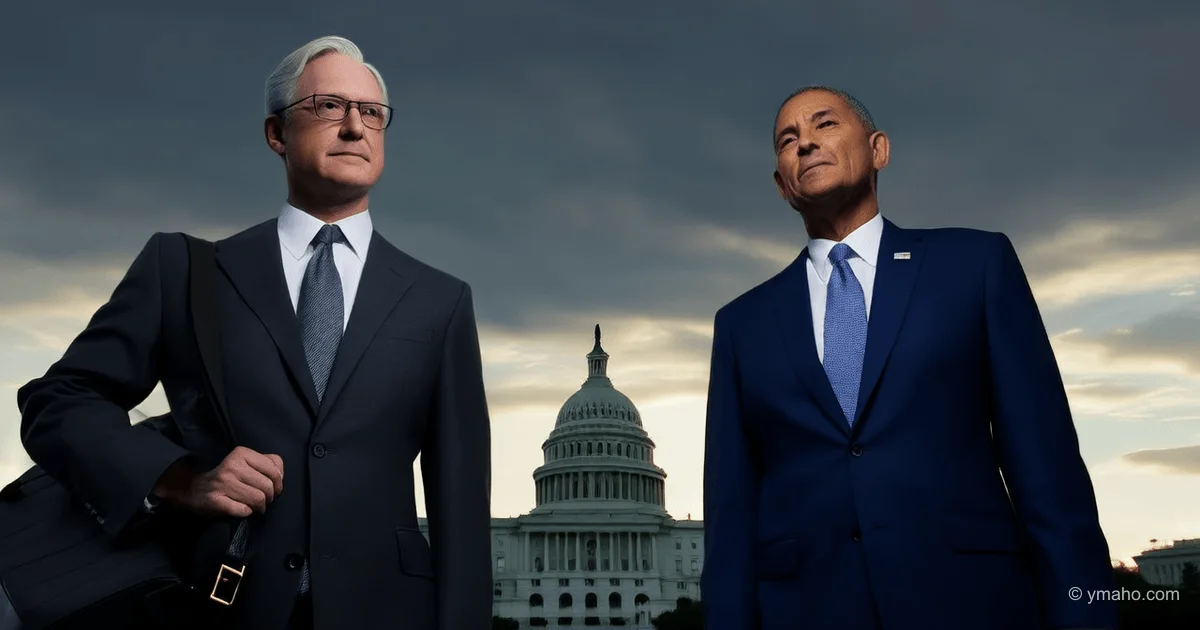
US Senate Confirms Kevin Warsh as New Fed Chair
The US Senate has officially confirmed Kevin Warsh as Chair of the Federal Reserve. He is expected to assume his duties on May 15, replacing Jerome Powell, and will face challenges including persistent inflation and high oil prices.
Warsh at the Helm of the Fed: Why Wall Street Got Its Man, and Trump Got an Outsider with a Seal
The Senate confirmed Kevin Warsh as Fed Chair on May 13, 2026, by a vote of 54-45, largely along party lines. On the surface, the story is clear: Trump pushed through his candidate, Powell is leaving, and the new chair takes over on May 15. But beneath this changing of the guard lies an institutional conflict that will shape US monetary policy for years to come. What markets are currently interpreting as a hawkish signal against a backdrop of 3.8% CPI is merely the top layer of a far more complex structure.
The Core: What's Really Happening
Warsh's confirmation is not a victory for Trump but a temporary tactical truce among the White House, Congress, and the Fed itself. The events leading up to the vote speak for themselves: Republican Senator Tom Tillis blocked the confirmation process in the Banking Committee until the Justice Department dropped its criminal investigation into Jerome Powell. An unprecedented move: a Republican defending the central bank's independence from a Republican president, effectively blackmailing the White House with a failed nomination. Tillis, who announced his retirement in January, proved unshakable—and Trump backed down; the Justice Department closed the case.
Meanwhile, Powell remains on the Board of Governors until 2028, breaking the tradition that former chairs leave the Fed entirely. Now, in the same room will sit: new Chair Warsh, whom Trump envisions as the architect of a low-rate regime, and former Chair Powell, against whom Trump tried to bring criminal charges—both with voting rights. This has never happened in Fed history.
Timeline and Context
The chain of events unfolded as follows. In late April, the FOMC held a meeting that ended in an 8-4 split, keeping rates at 3.50–3.75%—the closest vote since 1992. Three committee members signaled that the next move could be a hike, not a cut. Two weeks later, on May 12, April CPI came in at 3.8% YoY, core at 2.8%, and energy surged 17.9% amid the Iran crisis. On the morning of May 13, the Senate confirmed Warsh by a margin of just nine votes.
A key nuance most observers miss: Warsh is a former M&A banker at Morgan Stanley, where he worked for seven years before joining the Fed in 2006. During the 2008 crisis, he—after receiving an ethics waiver—directly negotiated with his former employer to save the bank by converting it into a bank holding company. Now this man returns not just as chair, but as a figure whose ties to Druckenmiller (whose family office is his current employer) and Wall Street are structurally deeper than any Fed chair since the 1940s.
Who Wins and Who Loses
Winners:
Wall Street gets its man at the helm of the central bank. Research by Christopher Adolph is unequivocal: central bankers with financial sector experience show heightened sensitivity to market conditions and a tendency toward more conservative regulation. Translation: the largest banks can count on a regulator who speaks their language. The dollar also benefits: the DXY index rose to 98.50, and OCBC strategists confirm the dollar will remain supported on dips—too many inflation risks are already priced in, and the prospect of tightening only adds to the appeal of US assets.
Jerome Powell won his personal battle. The criminal case is closed, he remains on the Board of Governors with voting rights until 2028, and his reputation as "one of the most honest people in the financial system" is effectively protected by Congress.
Losers:
Donald Trump is the biggest loser in this story, even though the media presents Warsh's confirmation as a White House victory. The president demanded rate cuts to 1% or lower, but his candidate is squeezed between 3.8% inflation and a committee where at least four hawks are ready to vote for a hike. Warsh testified about "independence," and his concept of rate cuts relied on the assumption that AI would push prices down—a thesis now almost irrelevant amid the Iran oil shock.
Academic economists and the Democratic establishment also lost. Warsh's appointment cements a break from a 30-year tradition: after Greenspan, Bernanke, and Yellen (all PhD economists), Trump has appointed a second consecutive non-economist. As a Wharton professor quipped in American Banker: "Warsh is a younger version of Powell, almost a clone: prestigious university, law school, Wall Street fortune, no PhD." For a central bank employing 400 PhD economists, a chair without an economics degree is a structural problem.
What the Media Isn't Saying
The biggest untold story: Powell stays. This point deserves its own analytical framework. For the first time in Fed history, a former chair against whom a sitting president pursued criminal charges will continue to sit on the Board of Governors and vote on rates. Powell has formally promised "not to overshadow Warsh," but his mere presence creates an unprecedented situation. Picture the June FOMC meeting: Warsh tries to build consensus for a rate cut, while three meters away sits the man Trump called an "enemy of the people" for refusing to cut rates—and votes. Any hint of easing from Warsh will immediately be contextualized by markets through the lens of this confrontation.
The second overlooked fact: the conflict over Warsh's confirmation exposed a rift within the Republican Party over Fed independence. Tillis was not alone—other Republican senators backed his stance. This means Warsh's mandate as "Trump's man" is undermined from day one by the very party members who confirmed him.
The third insider nuance: the 2008 ethics waiver. Warsh received special permission to negotiate with Morgan Stanley during the crisis while serving as a Fed governor. Now the same man will lead the central bank. For the Fed's institutional memory, this sets a precedent that will resurface in the next crisis.
Forecast: Next 30 and 90 Days
30 Days (by mid-June 2026):
The June FOMC meeting on June 16-17 will be a moment of truth. The probability of holding rates at 3.50–3.75% is priced at 98%. But the real intrigue lies not in the rate number but in Warsh's rhetoric at the press conference and the tone of the committee statement. I expect Warsh to try to balance two incompatible positions: signaling readiness for future easing (to avoid immediately disappointing Trump) while acknowledging inflation risks serious enough to maintain the status quo. This will be a classic "hawkish hold" in wording. The dollar will remain in the 98.10–99.00 range on the DXY index, as OCBC forecasts. Treasury yields will continue to pressure the tech sector.
Key risk on the 30-day horizon: verbal intervention from Trump. If the president perceives Warsh's rhetoric as insufficiently dovish, public criticism of the new chair could begin sooner than markets expect—not in six months, but as early as July.
90 Days (by mid-August 2026):
By August, the structural conflict within the FOMC will surface. CPI inflation will likely remain above 3.2% even if oil prices stabilize, as the pass-through of energy costs to services and food is just beginning. Ellen Zentner of Morgan Stanley Wealth Management already confirms: "Rising core consumer prices mean high oil prices are being felt across the economy." The probability of a rate hike by December is currently priced at 30%—and that number will rise.
My base case: by late summer, the FOMC will find itself in a situation where any easing looks like political capitulation to the White House, and any tightening looks like a revolt against the administration. Warsh, lacking an economics background and relying on his M&A banker experience, will likely try to find a "deal": hold rates steady but accelerate the Fed's balance sheet reduction (currently $6.7 trillion), presenting this as a form of tightening that doesn't look like a rate hike to the public and the White House. This will be a delicate game where the cost of error is measured not in basis points but in trust in the entire system.
Markets should prepare for a scenario where Warsh's "dovish ceiling" turns out to be much lower than optimists assumed earlier this year, and his historical ties to Wall Street become not an advantage but an additional source of political vulnerability. The Fed is entering a zone of turbulence where economics, geopolitics, and institutional crisis are tangled into a knot that no chair—with or without a PhD—can untie.
— Editorial Team









