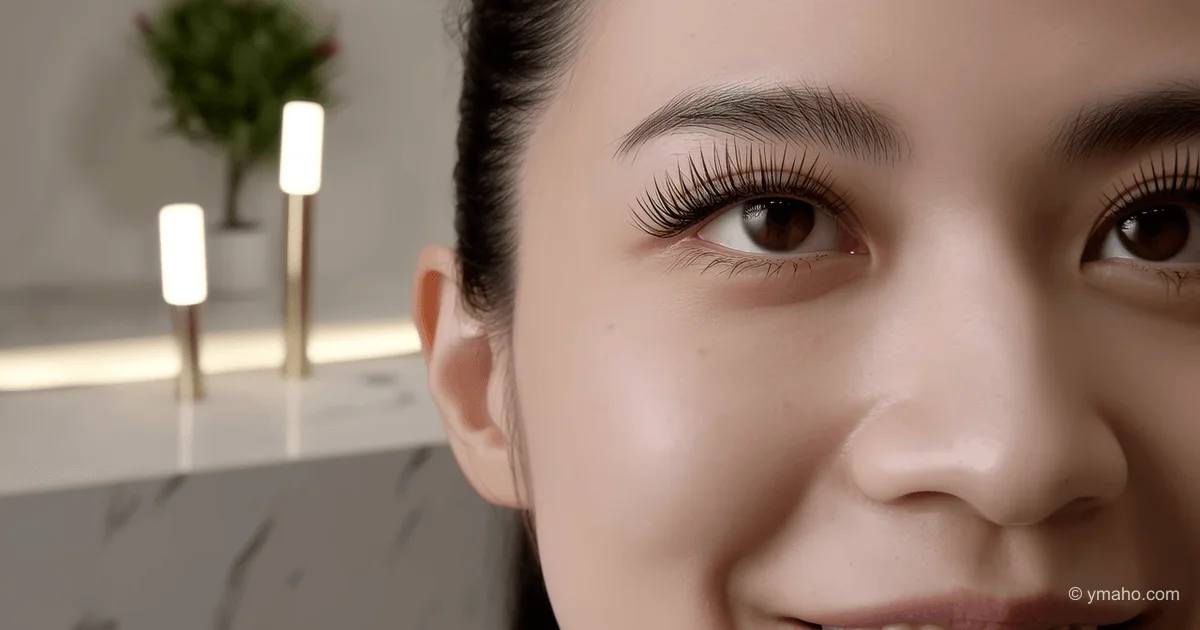
The Return of Natural Brows and Lashes: Lamination Over Extensions
Voluminous lash extensions are being replaced by the trend of long-lasting styling and lamination. This procedure costs more but creates the effect of natural lashes and brows without visible intervention, which is considered a sign of good taste.
The Death of Lash Extensions: How Quiet Luxury Killed the Big-Look Industry and What Comes Next
What's Really Happening
What glossy media present as a "return to naturalness" is not an aesthetic whim. It's the economic collapse of an entire segment of the beauty industry. The lash extension market is undergoing structural compression disguised as a trend shift.
The numbers speak for themselves. Major online retailer lashstuff.com recorded a 20-50% drop in annual revenue in 2025, with further acceleration expected in 2026. In January 2026, revenue was $11,137 against a median of $51,477 in the BEAUTY AND COSMETICS category. That's not even half—it's 22% of the median. Conversion rate: 1.00-1.50% versus the industry maximum of 4.7%. Another seller, lashboxla.com, lost 38% of revenue in three months, with an annual forecast of -50%+. Studio tatianabritz.com, after a 50%+ drop in 2025, continues to decline: January revenue was $1,758 from 330 sessions—microscopic traffic, even with a 4.00-4.50% conversion rate.
Meanwhile, Treatwell records a tectonic shift in preferences for spring 2026: organic brows, baby brows, Korean lash lift, soft brow lamination without rigid fixation or glossy shine. Clients no longer want to leave the salon with a "new face"—they want to leave with an enhanced version of their own.
Timeline and Context
This story didn't start today. The first signals appeared back in 2024, when the US lash extension market was valued at $1.54 billion. But even then, analysts looking at the micro level noticed slowing growth rates and falling studio margins.
By 2025, a perfect storm had formed. On the demand side: Quiet Luxury as a macro trend redefined what "looking expensive" means. Lash extensions visible from three meters away became a marker of "old luxury"—ostentatious and out of fashion. On the supply side: the market became oversaturated with technicians. The barrier to entry for a lash stylist was minimal—a two-day course and you're a specialist.
By early 2026, a macroeconomic factor was added. In Russia, according to the Association of Beauty Industry Entrepreneurs, demand for lash extensions, manicures, and brow styling dropped by 20-40%. December 2025—traditionally the most profitable month—saw salon revenue fall by up to 30%, a decade-low record. Economist Inna Litvinenko predicts a 20-30% increase in beauty procedure prices in 2026 due to logistics difficulties, currency weakening, and VAT hikes.
For the client, this means a simple choice: pay $80-120 per month to maintain lash extensions, or spend $60-90 on lamination every 6-8 weeks and forget about regular touch-ups. Math kills extensions faster than aesthetics.
Who Wins and Who Loses
Winners—salons with expertise in natural techniques. Korean lash lift, soft brow lamination with cysteamine formulas instead of thioglycolic acid, procedures focused on hair health rather than radical change—this is what clients are looking for in 2026. Manufacturers of lamination products are gaining market share at the expense of glue and synthetic lash suppliers. Treatwell notes that conditioning steps and nourishing serums are becoming standard parts of the procedure, not optional add-ons. This means the average ticket for "natural" procedures is rising, and profitability is shifting from product to service and experience.
Losers—classic lash studios that built their business on volume extensions. Their model relies on regular touch-ups every 2-3 weeks; the economics depended on visit frequency. When a client switches to lamination with a 6-8 week cycle, the number of salon visits drops by 3-4 times. Even if lamination costs more per session, the total annual revenue per client decreases.
Training centers that have churned out lash extension masters for decades also lose. Their business model relied on a constant influx of newcomers into a growing market. As the market shrinks, demand for basic courses collapses.
Suppliers of lash extension consumables lose too. The 20-50% annual drop at lashstuff.com and the forecast -50%+ at lashboxla.com are not stories of individual stores—they are symptoms of a collapse across the entire supply chain in the segment.
What the Media Isn't Saying
Insight: Lash extensions aren't dying because of the natural trend—they're being killed by GLP-1.
This is the connection no one talks about publicly. One in eight American adults takes GLP-1 agonist drugs. These molecules don't just suppress appetite—they turn off "food noise," obsessive thoughts about eating. But the neurobiological mechanism targeted by GLP-1 is the reward system as a whole, not just eating behavior.
A woman who previously got a dopamine hit from the ritual of "going to get lashes, grabbing coffee, and scrolling through her feed in the technician's chair" loses the impulse for this cycle on GLP-1. A Pogo study based on transaction data from 12,000+ verified GLP-1 users showed that consumers don't just cut purchases—certain categories of goods and services simply disappear from their mental map. Lash extensions are exactly in this risk zone: they are an impulsive, repetitive, dopamine-driven purchase, not a rational choice.
The second aspect is the reallocation of time and money within the beauty budget. Economist Litvinenko predicts a 20-30% price increase for all beauty services in 2026. With shrinking purchasing power, clients must choose which procedures to keep. Lamination at $70-90 every 6-8 weeks wins over extensions at $80-120 plus $50 touch-ups every 2-3 weeks, simply based on annual cost arithmetic.
The third point is the hygiene turn. The pandemic taught consumers to fear "foreign" things on their bodies. Lash extensions, which require avoiding oils, careful washing, and sleeping on your back, lose to lamination, which imposes almost no restrictions. For a client choosing between "beautiful but complicated" and "beautiful but simple," the decision is obvious.
Forecast
Next 30 days (through mid-June 2026):
Expect a wave of closures among small lash studios that relied solely on extensions. Those who haven't diversified into lamination and natural techniques will face cash flow gaps. Retailers of extension supplies will start aggressive sales to reduce inventory before the trend becomes irreversible.
At the same time, premium salons will actively add "lash health" and "post-extension recovery" services to their menus—the next logical step after mass abandonment of extensions.
Next 90 days (through mid-August 2026):
By the end of summer, the first major educational platforms will offer retraining for extension masters into lamination and natural technique specialists. The beauty labor market will experience a mini-migration: thousands of lash stylists will have to learn new skills or leave the profession.
Key risk: price dumping. Masters losing extension clients will start lowering lamination prices to fill their books. This will hurt procedure profitability and may create a false perception that lamination is a "cheap" service. Salons building premium positioning on natural techniques will need to invest heavily in differentiation: quality of formulas, certifications, experience.
Strategic conclusion: by August 2026, the lash extension segment will shrink to a niche. It will remain for special occasions—weddings, shoots, events—but will cease to be a daily-demand service. Lamination will take its place as a "basic" procedure, and the next round of competition will unfold within the natural techniques segment: who offers healthier formulas, longer-lasting results, and a more compelling narrative of client care. The battle for lashes is just beginning, but extensions have already lost.
— Editorial Team









