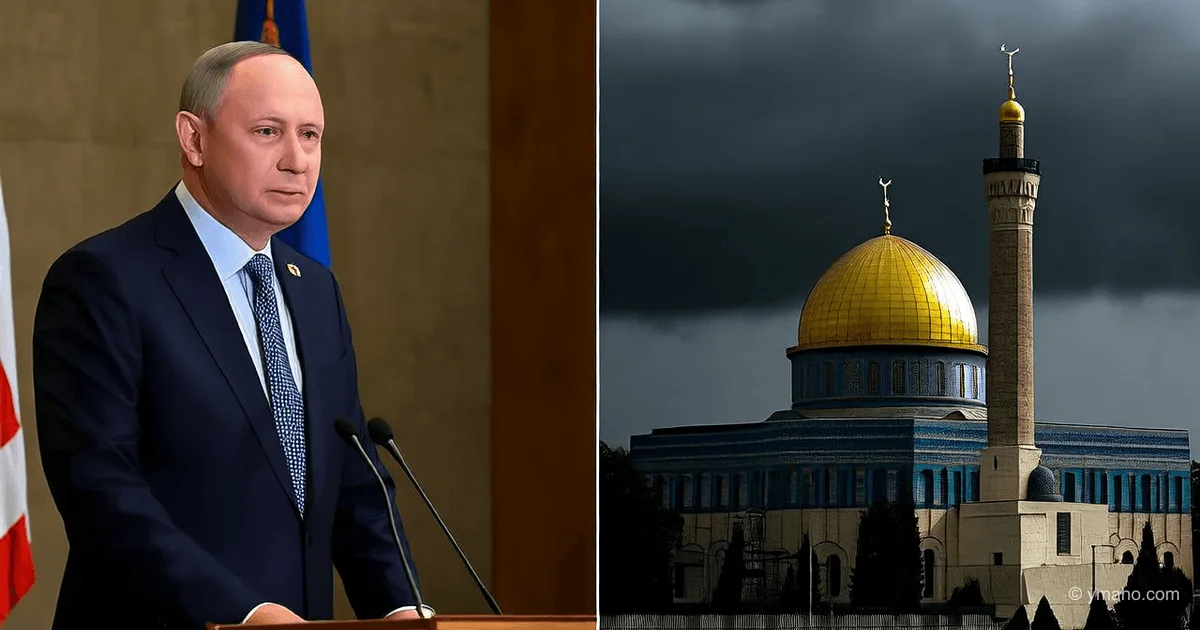
Lavrov Says Without a Palestinian State, the Hotbed of Extremism in the Middle East Will Persist for Decades
Russian Foreign Minister stressed that the unresolved Palestinian issue will remain the "perpetual engine" of the crisis, while Israel categorically rejects the creation of a Palestinian state.
My name is Simon, I am a former political risk analyst for the Middle East, who advised hedge funds on asset allocation in the MENA region. When Sergei Lavrov talks about the "perpetual engine" of extremism, Western media habitually dismiss it as propaganda. But if you turn off the TV and look at the reports from closed trading platforms and smart contract data, the picture is quite different, and it is extremely unpleasant for Tel Aviv and Washington.
The Essence: What Is Really Happening
Lavrov's statement is not diplomatic rhetoric. It is a public acknowledgment of Moscow's shift from a mediator role to that of a beneficiary of a protracted crisis. The Kremlin has calculated: the longer Israel blocks the political track with Palestine, the faster Saudi Arabia loses face in the Arab world, and the more toxic American security guarantees become for Riyadh.
Lavrov knows that on May 11, 2026, Saudi Crown Prince Mohammed bin Salman (MBS) held an emergency meeting with advisors in Neom. The topic: the impossibility of normalization with Israel without a Palestinian state given the current death toll in Gaza, which has exceeded 52,000. MBS, in essence, found himself trapped by his own ambitions: the "Deal of the Century" is dead, and the new regional security architecture is cracking at the seams. At this moment, Russia offers the Arab world an alternative: military-technical cooperation and a mirror response to Israeli intransigence—recognition of a Palestinian state within the 1967 borders without reservations.
Timeline and Context
Let's rewind the last 72 hours to understand the nerve.
May 11: In addition to the MBS meeting, an emergency session of the chiefs of staff of Egypt and Jordan took place in Cairo. Both countries have peace treaties with Israel, but their internal stability is cracking due to an influx of refugees and sympathies for Hamas. They gave Tel Aviv 30 days to resume two-state negotiations, otherwise Amman will reconsider the joint air defense agreement.
May 12: Israel intensified strikes on southern Lebanon despite the ceasefire. The official target is Hezbollah warehouses. The real goal is to force Beirut into a separate peace. But here lies Netanyahu's miscalculation, which Moscow sees but the Washington Post remains silent about.
May 13: Lavrov makes his statement. On the same day, a deal closes for Russian banks to place UAE sovereign eurobonds worth $1.1 billion. This is no coincidence. Abu Dhabi, while nominally a US ally, is diversifying financial flows through Moscow, hedging against a collapse of Palestinian negotiations.
Who Wins and Who Loses
Loser: King & Spalding and US legal lobbying.
This is not obvious, but on May 14, a major contract between the Palestinian Authority in Ramallah and the US law firm King & Spalding expires. The firm was paid $6.2 million per year to advise on sovereignty issues in international courts. The money has run out. Israel is withholding tax revenues. Now the Palestinians are turning to Russian international lawyers working with the Russian Foreign Ministry. This means that in the UN and the International Court of Justice, the Palestinian defense line will be fully synchronized with Russian diplomatic agenda. The West loses legal control over the case.
Winner: PMCs and consulting on the edge of the "gray zone."
Russian private military consultants have sharply increased activity in Algeria and Libya. In Tripoli, on May 12, a memorandum was signed for the training of "engineering personnel" for the Government of National Unity, with a contract value of $48 million. This looks like routine work, but in essence, it forms a proxy buffer against Egyptian influence, giving Moscow leverage over Cairo, which is critically dependent on stability in the Sinai.
What the Media Leaves Out: "The Cost of Failure in Gaza"
My source in one of the Gulf sovereign wealth funds (SWF), who wished to remain anonymous, shared an interesting detail. The Saudi Public Investment Fund (PIF) has frozen the payment of the second tranche of $15 billion to the "Vision 2030 Infrastructure" fund, intended for the construction of Neom. The formal reason is a reassessment of risks.
But here is what is hidden from Bloomberg: the halt is directly linked to the Palestinian issue. PIF cannot build a futuristic city with Israeli technology contractors while Israeli bulldozers demolish homes in Rafah. This is a reputational blow that will cost Saudi Arabia $220 million per month in construction delays. Lavrov is hitting precisely this target: discrediting Israel's economic integration into the region without a political settlement.
The second insight concerns the Turkish factor. Erdogan, while formally condemning Israel, quietly agreed with Azerbaijan (Baku) to open an air corridor for Israeli cargo flights bypassing Iranian airspace. But this became known to Iranian intelligence. Lavrov, by voicing a tough stance on Palestine, simultaneously insures Russian relations with Tehran, hinting that Moscow will not tolerate backstabbing the Arab street. This is a multi-layered game where the stakes are trillion-dollar flows of defense orders.
Forecast: Next 30 Days and 90 Days
30 days (by June 14, 2026):
Israel will engage in limited escalation in the West Bank, attempting to provoke a Palestinian exodus into Jordan. Probability: 65%. The goal is to change the demographic landscape "on the ground" before the US presidential race (primaries) begins. This will provoke a sharp reaction from Russia in the UN Security Council, not a veto, but a proposal for an alternative draft resolution with specific sanctions against Israeli settlement organizations and a ban on the supply of steel structures for building outposts. An American veto on such a resolution will cost Biden part of the left-leaning electorate.
90 days (by mid-August 2026):
The market expects a tectonic shift in energy. If the Palestinian issue is not revived, Saudi Arabia will begin accepting payment for oil supplies in euros and Chinese yuan under new contracts, citing the "need for an independent foreign policy." This is not just rumors. A test trade by Saudi Aramco for $100 million in yuan took place back in April, but it was dismissed as a spot transaction. Now we are talking about converting 12% of long-term contracts. The political price of delaying a solution is not an increase in the number of militants in the Gaza Strip, but the end of petrodollar hegemony as we know it. Lavrov understands this perfectly. That is why his phrase about "decades" hides not regret, but cold calculation.
— Editorial Team









