Central Bank of Russia Reveals Plan to Legalize Crypto Market — What Changes for Exchangers and Users
Russian crypto exchangers will soon be able to operate officially — the Bank of Russia is preparing clear rules similar to European ones. This doesn’t mean everyone can freely buy Bitcoin: the regulator wants to restrict average citizens’ access while granting legal status to professional market participants.
How Legalization Will Work
At the Blockchain Forum 2026, BoR representative Mikhail Iontsev stated that the new bill is "leaning toward the MiCAR approach" — meaning the European Union’s regulatory framework. It clearly separates roles: who can custody cryptocurrency (digital depositary) and who can exchange it (crypto exchanger). It’s like having one set of banks that only hold money and another that only handle transfers.
To operate legally, exchangers will need to wait for the law to take effect and meet BoR requirements. The regulator itself will gain "greater flexibility" to issue subordinate regulations — meaning it can refine rules after the main law is passed.
An interesting detail: during the same panel, out of hundreds of attendees, only two raised their hands when asked if they understood how to currently legalize their crypto activities. This shows how murky the situation remains, even for professionals.
What Will Be Banned for Ordinary People
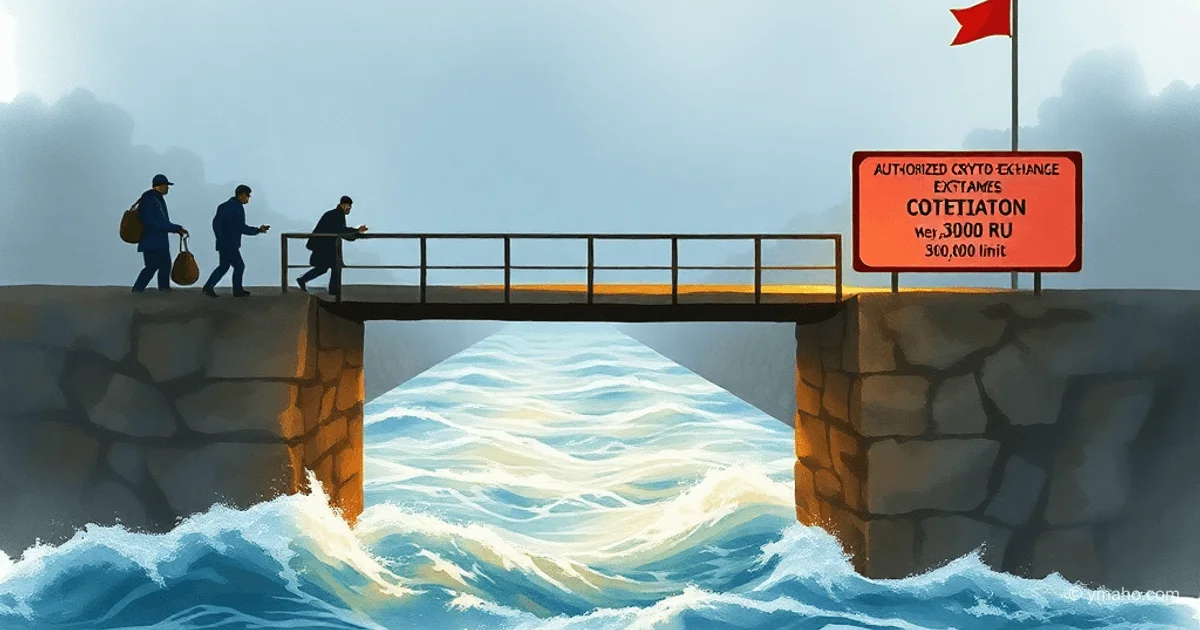
The BoR is blunt: it doesn’t want Russians to use cryptocurrency en masse. First Deputy Governor Vladimir Chistukhin proposed an annual limit of 300,000 rubles per intermediary for non-qualified investors. It’s like allowing you to spend only a fixed monthly amount on overseas online services — no matter how much money you have, you can’t go over.
This approach aims to protect people from losses, but in practice, it may push them toward gray or black-market schemes — especially if legal services become too expensive or slow.
Issues Still Unresolved
Lawyers have already pointed out gaps in the bill. For example, USDT — the most popular stablecoin (a digital currency pegged to the US dollar) — is barely mentioned. Without clarity on its legal status, companies won’t be able to use it legally for international payments.
As Andrei Tugarin from GMT Legal put it: "Paying for foreign goods and services with cryptocurrency will continue, but no one will shout about the mechanisms." In other words, businesses will operate quietly — to avoid attracting regulatory attention.
Moreover, the government recently approved criminal liability for illegal circulation of digital currency. This creates risk for anyone attempting to circumvent the new rules.
What Matters
- Russian crypto exchangers will have a chance to legalize under the MiCAR (EU) model.
- Ordinary users will face strict limits — up to 300,000 rubles per year.
- USDT and other stablecoins currently lack clear legal status.
- Violating the new rules may result in criminal liability.
- The BoR is betting on regulating professionals, not banning the entire market.
What This Means for Ordinary People
If you occasionally buy cryptocurrency, you’ll soon face tight transaction limits. But legal services will become more reliable — reducing the risk of losing money to fraud. However, if you use crypto to pay for foreign services (like subscriptions or freelancing), be prepared to find workarounds — until the law clarifies the status of stablecoins.
— Editorial Team









