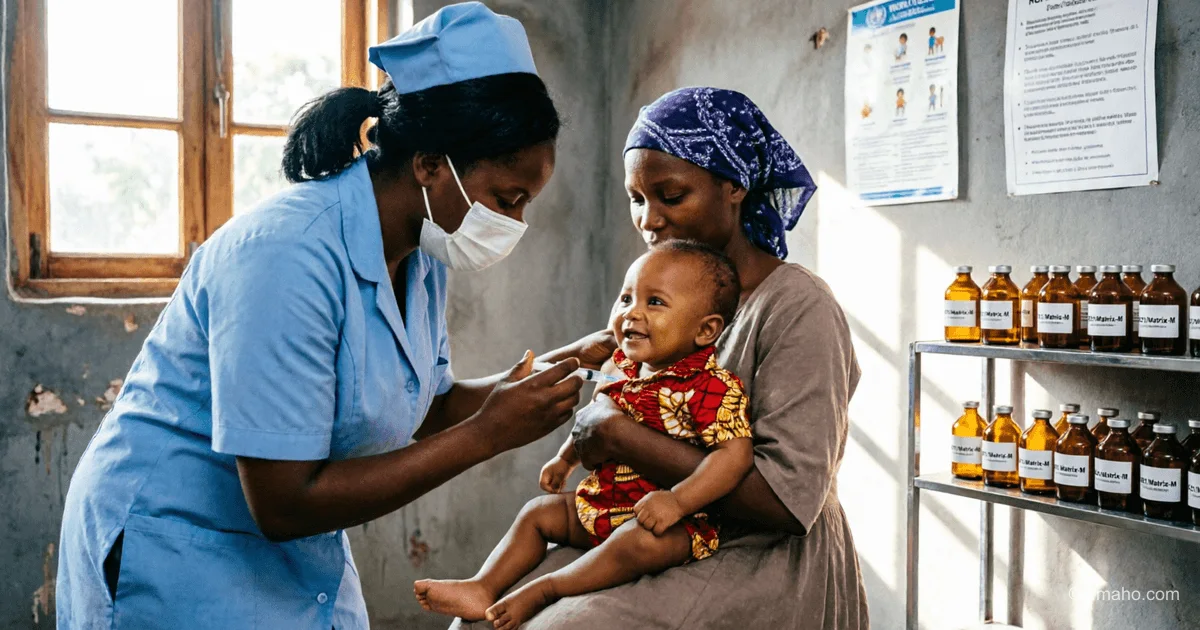
WHO Approves R21/Matrix-M Malaria Vaccine — 75% Efficacy
The low-cost Oxford University vaccine becomes the second WHO-recommended option for mass childhood immunization in Africa, capable of saving tens of thousands of lives annually.
Introduction
On October 3, 2023, the World Health Organization announced its recommendation of a second malaria vaccine for preventing the disease in children — R21/Matrix-M. Developed by Oxford University and the Serum Institute of India, it became the second (after RTS,S) WHO-approved tool for mass immunization in endemic regions, saving tens of thousands of lives each year.
Malaria remains one of the deadliest infectious diseases worldwide. It claims over 500,000 lives annually, primarily children under five in sub-Saharan Africa. A child requires four doses of the vaccine for full protection. The arrival of R21/Matrix-M is not just a scientific achievement but a practical solution to accessibility: the vaccine costs three to four times less than its predecessor and can be produced at scales sufficient to cover the entire continent's needs.
Event Details and Timeline
Development and Clinical Trials. R21/Matrix-M was created at the Jenner Institute of Oxford University using Novavax's Matrix-M adjuvant technology, which boosts the body's immune response. Development was supported by the European and Developing Countries Clinical Trials Partnership (EDCTP), the Wellcome Trust, and the European Investment Bank.
The pivotal Phase III trial, involving 4,800 children in Burkina Faso, Kenya, Mali, and Tanzania, showed impressive results. In regions with seasonal malaria transmission (4–5 months per year), the efficacy of three doses was 75%; in regions with year-round transmission, it was 67%. Among children aged 5–17 months (the primary target group), efficacy reached 79% in seasonal and 75% in standard regions. A booster dose restored protection to 74% over 18 months.
Regulatory Milestones. By the time of the WHO recommendation, the vaccine was already licensed for use in Ghana, Nigeria, and Burkina Faso. The WHO decision was based on the conclusions of the Strategic Advisory Group of Experts (SAGE) and the Malaria Policy Advisory Group (MPAG), which confirmed the vaccine met standards of safety, quality, and efficacy.
In November 2025, the Gavi Alliance and UNICEF reached an agreement to reduce the vaccine's price from $4 to $2.99 per dose — 25% cheaper. By April 2026, the vaccine had been integrated into routine immunization schedules of 24 African countries, which account for over 70% of the global malaria burden.
Impact and Significance
For Malaria Control. R21/Matrix-M became the first vaccine to achieve the WHO target of 75% efficacy set in the Malaria Vaccine Roadmap. Unlike the first vaccine, RTS,S, whose efficacy ranges from 30–50%, R21 demonstrates significantly higher and more stable protection.
R21's main advantage is its cheap and scalable production. The Serum Institute has already established production of 100 million doses per year, with plans to double capacity within the next two years. In comparison, RTS,S supplies have always been limited, creating a gap between demand and supply.
For Healthcare Systems. The price reduction to $2.99 per dose (full course: $11.96 per child) makes vaccination cost-effective even in the poorest countries. For context, treating one case of uncomplicated malaria in Africa costs $4–7 per outpatient visit, while hospitalization for severe malaria costs over $70. Preventing the disease through vaccination is cheaper than treating it.
The $90 million saved through the price reduction will allow the purchase of 30 million additional doses, providing full immunization for nearly 7 million children by 2030.
For Global Health. Having two recommended vaccines (RTS,S and R21) creates a competitive market, further driving down prices. Moreover, Bharat Biotech and GSK have committed to halving the price of RTS,S by 2028, when production will be transferred to the Indian company.
Dr. Matshidiso Moeti, WHO Regional Director for Africa, stated: "This second vaccine has real potential to close the huge gap between demand and supply. With widespread rollout, the two vaccines will help save hundreds of thousands of young lives in Africa."
Reactions from Key Players
Oxford University. Professor Sir Adrian Hill, Director of the Jenner Institute, called the WHO recommendation the culmination of years of work: "The R21/Matrix-M vaccine has proven its safety and high efficacy in several clinical trials and is now approved for widespread use. The vaccine is easy to deploy, cost-effective, and affordable, ready for distribution in the regions where it is most needed."
Serum Institute of India. CEO Adar Poonawalla emphasized the vaccine's global significance: "For too long, malaria has threatened the lives of billions of people worldwide, disproportionately affecting the most vulnerable among us."
Novavax. President and CEO John C. Jacobs highlighted the role of the Matrix-M adjuvant: "This WHO recommendation underscores the significant contribution that R21/Matrix-M is likely to make in accelerating and expanding access to a safe, effective, and potentially life-saving vaccine."
Gavi Alliance and UNICEF. An Vermeersch, Director of Vaccine Programs and Markets at Gavi, stated: "There is unprecedented demand for this new tool, which will better protect children from one of Africa's biggest killers. This agreement demonstrates how innovative financing can deliver affordable vaccines to low-income countries."
Forecast and Conclusions
What We Have as of April 2026. R21/Matrix-M is already integrated into routine immunization systems in 24 African countries, and over 40 million doses have been delivered through the Gavi program. The vaccine has proven safe and effective in the largest clinical trial involving nearly 5,000 children.
Remaining Key Challenges. Despite R21's triumph, the path to malaria elimination remains long. Vaccine efficacy declines after 12 months, although a booster restores protection. Further research is needed on long-term immune protection and optimal dosing schedules.
Additionally, the biological complexity of Plasmodium, characterized by a multi-stage life cycle and high genetic variability, makes it difficult to induce broad and lasting immunity. No existing vaccine provides 100% protection.
Future Prospects. Next-generation vaccines are on the horizon — based on mRNA, nanoparticles, and targeting other stages of the parasite's life cycle. Vaccines targeting the RH5 antigen (blood stage) or Pfs230 (transmission-blocking) show promising immunological responses, though clinical efficacy still needs confirmation.
Conclusion. The WHO recommendation of the R21/Matrix-M vaccine is a turning point in humanity's centuries-long fight against malaria. For the first time in history, we have not one but two safe, effective, and affordable tools to protect children from this ancient enemy. Combined with insecticide-treated nets and other preventive measures, vaccination can radically change the epidemiological situation in Africa.
Nevertheless, as experts warn, success will require concerted efforts and resources to ensure widespread rollout. Production capacity of 200 million doses per year is sufficient in theory, but logistics of delivery to remote areas, overcoming vaccine hesitancy, and maintaining the cold chain remain serious obstacles. R21 is a powerful weapon, but not a silver bullet. It will be decisive only in combination with sustained investment in health systems and research.
— Editorial Team









