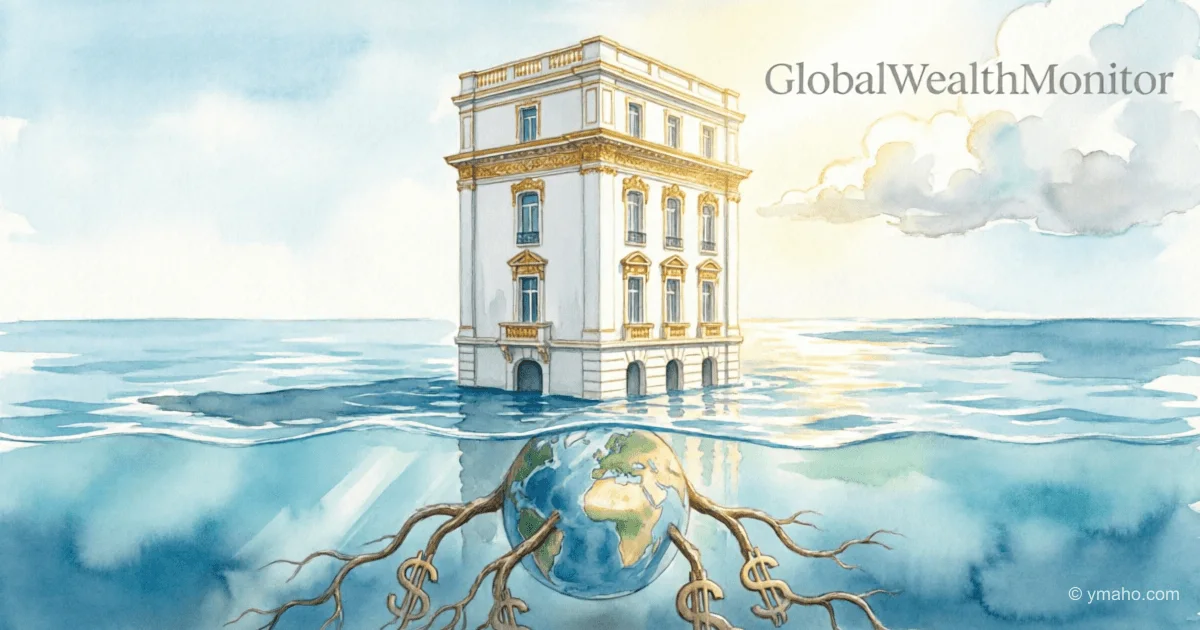
How Billionaires Hide Their Money: Akhmetov’s Record-Breaking Monaco Purchase
Ukrainian billionaire Rinat Akhmetov recently purchased a 21-room apartment in Monaco for $554 million—one of the most expensive residential properties in the world. Why should you care? Because these kinds of transactions reveal exactly how the ultra-wealthy shield their fortunes while everyday people grapple with soaring living costs.
A Deal That Breaks Every Record
Imagine an apartment the size of fifty standard studio apartments stacked on top of each other. That’s roughly the footprint—2,500 square meters—of Akhmetov’s new residence in the Mareterra district. This isn’t just a home; it features a private swimming pool, a jacuzzi, and at least eight dedicated parking spaces. To put that in perspective, building a house of that scale in a typical suburb would consume an entire city block.
The transaction was finalized in 2024 through his firm, System Capital Management. While the exact figure wasn’t officially disclosed, Bloomberg sources peg it at $554 million. This tops previous record-breaking sales in London ($350 million) and New York City ($240 million). Monaco, the tiny principality nestled between France and Italy, has long been synonymous with ultra-luxury real estate, where a single square meter commands the price of a modest suburban home elsewhere.
Why Monaco? A Safe Haven for Global Capital
Monaco is far more than a glamorous playground of yachts and casinos. It represents a financial ecosystem designed to help wealthy nations and individuals minimize tax liabilities. There’s no personal income tax, no inheritance tax, and virtually no property tax. According to the OECD, such “quiet harbors” cost national treasuries trillions of dollars every year. That revenue could otherwise fund schools, hospitals, and infrastructure, but instead, it gets parked in offshore accounts.
The principality has had to constantly expand its borders: the Mareterra district itself was built entirely on reclaimed land. It’s a stark reminder of how global capital continuously claims new territory. Construction spanned over a decade, and the area now hosts 114 luxury residences. Interestingly, even amid geopolitical conflicts and economic downturns—such as the ongoing war in Ukraine—the ultra-wealthy continue pouring money into assets like this. It’s their ultimate financial safety net.
Why the Super-Rich Choose Monaco:
- Zero taxes on personal wealth and income
- Unmatched security, even during global crises
- Exclusive prestige: rubbing shoulders with royalty and celebrities
- Prime geographic location in the heart of Europe
How Does This Impact Everyday People?
When billions are siphoned into offshore accounts, governments lose critical tax revenue. That translates to underfunded roads, education, and healthcare for the general public. Furthermore, these mega-deals artificially inflate the luxury real estate market. Data from Knight Frank shows demand for Monaco apartments jumped 15% in a single year, while real incomes have plummeted in 80% of countries worldwide. In short, while the middle class tightens its belt to afford groceries, the ultra-wealthy market is booming.
This isn’t just a distant issue affecting someone else. Even if you’ve never set foot in Monaco, the offshore economy directly impacts your daily life. For instance, when states face budget shortfalls due to tax avoidance, they often respond by raising consumption taxes like VAT or slashing social welfare programs. These transactions also highlight how extreme wealth disparity has become a global phenomenon, not just a local grievance.
Key Takeaways:
- Akhmetov’s purchase ranks among the most expensive residential buys in history, underscoring widening global wealth inequality.
- Monaco remains the premier capital haven, despite international crackdowns on tax evasion.
- Geopolitical instability and economic crises drive the wealthy toward “safe harbors,” deepening existing economic imbalances.
- These transactions prove the current system favors the few: while some drop billions on luxury real estate, others struggle to make ends meet.
So what does this mean for you? It means the financial playing field is heavily tilted. As long as tax regulations remain unchanged, the gap between the ultra-wealthy and everyone else will keep widening. On a brighter note, nations are increasingly banding together to crack down on offshore loopholes, and headline-grabbing deals like this are forcing the conversation into the mainstream.
— Editorial Team









