Moon’s Hidden Heat Surprises Scientists — And Rewrites What We Thought We Knew
A tiny robotic lander just sent back data that’s shaking up decades of lunar science. The Blue Ghost mission found unexpectedly high heat deep beneath a part of the moon scientists thought was cool and quiet — suggesting our natural satellite may be far more geologically active than we believed. For anyone wondering why this matters: understanding the moon’s inner heat helps us piece together how Earth and its closest neighbor formed, evolved, and whether future astronauts can safely live there long-term.
Why the Moon’s Temperature Matters
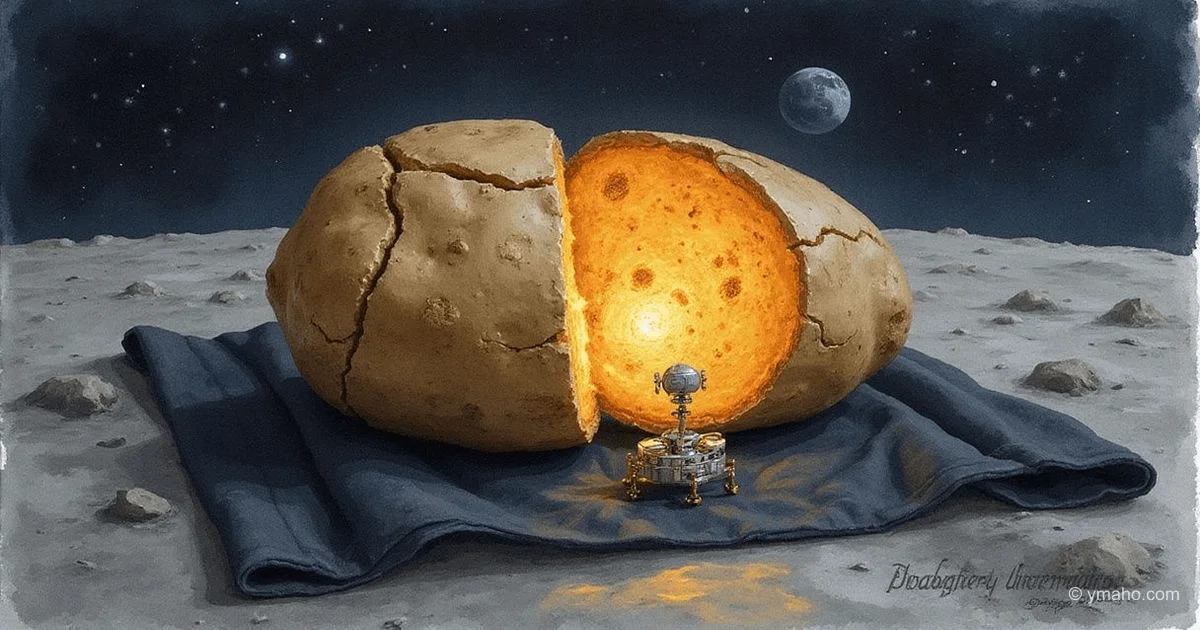
Think of the moon like a baked potato left out overnight. The outside cools quickly, but the inside might still be warm hours later — especially if it had extra “seasoning” like radioactive elements that generate heat as they decay. Scientists have long assumed that the side of the moon facing Earth (the near side) is hotter because it’s covered in dark, smooth plains called maria — ancient lava flows that required lots of underground heat to erupt. The far side, by contrast, looks rugged and cratered, suggesting it stayed cooler.
But new data from Firefly Aerospace’s Blue Ghost lander, which touched down in March 2025 in Mare Crisium — a volcanic plain well outside the traditional “hot zone” — tells a different story. There, instruments measured heat escaping from below the surface that was nearly as strong as readings taken during Apollo missions 50 years ago.
A Drill, Some Rocky Soil, and a Big Surprise
Blue Ghost carried a special tool called LISTER (Lunar Instrumentation for Subsurface Thermal Exploration with Rapidity). It’s essentially a smart drill that measures temperature at different depths to figure out how much heat is rising from the moon’s interior.
Scientists hoped it would go deeper than one meter — far enough to avoid the wild temperature swings between lunar day (scorching hot) and night (freezing cold). But the drill hit unexpectedly dense, rocky soil and stalled at about 98 centimeters (just under 3 feet). Still, even that shallow depth gave them eight solid temperature readings.
And here’s the kicker: the heat flow was similar to Apollo-era measurements. That’s surprising because Mare Crisium wasn’t supposed to be a hotspot.
Rethinking the Moon’s Inner Engine
This finding challenges a key assumption: that heat-producing elements like thorium are mostly packed into the near side. Thorium is a radioactive element; as it slowly breaks down over billions of years, it releases heat — like a slow-burning ember inside a campfire.
Now, scientists are considering other explanations. One idea: maybe the crust is thinner in certain areas, so magma could rise more easily to the surface — not because there was more heat underground, but because the “lid” was easier to crack open. Another possibility: these heat-generating elements are spread more evenly across the moon than we thought, just hidden beneath the surface.
A second instrument on Blue Ghost, the Lunar Magnetotelluric Sounder (LMS), also hinted that radioactive materials might be concentrated closer to the surface — within the crust itself — rather than deep in the mantle.
What Does This Mean for Regular People?
You won’t feel this heat walking on the moon — but it affects real plans for human exploration. If parts of the moon are warmer or more geologically complex than expected, it could influence where we build bases, how we drill for water ice, or even how we design equipment that must survive extreme conditions. More broadly, it reminds us that even our closest cosmic neighbor still holds secrets. Understanding those secrets helps us learn not just about the moon, but about how rocky planets — including Earth — evolve over time.
Key Takeaways
- The Blue Ghost lander found higher-than-expected heat flow in Mare Crisium, a region previously considered geologically “cool.”
- This suggests radioactive heat sources like thorium may be more widely distributed across the moon than the Apollo-era model predicted.
- Volcanic activity might depend more on crust thickness than on how much heat exists below.
- Future lunar missions will need to gather more subsurface data to confirm these findings.
- These insights directly impact NASA’s Artemis program and plans for sustainable human presence on the moon.
— Editorial Team









