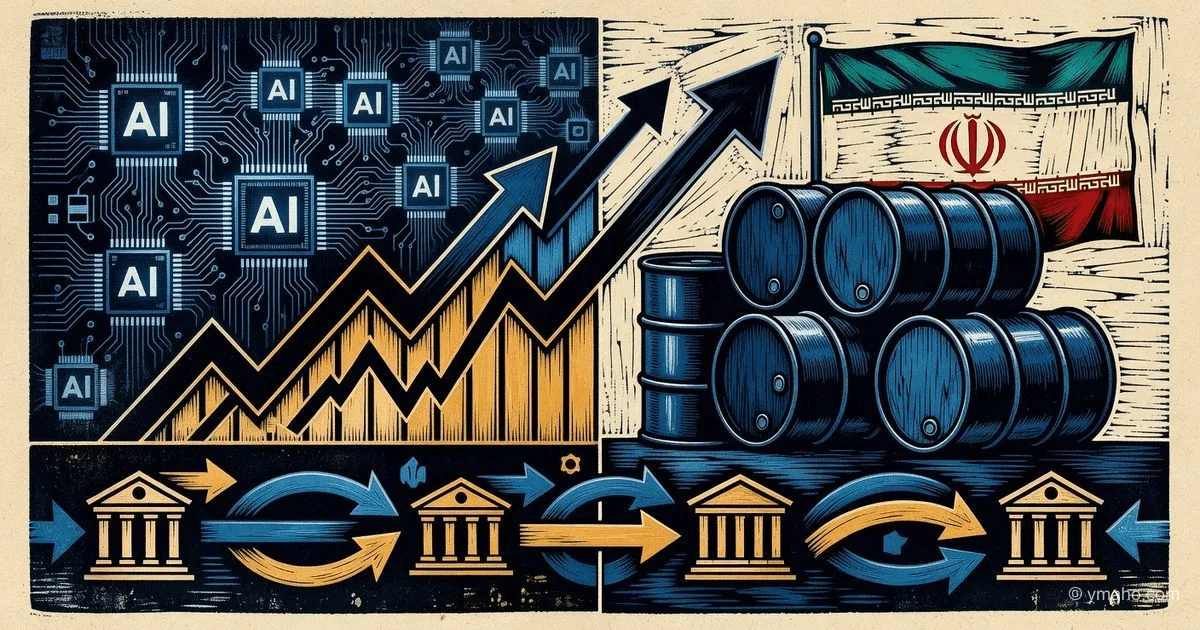
Morgan Stanley forecasts global GDP recovery to 3.4% in 2027 driven by AI
Bank analysts expect global GDP growth of 3.4% in 2027 as AI investments support the US economy, although an energy price shock from the Iran conflict will temporarily slow growth to 3.2% in 2026.
Analytical article: Morgan Stanley Forecast — AI Will Save the World, But Not Everyone
Author: Independent Financial Analyst
[The Gist]: What's Really Happening
Morgan Stanley's forecast is not just an optimistic view of the future. It is a bet on a structural shift that most investors underestimate. The bank's analysts expect global GDP of 3.2% in 2026 and an acceleration to 3.4% in 2027 thanks to AI investments.
But here's what didn't make the headlines: this growth is the most uneven in two decades. Essentially, Morgan Stanley describes a two-speed economy where one part (capital owners, Big Tech shareholders, chipmakers) thrives, while another (young professionals, office workers, the middle class) is left behind.
Seth Carpenter, Morgan Stanley's chief economist, stated outright: "AI investment is the dominant force in the current investment cycle." But behind the scenes, his team acknowledges: we are seeing for the first time a scenario where GDP grows but jobs for certain population groups do not. This is not just a recession — it is an existential question for social stability.
Timeline and Context
Let's break down the key dates and figures from Morgan Stanley's May 15, 2026 forecast:
- 2026 — global GDP will grow by 3.2% (down from 3.4% in 2025 due to the energy shock from the Iran conflict)
- 2027 — acceleration to 3.4% (return to pre-crisis rates assuming oil price normalization)
- US GDP — 2.25% in 2026, 2.5% in 2027
- Brent crude — year-end 2026 forecast: around $90 per barrel
- US AI capital expenditure — growth of 7% in 2026 and 8% in 2027
The most critical assumption without which this forecast collapses: the Iran conflict will be resolved by mid-June 2026. If not, and oil settles above $150, Morgan Stanley forecasts a global recession.
Why is this critical? Because Brent crude is currently trading around $102-105 — already above Morgan Stanley's comfortable range of $80-90. Every 10 days of delay in resolution increases the risk of Scenario #2 (oil at $100-110) and Scenario #3 (oil at $150+).
Who Wins and Who Loses
Winners:
- Big Tech and chipmaker shareholders. Morgan Stanley raised its year-end S&P 500 target to 8,000 by end-2026 and 8,300 by mid-2027. That's +12% from current levels.
- Nvidia and SK Hynix. Hyperscaler capital expenditure (Amazon, Google, Microsoft, Meta) will grow from $800 billion in 2026 to $1.16 trillion in 2027. The main beneficiaries are chipmakers and HBM memory producers.
- Asian manufacturers. About 20% of US imports are now AI-related, with China, Taiwan, and Korea as the main suppliers.
Losers:
- Young workers (22-27) in office professions. The most underestimated risk. Morgan Stanley data shows: the unemployment rate among youth in AI-vulnerable occupations rose from 2.6% to 3.6%, and hiring for entry-level positions has dropped 35% compared to early 2023. This is not layoffs — it's the absence of the first rung on the career ladder.
- Europe. Most vulnerable to the energy shock due to high dependence on oil and gas imports. In a prolonged conflict scenario, Eurozone inflation could spike to 6.5%.
- Low- and middle-income households. Even in the optimistic scenario, rising gasoline prices eat into disposable income. Morgan Stanley acknowledges: "Higher gas prices will weigh on low- and middle-income consumers."
What the Media Isn't Saying
Here's my key insight that didn't make the mainstream news.
Morgan Stanley's forecast is based on oil at $90 by end-2026. But the current price is $102-105. The gap is $12-15. And no one knows how to close it.
In its base case, the bank assumes the conflict will be resolved "by mid-June" and supplies will normalize within a few months. However, even then, prices won't return to $60 (the November 2025 forecast). They will stay in the $80-90 range.
But what if the conflict drags on? Morgan Stanley describes Scenario #3 — oil at $150-180, recession, mass flight to safe havens.
But there is a fourth scenario the bank doesn't mention: a long-term geopolitical risk premium. Even if the conflict ends tomorrow, the fear of another Strait of Hormuz closure will remain. This means oil will never return to $60. The new equilibrium is $85-95. And that changes the entire macroeconomic model.
The second hidden fact: the AI boom creates unexpected inflationary pressure. Morgan Stanley confirms: hyperscaler capital expenditure in 2026-2027 will total about $2 trillion. This money goes to chips, electricity, construction. But DRAM memory prices have already risen 70% year-over-year. Data center energy consumption has grown 35% in 12 months. Who will pay for this? Consumers, through electricity tariffs and electronics prices.
Forecast: Next 30 Days and 90 Days
30 days (through end of June 2026):
- June FOMC meeting on June 16-17 — Morgan Stanley expects rates to be held for all of 2026. But I disagree (see my previous analysis on Cook). Probability of a hike in June: 40%.
- S&P 500 — Morgan Stanley sees a year-end target of 8,000, implying about +5-6% from current levels. But in the next 30 days, a 3-4% correction is possible before the FOMC meeting.
- Brent crude — key range $98-112. If the price does not fall below $105 by June 15, Morgan Stanley will have to revise its base case.
90 days (through end of August 2026):
- If oil falls to $90-95 as Morgan Stanley forecasts — stocks rise, the dollar may weaken, gold corrects.
- If oil remains above $105 — markets will start pricing in Scenario #2 (protracted conflict), and safe havens (gold, Treasuries, dollar) will be favored.
- Key indicator I will track: weekly hiring data in the information services sector. If the decline in youth hiring continues (currently -35% from peak), this will become a political issue and could shift Fed rhetoric toward easier policy.
Editorial Forecast
Asset: S&P 500 (SPX)
Direction: Up in the next 72 hours (bounce after recent correction)
Key levels: Current around 7,400. Nearest resistance 7,480, next 7,550. Support 7,320.
Confidence level: Low (45%)
Main risk: Morgan Stanley's forecast is already partially priced in. If US inflation data in the next 72 hours comes in above expectations (e.g., core PCE 3.7%+), markets will shift from AI optimism to "Fed will hike," and the S&P 500 could fall to 7,250. Also risk: lack of progress in Iran talks — any negative news from the Persian Gulf will erase all AI-positive sentiment.
Editorial opinion. Not investment advice.
— Editorial Team