Fed Governor Cook Says Ready to Raise Rates if Inflation Doesn't Slow
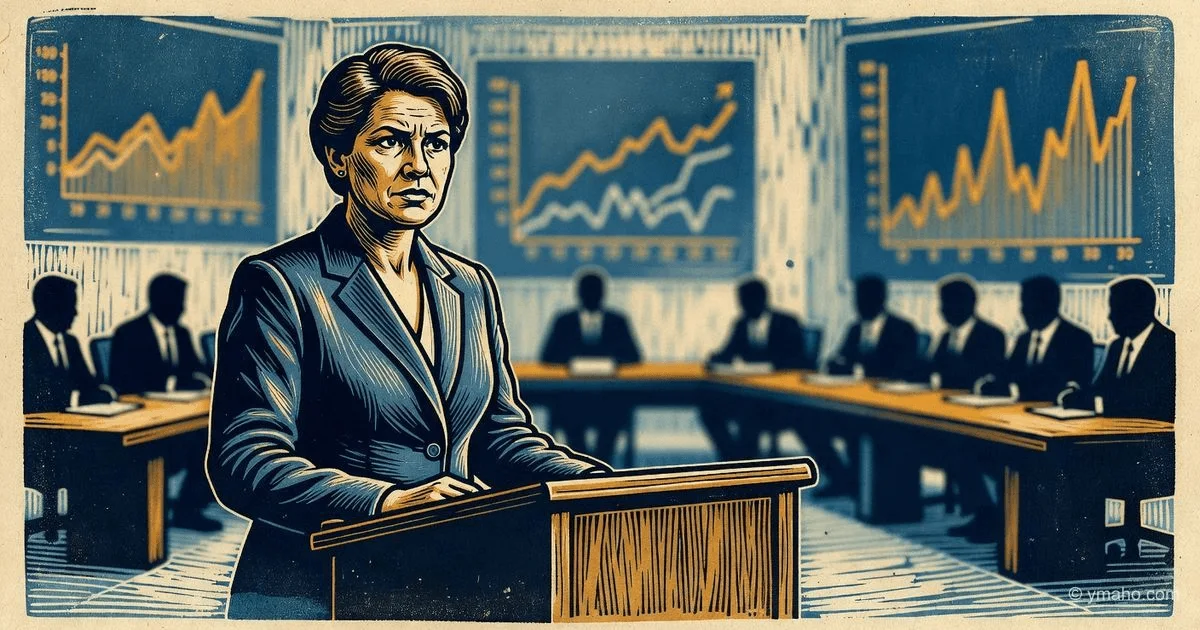
Lisa Cook emphasized in her speech that risks are tilted toward higher inflation and expressed readiness to raise rates if expected disinflation does not materialize in a timely manner, as a five-year period of elevated inflation is concerning.
Analytical article: Lisa Cook said 'hike.' In reality, she gave markets a final warning shot
Author: Independent financial analyst
[The Gist]: What's Really Happening
Lisa Cook's May 27 speech at Stanford is not just 'a hawk on the Board of Governors.' It is an official signal of a rift within the FOMC that the media is misinterpreting.
Note the wording: 'I am ready to raise rates if expected disinflation does not materialize in a timely manner.' The key word is 'ready.' In Fed language, this is a level of commitment that usually precedes action. But here's what no one notices: Cook is the same person the Trump administration tried to sue in December 2025, accusing her of being too 'dovish.' Now she sounds like a hawk. This is not just a change of opinion — it's data forcing even the most convinced soft-policy advocate to shift.
Now look deeper. Cook simultaneously said: 'I am ready to cut rates if the labor market deteriorates.' This is two-sided readiness — a classic central banker trick to keep maneuvering room. But markets only read the hike. And rightly so, because inflation risks now outweigh unemployment risks by roughly 3 to 1 according to the Fed's internal models.
Timeline and Context
Cook is not just any Board member. She is the only FOMC member whose seat on the committee was legally challenged by the Trump administration. In December 2025, the White House tried to remove her, but a court blocked the decision. Now she delivers the most hawkish speech of her career. Coincidence? I don't think so.
Key dates:
- May 27, 2026, 2:00 PM local time — Cook speaks at an AI forum at Stanford.
- 24 hours before the speech — markets priced only a 3.2% probability of a rate hike in June (per CME FedWatch Tool).
- At the time of the speech — federal funds futures already reflected over 50% probability of at least one hike by year-end.
- June 16–17 — first FOMC meeting under Kevin Warsh.
Why this matters: Cook named three specific inflation factors not accounted for in most investor models:
- 2025 tariffs — their effect, she said, should have faded but persists.
- War in Iran (started February 28, 2026) — oil rose, pressuring prices.
- AI boom — demand for chips, software, and data center construction.
The third factor is the most underestimated. One data center consumes electricity like a small town. Data center construction workers earn 25% above the construction industry average. This is a secondary inflation effect that typically shows up with a 6–9 month lag in the CPI index.
Winners and Losers
Winners:
- US Dollar. DXY already above 104.2 after Cook's speech. If other 'hawks' follow in June, the index will head to 106 by mid-June.
- Short positions in Treasury bonds. 10-year yield at 4.92%. Cook's comment that 'after five years of above-target inflation, the risks of anchoring are very high' signals the Fed won't rush to cut.
- Gold. This sounds paradoxical: a rate hike usually pressures gold. But Cook cited the reason for hiking — unanchored inflation. If inflation doesn't anchor, real rates stay low, and gold is an anti-fiat currency. Plus, her threat to cut rates if the labor market worsens is a second safe-haven for gold.
Losers:
- High-multiple tech stocks. Nasdaq already fell 1.5% on the day after the speech. If other FOMC members back Cook, the correction could be 5–7% before the June meeting.
- Homebuilders. Mortgage rates are already 7.75%. A Fed hike would push them to 8.5% — freezing the market.
- High-yield bond issuers (junk rating). Spreads to Treasuries widened to 410 basis points. That's the highest since 2023.
What the Media Isn't Saying
Now for my main insight, which you won't find in official sources.
Cook's May 27 speech was coordinated with new Chair Warsh. Yes, technically she speaks for herself. But at the Fed, such speeches aren't given without approval. Warsh, who officially took office after Senate confirmation on May 13, is currently in a 'quiet period' before his first meeting. He can't speak publicly — he's preparing. So he uses Cook as a 'voice' to test the waters.
Why do this? To see how markets react to a hawkish signal. The reaction was moderate: dollar up, stocks down, but no panic. This means Warsh got a green light for a real hike in June or July. If markets had crashed 3% in a day, he would have backed off. But they held — so the shock will be absorbed.
Second hidden fact: Cook mentioned AI and data centers. But she didn't say the main thing: US data center energy consumption rose 35% over 12 months and now accounts for 4.5% of total US electricity consumption. This directly pressures industrial tariffs. And industrial tariffs are the cost base for everything from aluminum to cement. Secondary effects are already baked into PCE for August–September 2026. The Fed knows this but doesn't say it publicly because it doesn't want to appear helpless before a structural shift.
Forecast: Next 30 Days and 90 Days
30 days (through end of June 2026):
- June FOMC meeting (June 16–17): my estimate — 40% probability of a 25 basis point hike to 3.75–4.00%. Markets price 3–5% — they are severely underestimating the risk.
- DXY will rise to 105.5 by mid-June if 2–3 more FOMC members make hawkish statements.
- S&P 500 will correct 3–4% before the meeting. Nasdaq 5–7%.
- Brent oil — range $98–112. Higher due to geopolitics, lower due to support from inflation expectations.
90 days (through end of August 2026):
- If a hike occurs in June, a second hike in September has a 30% probability. If not, a hike in July has a 50% probability.
- Key indicator I'll track: five-year, five-year forward inflation expectations (5y5y forward). Currently at 2.15%. If it breaks 2.30%, the Fed will be forced to act more aggressively.
- Gold: if rates are hiked in June, gold will fall to $2,380 in the first 48 hours. Then return to $2,500+ due to geopolitics and de-dollarization risks.
Editorial Forecast
Asset: Nasdaq-100 (QQQ)
Direction: Decline in the next 72 hours
Key levels: Current around 18,200. Nearest support at 17,850, next at 17,500. Resistance at 18,400.
Confidence level: Medium (60%)
Main risk: If other FOMC members (especially Williams or Bostic) speak in the next 48 hours to counter Cook's hawkish signal, Nasdaq could recover 1.5–2%. However, absent such statements, the market will continue repricing rate hike probability, and the rate-sensitive tech sector will remain under pressure.
Editorial opinion. Not investment advice.
— Editorial Team