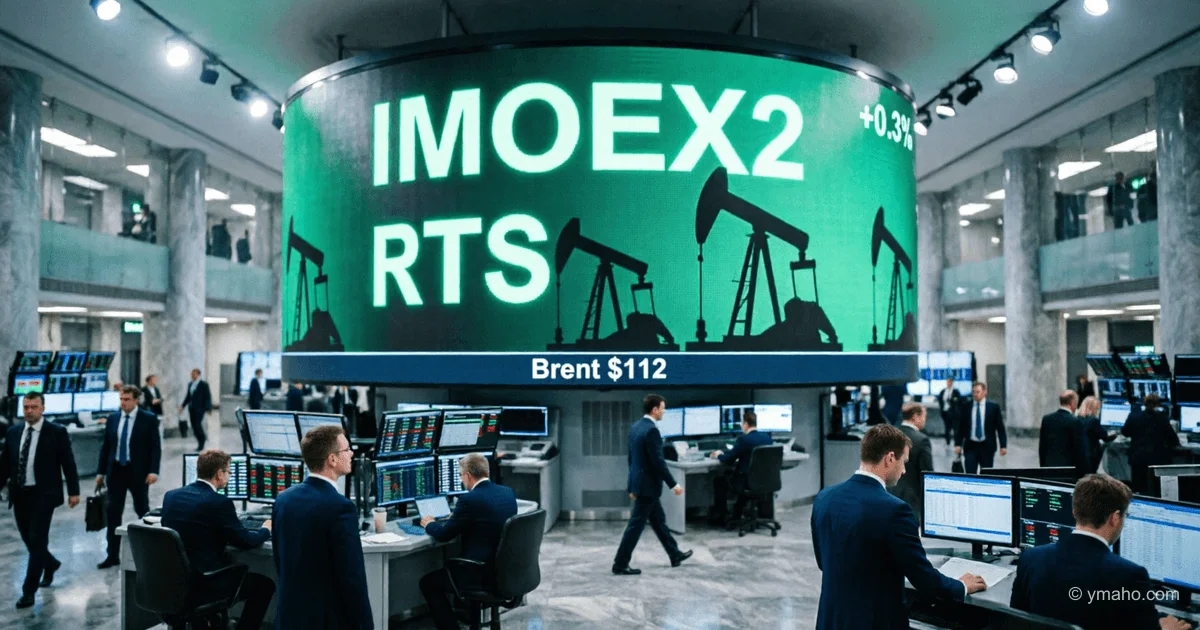
Moscow Exchange Main Session Opens with Indices Up 0.3%
The MOEX and RTS indices gained at the start of trading amid rising oil prices and mixed signals from global markets. U.S. exchanges showed negative dynamics the day before, while Asia saw predominantly growth.
Introduction
The morning of April 29, 2026, began for the Russian stock market with cautious optimism. The main trading session on the Moscow Exchange opened with gains in key indicators: the MOEX index (IMOEX2) rose 0.3% to 2,704.56 points, and the RTS index (RTSI) climbed to 1,140.64 points, also up 0.3%. This positive start came amid mixed signals from global markets and, importantly, against the backdrop of a continued rally in oil prices driven by geopolitical tensions in the Middle East.
The moderate rise in the Russian market looks like a corrective attempt to recover after the previous weak session. At the same time, investors remain cautious, closely watching two key factors: developments around the Strait of Hormuz and the upcoming U.S. Federal Reserve interest rate decision, which will be the last under Jerome Powell's leadership. In such conditions, the Russian market shows resilience, supported by expensive commodities and domestic corporate stories.
Event Details and Timeline
In the first minutes of trading, by 10:01 Moscow time, both indices showed a confident rise. The MOEX index settled at 2,704.56 points, up 0.3%. The dollar-denominated RTS index also rose 0.3% to 1,140.64 points. However, by 10:15, the pace of growth slowed: the MOEX index corrected to 2,698.24 points (+0.06%), and the RTS to 1,137.97 points.
Among the leaders in the first minutes were:
- Shares of Moscow Credit Bank (MKB) — up 2.5%
- PhosAgro — gained 1%
- HeadHunter Group — rose 0.9%
- Inter RAO, Aeroflot, VTB, and Sistema — growth within 0.7–0.8%
- Novatek and Yandex — added 0.6%
- Gazprom, NLMK, and Sberbank — showed growth of about 0.5%
At the same time, some securities came under selling pressure: Rusal shares fell 1%, Tatneft — 0.8%, Rosneft — 0.4%.
The key external support factor remained the oil market situation. By 10:01 Moscow time, June Brent futures reached $112.25 per barrel (+0.9%), and June WTI futures traded at $100.56 per barrel (+0.6%). Oil prices continued to rise after a confident increase the day before: on Tuesday, Brent rose 2.8%, WTI — 3.7%. The price of Russian Urals on the morning of April 29 held around $107.40 per barrel, up 0.21%.
Impact and Significance (for the World / Industry / Society)
For the global economy and finance: The situation in the Russian market is part of the global puzzle, where the main driver of volatility remains the Middle East. U.S.-Iran talks on the Strait of Hormuz have reached a deadlock — the second round of consultations between Tehran and Washington collapsed. U.S. President Donald Trump refused to send an American delegation to Islamabad for negotiations. However, Iran made a new proposal: open the strait and end the conflict in exchange for a postponement of nuclear talks. The White House received this proposal, but its willingness to consider it remains unclear. As long as uncertainty persists, oil will trade with a high geopolitical premium, supporting the oil and gas sectors of exporting countries, including Russia.
For the Russian economy and financial industry: The rise in indices amid expensive oil is a classic scenario for the Russian market. However, today's dynamics have important nuances. The dollar-denominated RTS index is rising simultaneously with the ruble-denominated MOEX index, indicating real demand for Russian assets, not just currency revaluation. At the same time, the official dollar rate set by the Central Bank of the Russian Federation on April 29 was 74.6947 rubles, down 11.34 kopecks; the euro rate fell to 87.5928 rubles (-28.98 kopecks). The strengthening ruble limits the growth of the RTS index in ruble terms but does not stop it.
An important domestic factor remains monetary policy. On April 24, the Bank of Russia predictably cut the key rate by 50 basis points to 14.5%. The decision matched the consensus of analysts, but the regulator's signal turned out to be tougher than the market expected. The Central Bank kept its year-end inflation forecast at 4.5–5.5% and raised its estimate of the average key rate for 2026 to 14.0–14.5%. This means investors should not expect rapid policy easing — the rate will remain double-digit until the end of the year.
For society: For Russian citizens with savings in stocks, bonds, or through pension funds, the situation sends mixed signals. On the one hand, expensive oil supports budget revenues and exchange rate stability. On the other hand, the high key rate continues to pressure lending and economic activity. Analysts at Sovcombank note that the economic situation in Q1 is significantly worse than the Central Bank's forecast, and the risks of an "overcooling" economy are growing. This means that the current stock market growth may not be related to an improvement in companies' fundamental indicators but rather reflects only commodity market conditions and currency effects.
Reaction of Key Players
Analysts and forecasters: Vladimir Chernov, analyst at Freedom Finance Global, expects the MOEX index daily range of 2,685–2,735 points. In his assessment, expensive oil and company reports could support the market, but caution ahead of major issuers' results and weakness in certain sectors limit growth potential. The forecast for Urals oil for the day is $106–109 per barrel, and for the dollar exchange rate — 74.7–75.8 rubles.
Mikhail Vasiliev, chief analyst at Sovcombank, commenting on the Central Bank's rate decision, noted that the Bank of Russia maintained a soft signal about the possibility of further cuts at upcoming meetings. He predicts the next rate cut of 50 bps (to 14%) at the June 19 meeting and expects a rate of 12.5% by the end of the year.
Institutional investors and traders: In the first minutes of trading, selective demand was observed — growth was concentrated in specific stocks rather than broad-based. Particularly strong dynamics were shown by MKB shares (+2.5%), which may be related to corporate news or expectations of dividend payments. PhosAgro and HeadHunter also became favorites — these companies are considered quality "dividend stories" in current conditions.
Notably, oil company stocks showed a restrained reaction to rising oil prices: Lukoil added only about 0.3%, Rosneft even fell 0.4%. This may indicate that the high geopolitical premium in oil prices is already fully priced in, and traders are taking profits in the oil sector, rotating into other stories.
External markets: On Monday, April 27, U.S. indices showed mixed dynamics — the Dow Jones fell 0.13%, while the S&P 500 (+0.12%) and Nasdaq (+0.2%) again hit record highs. However, on Tuesday, the U.S. market corrected downward: the S&P 500 lost 0.51%, the Nasdaq — 1.11% amid fears that capital expenditures on AI infrastructure may not meet expectations.
Asian markets, on the contrary, showed predominantly growth, adding optimism to Russian investors. This divergence in dynamics between regions indicates a lack of a single trend and increased fragmentation of global capital.
Forecast and Conclusions
The short-term outlook for the Russian stock market remains moderately positive but with a high level of uncertainty. Analysts at Freedom Finance Global expect the MOEX index to move in the range of 2,685–2,735 points. The key factor that will determine dynamics in the coming days will be the outcome of the Fed meeting on April 29. If the regulator gives a "dovish" signal, it will support global risk appetite and could trigger a new wave of buying. If rhetoric remains hawkish, a correction should be expected.
The most important driver remains the price of oil. As long as the threat of supply disruptions from the Persian Gulf persists, oil will remain above $100 per barrel, and likely above $110. This creates a favorable backdrop for the Russian market, but traders should remember: geopolitical risks work both ways. Any positive signal on conflict resolution will lead to a sharp drop in oil prices and could trigger a market correction.
On the domestic front, investors will be watching quarterly reports from major companies published these days. "The reporting season will give the market new benchmarks," as analysts note, especially important will be management comments on dividend policy in a high key rate environment.
Conclusion: The morning rise in the Russian market on April 29 reflects a strong commodity backdrop and an attempt at correction after previous weakness. However, the dynamics remain fragile: investors combine optimism about expensive oil with caution ahead of external risks (Fed decision, Middle East situation) and domestic constraints (tight Central Bank monetary policy). In such conditions, the most likely scenario is a sideways movement in the range of 2,685–2,735 points for the MOEX index, with periodic volatility spikes when significant news breaks. For long-term investors, current levels look neutral — neither overbought nor clearly undervalued, excluding the commodity component.
— Editorial Team









