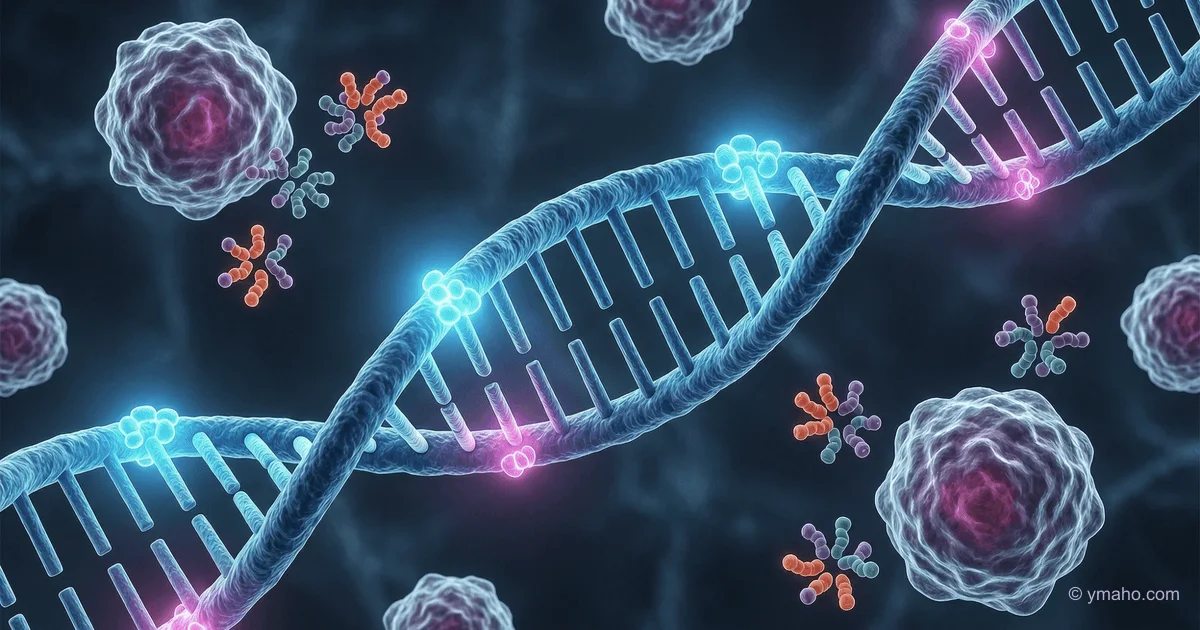
Nature: Over 1,700 New Microproteins Discovered in 'Junk' DNA
An international team of scientists published a study in Nature identifying over 1,700 new microscopic proteins in previously considered useless DNA regions. Experiments showed that disabling the genes of six of these microproteins reduced cancer cell survival by 85%, opening new targets for immunotherapy.
The Gist: What's Really Happening
The TransCODE consortium didn't just find "a few more proteins." They discovered an entire parallel layer of biological regulation that remained invisible for decades. We're talking about 1,785 new microproteins, dubbed "peptideins." They are encoded by DNA regions that geneticists always classified as "junk" or non-coding. In fact, about a quarter of the 7,264 studied non-canonical open reading frames (ncORFs) produce these molecules.
The term "peptidein" isn't just linguistic embellishment. It's an attempt to create a new taxonomic category between "noise" and "full-fledged protein." The term's author, Jonathan Mudge from EMBL-EBI, explains simply: "These molecules were effectively invisible before. We were looking at biology through an incomplete lens." Now the lens has been replaced.
The number that should force oncologists to rethink their development pipelines: when the OLMALINC gene, previously considered non-coding, was disabled, 85% of 485 tested cancer cell lines lost their ability to survive. This isn't a marginal effect—it's an indicator that "junk" DNA contains master regulators of tumor survival.
Timeline and Context
The story of this discovery didn't start yesterday. Back in 2024, M. Mar Albà's team from Barcelona published a paper in Science Advances showing that non-coding RNAs encode microantigens presented on the surface of liver tumor cells. At the time, it seemed like a niche finding for hepatocellular carcinoma. Now TransCODE has scaled this approach to the entire proteome.
Key dates:
- 2007: First detection of the link between non-coding RNA miR-10b and metastatic tumor behavior.
- 2024: Publication in Science Advances on microantigens in liver cancer—proof of an immunopeptidome from the "dark genome."
- May 5, 2026: TransCODE publishes in Nature the results of analyzing 95,520 proteomic experiments and 3.7 billion spectra.
- May 6, 2026: EMBL-EBI announces the inclusion of peptideins in the GENCODE, UniProt, and PeptideAtlas databases.
Context many miss: simultaneously, a clinical trial by TransCode Therapeutics (not to be confused with the TransCODE consortium) is underway—their drug TTX-MC138 targets precisely the non-coding RNA miR-10b, which traditional pharmacology ignored. Phase 1a has already shown disease stabilization in patients with advanced solid tumors. This means the "dark genome" is not an academic abstraction but a ready therapeutic target.
Who Wins and Who Loses
Winners
Biotech companies with platforms for neoantigen discovery. Those who already invested in immunopeptidomics get a goldmine of 1,785 new targets. Companies like TransCode Therapeutics, whose scientific foundation is the work of Associate Professor Zdravka Medarova from Harvard Medical School, can now cite the Nature publication as validation of the entire approach.
Sequencer and mass spectrometer manufacturers. Every new protein is a potential biomarker. Every biomarker requires a test. The analysis alone used 3.7 billion spectra—and that's just the beginning. Expect increased orders for proteomics equipment.
Patients with cancer resistant to standard immunotherapy. Checkpoint inhibitors work for only 20–30% of patients. Peptideins presented on MHC-I could become alternative targets for T cells.
Losers
Classical genomics companies. The "sequence the exome and look for mutations" model is becoming obsolete. Over 1,700 functional genome elements that no one included in analysis mean existing oncodiagnostic panels are like a world map without America.
Laboratories without access to proteomics. Finding peptideins requires high-resolution mass spectrometry and complex bioinformatics. The gap between top-tier institutes and the rest will widen. EMBL-EBI promises to make data open, but analyzing raw spectra is a competency most clinical centers lack.
What the Media Isn't Saying
Insight #1: The competition around the term "peptidein" is a battle over standards. Introducing a new category into GENCODE and UniProt is as much a political decision as a scientific one. If the term sticks, the TransCODE consortium becomes the de facto arbiter of what counts as a functional genome element and what is noise. This gives them priority in patenting. Watch closely which specific peptideins appear in subsequent intellectual property filings from the University of Michigan and MIT.
Insight #2: The connection to the Cancer Grand Challenge program. The EMBL-EBI press release casually mentions that the consortium collaborates with the ILLUMINE team, which recently received a Cancer Grand Challenge grant. Cancer Grand Challenge is an initiative by Cancer Research UK with budgets up to $25 million per project. This means the Nature publication is not a one-off study but part of a coordinated program with multi-year funding.
Insight #3: The problem with normal tissues. The authors honestly admit: "the role of the peptidein OLMALINC in normal, healthy cells remains unclear." This is not a minor detail. 85% suppression of cancer cell survival is impressive, but if the same mechanism is critical for intestinal stem cells or bone marrow, toxicity will render the therapy unusable. The first candidate targeting such molecules will face the same issues as early BET domain inhibitors—powerful tumor effect and intolerable toxicity to normal tissues.
Forecast: Next 30 Days and 90 Days
30 Days (until June 6, 2026)
The first thing to happen will be a reshuffling of R&D priorities at large pharma companies. Any Big Pharma with an oncology portfolio has already downloaded the TransCODE dataset. In the coming weeks, internal bioinformatics groups will comb through the list of 1,785 peptideins for overlaps with their own transcriptomic data on tumors of interest. Expect leaks about "priority targets" via employee LinkedIn activity.
Citation surge. The paper will see an explosive spike in the first 30 days—not so much due to the quality of findings, but because all groups working with ncORFs will rush to add the term "peptidein" to their manuscripts under review to align with the new annotation standard.
FDA silence. The regulator won't comment yet, as no peptidein-targeted therapies are even at the IND stage. But internally, the agency will begin forming an approach to assess the safety of drugs targeting "dark genome" products.
90 Days (until August 5, 2026)
First preprints on preclinical validation. Groups that had early access to data through collaboration with TransCODE (remember, there are over 60 researchers from 30+ institutes) will start publishing validation results for specific peptideins in animal models. Special attention to the peptidein linked to medulloblastoma, which the consortium already partially characterized earlier.
Patent race. The University of Michigan and MIT have strong technology transfer offices. Expect provisional patent applications for panels of 10–20 peptideins as biomarkers for liquid biopsy. Market estimate: early cancer detection via proteomic signatures is a market worth over $2 billion in the US. Even one validated peptidein biomarker could be worth $200–500 million in company valuation.
Community split. Geneticists who spent their careers studying canonical proteins will begin criticizing the term "peptidein" as premature. The main argument: functional evidence exists for only a few molecules; assigning status to the other 1,700+ is speculation. This will echo the 2010s debates around lncRNAs, where initial excitement gave way to skepticism after realizing most are transcriptional noise. But unlike lncRNAs, peptideins are detected at the protein level via mass spectrometry—a much stricter criterion for existence.
Strategic window for biotech. The next 90 days are a period when small biotech companies can raise funding under the "dark proteome targeting" concept without their own data, simply by citing the Nature publication. After the first negative validation results from independent labs, this window will begin to close. Those who manage to raise a seed round of $5–15 million in June–July 2026 will have resources for their own validation; the rest will have to wait for others' data.
The main takeaway for everyone working in oncology: "junk" DNA turned out to be a treasure trove. But treasure troves require maps, and no one has a map yet. 1,785 points on a map are not a route to a drug; they are a list of places worth digging. And the digging will start immediately.
— Editorial Team









