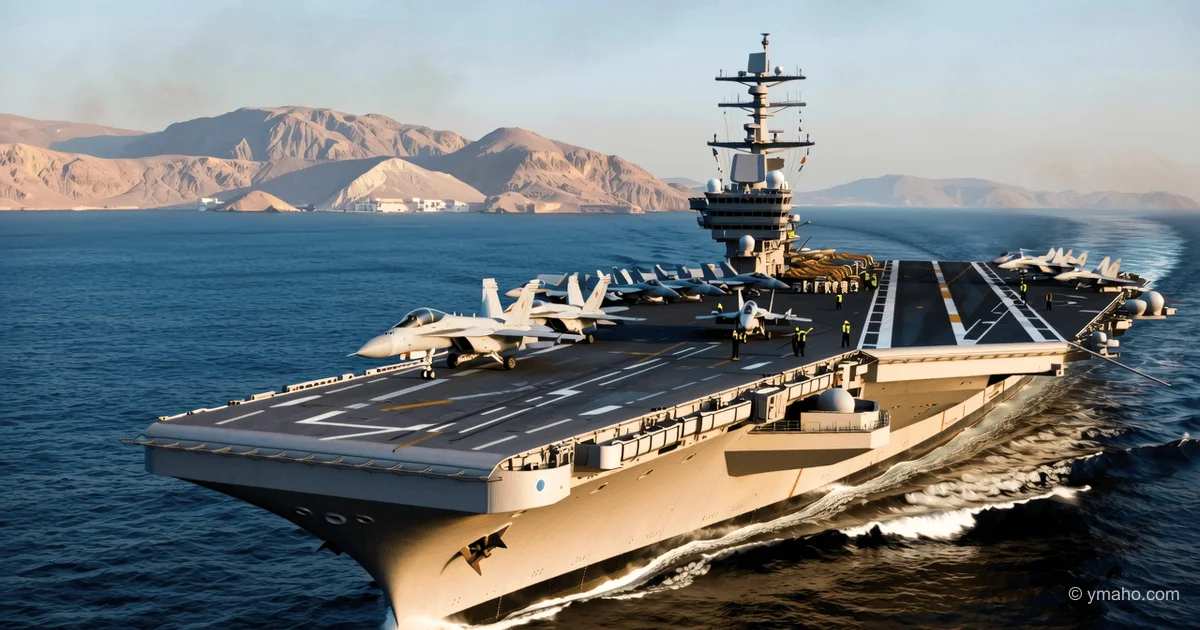
France Deploys Nuclear Aircraft Carrier Charles de Gaulle to the Strait of Hormuz to Ensure Navigation
France and Britain are preparing a joint mission to protect freedom of navigation, under which the French aircraft carrier has already arrived in the region, and London plans to send the destroyer HMS Dragon. Macron, meanwhile, stated that the mission will be coordinated with Iran.
[The Core]: What Is Really Happening
The deployment of the Charles de Gaulle to the Strait of Hormuz is not an operation to protect navigation. It is an operation to save European strategic autonomy from total collapse. Macron is betting that Paris, not Washington, will become the architect of the new security architecture in the Persian Gulf. The statement about "coordination with Iran" is not a diplomatic courtesy but a tough signal to the White House: France is no longer willing to automatically follow the US policy of containment and is choosing the role of a mediator with muscle.
The carrier strike group left Toulon on May 2, but the route was kept secret until May 10. The group is now 280 nautical miles southeast of Muscat, in international waters of the Gulf of Oman. Its composition includes: the carrier itself with 24 Rafale M fighters, the air defense frigate Alsace, the anti-submarine frigate Normandy, and a Suffren-class nuclear submarine, whose exact location is undisclosed. The British destroyer HMS Dragon is expected to join the group on May 14, departing from the naval base in Bahrain. The joint Franco-British mission has been codenamed Operation Bayard—after the fearless and blameless knight, which is telling in itself.
The main contradiction of the plan lies in Macron's words about coordination with Tehran. How can one coordinate the protection of freedom of navigation with a country that three days ago established the "Strait of Hormuz Administration" to charge fees for passage? This contradiction is not a mistake but the essence of the French position. Macron is trying to pull off a trick: de facto recognizing Iranian control over the strait in exchange for guarantees of unimpeded passage for European ships. Iran's "Administration" needs an international partner to legitimize its existence. France is offering itself in that role—and this is a radical break with the US approach, which denies the very idea of Iranian sovereignty over the strait.
Timeline and Context
The roots of Operation Bayard go back to April 9, 2026—the date of a secret meeting in Geneva. Then Macron's geopolitical advisor Emmanuel Bonne held three-hour talks with Iranian Deputy Foreign Minister Ali Bagheri Kani at the Hotel President Wilson without US representatives present. It was there that the formula "recognition of Iran's role in ensuring strait security in exchange for guarantees of unimpeded passage for European tankers" was first voiced. The protocol of the Geneva meeting was not shared with Washington—only the Élysée Palace and the British Cabinet knew about it.
Events then developed rapidly. May 7—an incident near Lavan Island resulting in the deaths of sailors and the loss of an Iranian corvette. May 8—Macron convened an emergency meeting of the Defense Council, where he stated that "France cannot wait for Washington and Tehran to exchange three more salvos." May 9—the decision to deploy the Charles de Gaulle was formalized, and on the same day, French Ambassador to Tehran Nicolas Roche notified the Iranian Foreign Ministry of the upcoming mission and received assurances that the group would not be considered hostile if it did not approach closer than 50 miles to Iranian territorial waters.
On May 10, Trump publicly criticized Paris's actions, calling them "naive appeasement." In response, Macron stated that "France does not ask permission to protect its economic interests." Total European oil imports through Hormuz amount to 3.1 million barrels per day, and each week of instability costs the European economy €2.7 billion in additional energy costs. These figures are key to understanding why Macron is acting outside traditional alliance discipline.
Who Wins and Who Loses
The paradox of the situation: the main beneficiary could be Iran itself. Iran's "Strait of Hormuz Administration" gets exactly what it wanted—the first major Western player that, in practice rather than words, recognizes the need to negotiate with Tehran over navigation rules rather than simply ignore its claims. For the head of the Administration, Rear Admiral Ali Reza Tangsiri, this is a huge bureaucratic victory, strengthening the position of the IRGC Navy within the Iranian elite at a time when the question of Khamenei's successor is being decided. If the French convoy passes through the strait without incident after coordination with Tehran, Tangsiri can say: "Look, even the Europeans recognize that we provide security here."
France gains status and leverage. TotalEnergies, whose $4.7 billion contract to develop Iran's South Pars has been frozen since 2018, gets a chance for unfreezing. The company's CEO Patrick Pouyanné said back in March that without Iranian gas, Europe's diversification from Russia would remain incomplete. The military-political success of the mission will allow Macron to sell the deal with Tehran as a strategic breakthrough—especially against the backdrop of the failure of the US policy of "maximum pressure."
Washington loses. The French mission undermines the very foundation of the sanctions regime: if Tehran can negotiate security with Paris bypassing Washington, then secondary sanctions become meaningless. It is no coincidence that National Security Advisor Waltz stated on May 11 that the US is "studying the compatibility of French actions with alliance obligations under NATO." This is a veiled threat to move the conflict into the alliance's arena.
Israel also loses. Netanyahu categorically opposed any negotiations with Tehran except from a position of "capitulation." The French mission means that the EU's largest military power is betting on a deal, not regime change. Israeli diplomats in Paris have already called Macron's actions a "stab in the back."
What the Media Are Not Saying
Mainstream media present the story as a humanitarian mission to protect navigation, but they miss a critically important detail: the Charles de Gaulle is not just a warship; it is a floating diplomatic center. On board is a mobile Syracuse IV secure satellite communication station, which can provide a direct and unlistenable channel between the Élysée Palace and the Iranian leadership. Neither US intelligence nor the Five Eyes have access to Syracuse IV. This means Macron has created the technical infrastructure for separate negotiations that even the closest allies cannot monitor.
The second non-obvious point concerns the British destroyer HMS Dragon. The stated goal is to reinforce the group, but Dragon's real task is reconnaissance. The ship is equipped with the Shaman signals intelligence system, capable of intercepting Iranian military communications within a 400 km radius. Britain is playing a double game: outwardly supporting the French initiative, London is gathering intelligence that it then shares with Washington via the NSA base at Menwith Hill. Macron knows this but deliberately turns a blind eye—he needs the British flag for the mission's legitimacy, even if it means data leaks.
Third insider info: the French Suffren-class nuclear submarine accompanying the group carries MdCN cruise missiles with a range of 1,000 km. Its presence is not defense but a hidden threat to Iran in case negotiations fail and the IRGC decides to attack the carrier. Suffren can strike Iranian coastal batteries in Bandar Abbas before Iranian missiles reach the group. This is a trump card that Macron does not advertise, but Tehran is aware of through military intelligence channels.
Forecast: The Next 30 Days and 90 Days
Next 30 days: The Charles de Gaulle will conduct a demonstration passage through the Strait of Hormuz escorted by three French LNG tankers from TotalEnergies. This will occur between May 18 and 22. The passage will be coordinated with the Iranian Administration, and Tehran will use it to demonstrate "peaceful coexistence." Iranian media will show footage of their boats "escorting" the French group. Brent prices will temporarily drop to $106 per barrel on de-escalation news. However, Trump will react immediately: on May 20-22, a new package of secondary sanctions against European companies cooperating with the Iranian Administration is expected. Macron will respond by threatening to activate the EU's 1996 "blocking statute," which prohibits European companies from complying with US sanctions. The transatlantic crisis will reach a new level.
90-day horizon: If the demonstration passage is successful, by mid-July other European countries will join the French model. Italy's Eni and Spain's Repsol are already holding closed consultations with the French Foreign Ministry about joining the mission. By August 2026, a de facto three-layer security system will operate in the Strait of Hormuz: American (force-based, without coordination with Iran), European (coordinated, with elements recognizing Iran's role), and Iranian (claiming full sovereignty). This three-layer system is extremely unstable: a single incident between a US destroyer and an Iranian boat near a European convoy could trigger a crisis involving three nuclear powers simultaneously. By the end of August, Brent prices will settle in the $115-125 per barrel range, and the global economy will begin adapting to a permanent "Hormuz premium" of $18-22 per barrel. The era of cheap globalization will finally give way to an era of fragmented energy markets, where supply security is paid for by military-political alliances, not market mechanisms.
— Editorial Team









