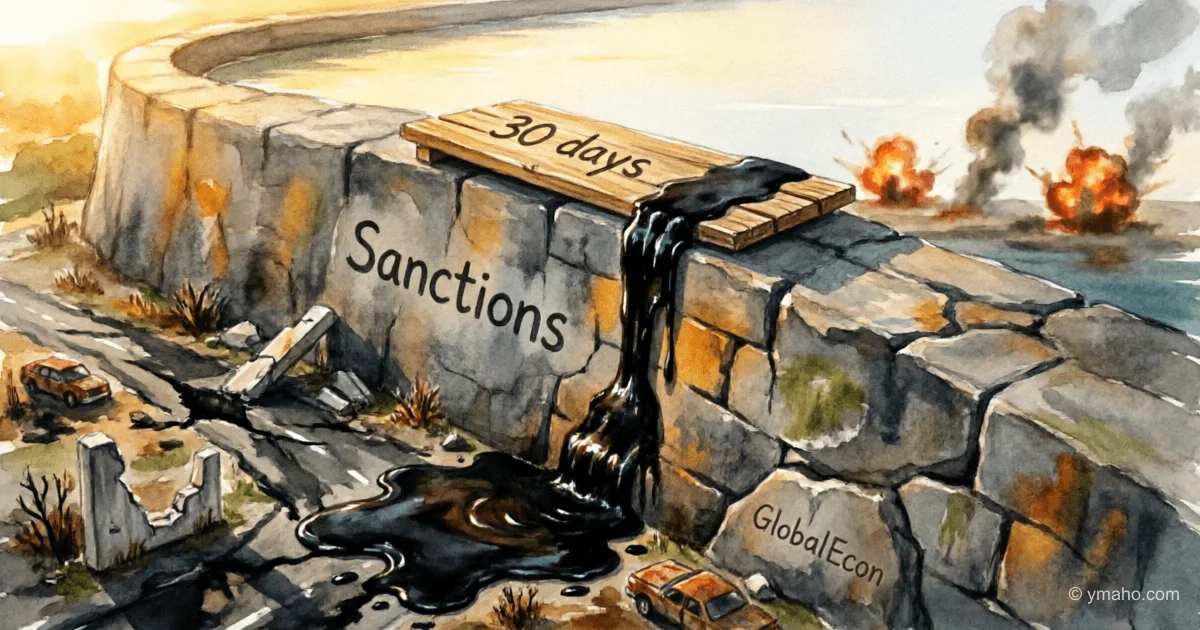
How a 30-Day U.S. Sanctions Loophole Could Fund Russia’s War With $10 Billion and Hit Your Wallet
Imagine you turn off a water faucet, only to find out a week later that it’s been temporarily reopened for 30 days. Water is gushing out, and you know full well that this flow is feeding a fire raging behind the wall. That’s exactly what the U.S. decision to pause sanctions on Russian oil looks like. It matters to everyday people because every drop of “spilled” oil might lower your gas prices today, but tomorrow it could intensify a conflict that destabilizes costs across the board—from heating bills to groceries.
What Unexpectedly Changed
On April 17, the U.S. took a step that directly contradicted its own previous commitments. It temporarily lifted sanctions on the maritime transport of Russian crude oil and petroleum products—strictly for 30 days. Washington had publicly stated it would not renew such waivers. Now, tankers that previously operated in the shadows (lacking insurance and using forged documentation) have received the green light.
According to Ukrainian President Volodymyr Zelenskyy, more than 110 of these vessels are currently at sea, carrying 12 million metric tons of Russian oil. To put that in perspective: that’s enough to fill 50,000 railway tank cars. If all this oil hits the market without restrictions, Russia could rake in roughly $10 billion. “Every dollar earned from Russian oil is money for war,” Zelenskyy emphasized, noting that these funds are being funneled directly into new missiles and shelling campaigns against Ukrainian cities.
Why This Isn’t Just a “Local Issue”
Many assume: “Sanctions on Russia are their internal affair.” But oil is a global commodity. Its price is set on international exchanges, and any shift in supply ripples worldwide. Think of the oil market as a shared pressure cooker: dumping extra fuel into it (in this case, 12 million tons) drives down the pressure (the price). For Russia, it’s an unexpected windfall—they sell more oil and refill their treasury. For the rest of the world, it’s a short-term dip in gas prices, but with a hidden catch.
Here’s another way to look at it: You tighten your grocery budget, only to suddenly realize your neighbor has gained access to your refrigerator. Sure, you’ve got extra food for a while, but they’re using it to build barricades right outside your window. In the end, your stability is compromised.
How “Dark Fleet” Tankers Operate
For years, Russia has cultivated a shadow fleet—vessels with opaque ownership histories, constantly swapping names and flags. Before April, these tankers faced serious hurdles: insurers shied away, and ports turned them away. U.S. sanctions acted like a global “no entry” sign on major shipping lanes. That sign has now been temporarily taken down.
What this means in practice:
- Tankers gain access to international ports
- Insurance becomes cheaper and more readily available
- Oil is easier to offload through middlemen
But the biggest factor is that Russia sidesteps the $60-per-barrel price cap. Previously, they had to sell below market value, bleeding revenue. Now, they can command the going rate ($85–$90), pocketing the difference straight into state coffers.
What Countries Can Do
Physically intercepting tankers is nearly impossible—the ocean is too vast. But there are actionable levers:
- Block financial channels — freeze the accounts of banks facilitating these deals
- Enhance cargo tracking — deploy satellites and AI to monitor suspicious vessels
- Coordinate joint patrols — similar to anti-piracy operations off Somalia, but targeting illicit oil networks
- Penalize intermediaries — sanction nations that rebrand and resell Russian crude under their own labels
Ukraine is already urging the U.S. to reverse course. Deputy Prime Minister Oleksandra Stepanishyna stated: “This undermines the entire sanctions architecture.” Europe is also weighing its options: on one hand, cheaper oil; on the other, an ethical dilemma.
What This Means for Everyday People
You’ll feel the impact in three key areas. First, gas prices could drop by 5–10% over the next month—but that relief is fleeting. Second, prolonging the war through fresh Russian funding heightens energy security risks: imagine sudden gas shortages triggered by further escalation. Third, such loopholes erode trust in sanctions as a tool. If rules can be flipped in just 30 days, tomorrow’s headlines might warn of eased restrictions on weapons or dual-use technologies.
Key Takeaways
- $10 billion a month — the sum Russia stands to earn from selling 12 million tons of oil without sanctions
- 30-day window — even this brief period is enough to bankroll new military operations
- Global ripple effect — oil markets react instantly: prices drop today, spike tomorrow on breaking news
- The ethical trade-off — cheap fuel now, or long-term security later?
- Behavioral precedent — if the U.S. concedes here, it emboldens future sanctions evasion attempts
While the world debates, the tankers keep moving. And each one isn’t just a ship—it’s a floating war chest. Staying informed is the first step toward asking your leaders: “Why are we letting them keep filling this account?”
— Editorial Team









