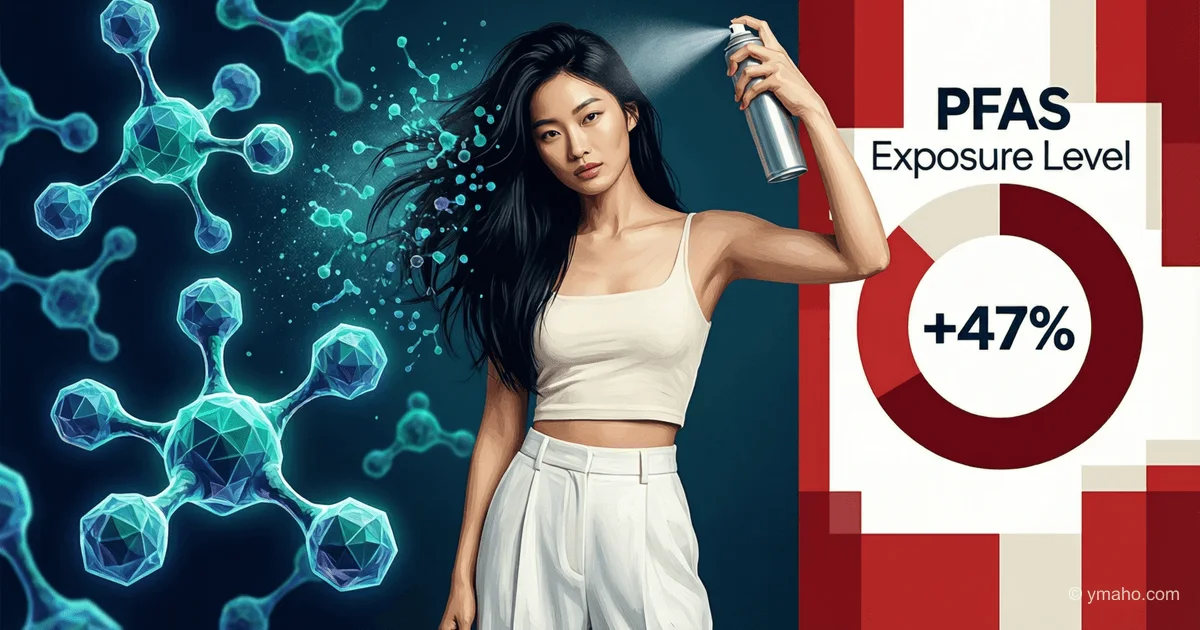
New UNC Study: Daily Dry Shampoo Use Raises Blood PFAS Levels by 47% in 6 Months
Toxicologists recommend switching to starch-based powders without perfluorinated chemicals — brand Acure has already announced a 'Zero PFAS' line.
Chemical trail on hair: why PFAS in dry shampoo is just the tip of the iceberg
[The Gist]: What's Really Happening
A study from the University of North Carolina (UNC) found that daily dry shampoo use increases blood levels of PFAS (per- and polyfluoroalkyl substances) by 47% in just 6 months. Toxicologists advise switching to starch-based powders without perfluorinated chemicals — brand Acure has already announced a 'Zero PFAS' line. At first glance, it's yet another study about 'toxins in cosmetics.' In reality, it's documented proof that the beauty industry has ignored for decades the accumulation of 'forever chemicals' through the scalp — one of the most efficient absorption pathways.
The real insight: the scalp has 2–3 times higher permeability than the skin on the forearm or face. Hair follicles and sebaceous glands create direct channels for substances to enter the systemic bloodstream, bypassing the stratum corneum barrier. PFAS, added to aerosol dry shampoos as anti-static agents and texture enhancers, form micron-sized particles when sprayed, settling directly on the scalp. The result is direct absorption without the metabolic protection of the gastrointestinal tract, which partially reduces the bioavailability of PFAS from food.
The technical nuance that goes unmentioned: 47% is not just a number. PFAS have a half-life in the body of 2 to 9 years depending on carbon chain length. A 47% increase over six months means that with daily use, concentrations will grow exponentially, not linearly. After one year — plus 80–100%, after two — plus 150–200%. And that's without considering additional sources (Teflon cookware, waterproof clothing, fast food packaging).
Timeline and Context
The 2026 UNC study didn't come out of nowhere. It's the culmination of a series of works that began in the early 2020s.
- 2021 — Valisure detects benzene in dry shampoos from 30+ brands, including Dove, Tresemmé, and Not Your Mother's. Product recalls, scandal. At the time, attention was focused on the carcinogenic impurity, not PFAS.
- 2023–2024 — EPA tightens PFAS limits in drinking water, setting thresholds at 4 parts per trillion. Cosmetics remain unregulated.
- 2025 — First studies link PFAS in cosmetics to increased risk of testicular and kidney cancer among cosmetology industry workers.
- 2026 (current study) — UNC focuses specifically on dry shampoos, showing a direct correlation between usage frequency and blood PFAS levels.
Who Wins and Who Loses
Winners:
- Manufacturers of PFAS-free alternatives (Acure, Briogeo, Crown Affair). Acure has already announced a 'Zero PFAS' line — a marketing advantage that will allow a 30–50% price increase. The cost of PFAS-free starch base is virtually the same as aerosol with PFAS (difference of $0.5–1 per bottle), but it can be sold for $15–20 instead of $10–12.
- Chemical companies producing safe propellants (Honeywell, Mexichem). Modern aerosols use hydrocarbons (propane, isobutane) or compressed nitrogen. The problem isn't the propellant but the absorbent itself. However, the shift to non-aerosol formats will hit valve and canister suppliers.
- Trichologists and dermatologists. Each such study increases the flow of patients asking about detox and safety. A scalp check-up with trichoscopy costs $150–300.
Losers:
- Major mass-market brands (Dove, Pantene, Tresemmé, Batiste). They control 60–70% of the dry shampoo market. Reformulating all SKUs will cost $10–20 million in R&D and packaging redesign. Without reformulation — loss of market share.
- Chain drugstores (Walgreens, CVS). Dry shampoo shelves represent ~$300 million in annual US sales. If consumers start abandoning the category en masse, pharmacies lose not only revenue but also foot traffic (dry shampoo is a frequent 'basket add-on').
What the Media Isn't Saying
First. PFAS in dry shampoos are not an 'impurity' or 'contamination.' They are an intentional ingredient. Fluoropolymers are added to create smoothness, anti-static effect, and even spray distribution. Manufacturers knew about PFAS in their formulas. Moreover, on labels they are often hidden under names like 'PTFE,' 'perfluorooctyl triethoxysilane,' or 'polyperfluoromethylisopropyl ether.'
Second. The aerosol form exacerbates the problem. When sprayed, up to 30–40% of particles do not settle on hair but become airborne. The user inhales them — this is a second route of PFAS entry into the body, directly into the lungs, where absorption is almost instantaneous. The UNC study, judging by the protocol, only accounted for the transdermal route. The real increase may be higher than 47%.
Third. An insight that turns everything upside down: the problem isn't dry shampoo per se, but that it replaced regular washing. PFAS are not removed by regular shampoo. They adhere to hair and scalp, and with the next dry shampoo application — a new layer. And when the user finally washes their hair with regular shampoo, PFAS are partially rinsed down the drain — and enter waterways, from which they return to tap water. This is a closed loop that researchers have called the 'PFAS treadmill.' You can't get off it just by stopping dry shampoo. PFAS are already in your blood, in water, in food.
Fourth. PFAS-free starch powders are not a panacea. Cheap starches can be contaminated with arsenic and heavy metals from the soil. In 2024, Consumer Reports found lead in 7 out of 10 'natural' dry shampoos based on rice starch. Switching to 'Zero PFAS' is swapping one risk for another, just less studied.
Forecast: Next 30 Days and 90 Days
30 days:
- Class action lawsuit against Unilever (Dove), P&G (Pantene, Herbal Essences), and Church & Dwight (Batiste). The legal strategy will mirror the 2021 benzene lawsuit but focus on cumulative harm rather than a single poisoning incident.
- FDA will issue a statement of intent to regulate PFAS in cosmetics. No specific timeline — a political gesture to reassure the public.
90 days:
- Target, Ulta, and Sephora will announce the creation of 'PFAS-free' sections in the hair care category. This is a standard retailer tactic — turning a crisis into a monetizable trend.
- 'Home tests' for PFAS in blood will appear for $150–200. This will be a new business for startups like Everlywell or LetsGetChecked. Accuracy — questionable, demand — huge.
Insight that will determine the category's fate:
Dry shampoo as a category won't die. But it will radically transform. By 2028, PFAS-based aerosol formats will either be banned (Europe, California) or pushed into the cheapest segment (dollar stores). They will be replaced by:
- Non-aerosol powders in brush dispensers — like mineral face powder but for hair. Leaders: Acca Kappa, Aveda.
- Fabric wipes for refreshing the scalp — soaked in mild surfactants and alcohols. A format migrating from the 'dry shampoo for dogs' category into human cosmetics.
Real winner: consumers who return to regular hair washing. The 'no wash movement' (washing once a week) that dry shampoos served will fade. People will start washing their hair every other day again — and regular shampoo sales will rise by 15–20%. That will be the main economic consequence of the UNC study. PFAS will kill the category that tried to replace water with powder. Ironic.
— Editorial Team









