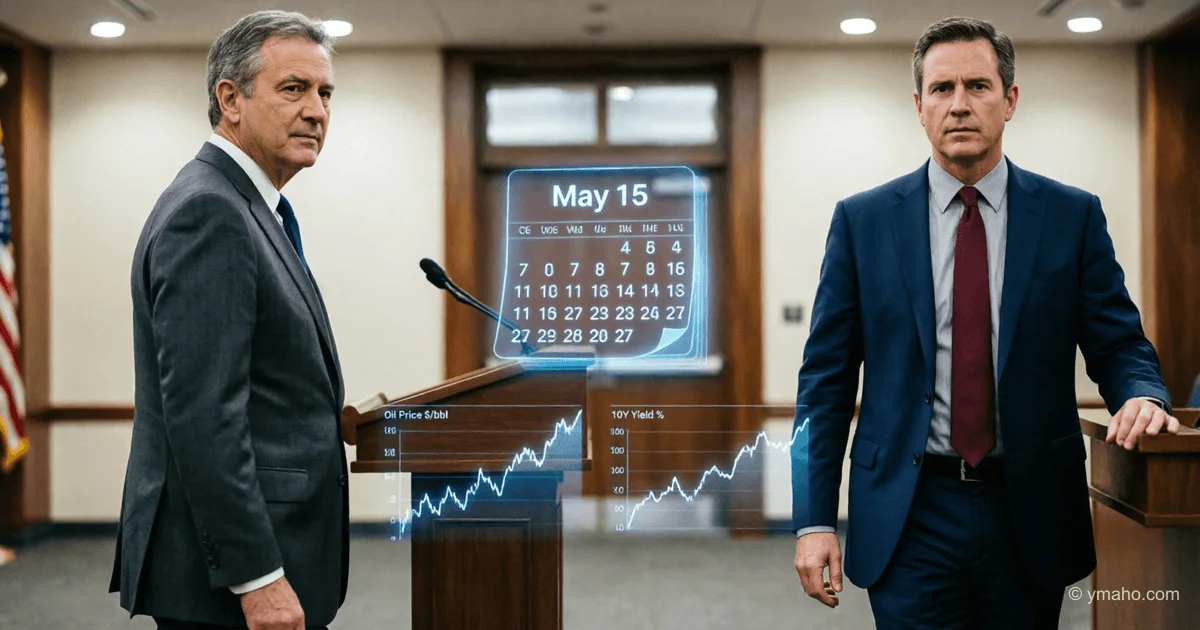
Powell's Final Press Conference: Fed Prepares for Leadership Change Amid Uncertainty
Jerome Powell held his last press conference as Fed Chair, as his term expires on May 15 and Kevin Warsh's nomination was approved by the Senate Banking Committee by a narrow margin. In its statement, the Fed noted that events in the Middle East are contributing to a high level of uncertainty in the economic outlook.
Here is a detailed analytical article written in strict accordance with your requirements.
Farewell to an Era: Powell's Last Press Conference and the Fed Power Transition Amid a Perfect Storm
Introduction
The Federal Reserve's meeting on April 28-29, 2026, became historic not so much for the rate decision but for its finale. Jerome Powell stepped before the press to hold his last press conference as chair of the U.S. central bank. His term expires on May 15, and the Senate Banking Committee has already greenlit Kevin Warsh's nomination, albeit by a razor-thin margin. In Powell's farewell remarks and the accompanying FOMC statement, a separate line emphasized that events in the Middle East are contributing to a "high level of uncertainty" in the economic outlook. This phrasing ties together the "Project Freedom" military operation, a record split in the Committee's vote, and a leadership change at a time when U.S. inflation has reached 3.3% and the stock market is simultaneously hitting all-time highs.
Event Details and Timeline
The timeline of events leading to this symbolic changing of the guard at the Fed spans several tense weeks. After March inflation data delivered an unpleasant surprise—CPI rising to 3.3% and core PCE to 3.2%, with a 21.2% spike in gasoline prices—markets began pricing in a longer period of high rates. Simultaneously, President Trump's "Project Freedom" operation in the Persian Gulf and Iran's retaliatory actions, including an IRGC ultimatum for civilian vessels to leave anchorages, triggered a logistics collapse whose cost to global trade is already estimated in the hundreds of millions of USD per week.
Against this backdrop, the April 28-29 FOMC meeting was supposed to be routine. Formally, the Committee met expectations by keeping the rate in the 3.50-3.75% range. However, behind the scenes, drama unfolded: four FOMC members voted against. One demanded immediate easing, while three wanted to remove any hints of future rate cuts. This split was the largest since 1992 and placed a heavy burden on Powell, who had to explain a position not backed by consensus within his own team.
The post-meeting press conference was conducted in a notably cautious tone. Powell, knowing this was his last appearance in this capacity, avoided sharp statements but specifically addressed the geopolitical factor. The direct reference to Middle East escalation clouding the economic outlook signaled that the central bank sees the conflict around the Strait of Hormuz not as a temporary disruption but as a structural risk capable of altering the trajectory of inflation and growth for a long time. Warsh's nomination, a former advocate of tighter price control, was approved by the Senate by a narrow margin, reflecting political polarization over the future course of monetary policy.
Impact and Significance
A change in Fed leadership is always a global event, but under current circumstances, its significance is magnified many times over. The power transfer occurs when the global economy faces a unique combination of factors: geopolitically driven inflation, disruption of critical sea lanes, and an AI technology boom that simultaneously drives stock indices higher and creates overheating risks in certain sectors.
For international financial markets, Powell's departure means a loss of predictability. However controversial his legacy, markets had grown accustomed to his communication style and understood the internal logic of his decisions. Warsh's arrival, whose economic views diverge in some aspects from his predecessor's course, creates an adjustment period during which volatility is virtually guaranteed. The yield on 10-year Treasury notes, already risen to 4.39%, could continue to climb if the new chair signals a more aggressive fight against inflation at the expense of economic slowdown.
The cost of servicing U.S. government debt becomes a critical factor. At current yields, each additional basis point means billions of USD in extra federal budget outlays for interest payments. If Warsh takes a hawkish stance and rates stay higher for longer than expected, the fiscal space for new government spending will shrink, inevitably affecting funding for social programs and the defense budget, including operations like "Project Freedom."
For businesses, uncertainty about the Fed's course translates into freezing investment decisions. Large corporations, whose financial models require predictable capital costs, are postponing multi-billion-dollar projects. Small businesses, reliant on credit availability, face higher borrowing costs and tighter bank lending conditions. Additional logistics costs of $4,500-5,500 per container on Persian Gulf detour routes only add to corporate budget pressures.
Reactions of Key Players
Reactions to the Fed leadership change are distinctly political. The Trump administration publicly welcomes Warsh's appointment, expecting the new chair to be more receptive to arguments for supporting economic growth through rate cuts. However, private White House concerns center on Warsh, known in the past for criticizing overly accommodative policy, possibly taking a more independent stance than expected.
Financial markets reacted paradoxically to the news of the imminent leadership change: the S&P 500 closed at an all-time high of 7,230.12 points, and the Nasdaq Composite reached 25,114.44 points. This optimism partly stems from a belief that any new chair will strive not to crash markets in the first weeks of tenure. However, history shows that periods of Fed leadership change are often accompanied by significant corrections when illusions about the new leader's policies collide with reality.
The Fed's European counterparts—the ECB and the Bank of England—are watching closely. Eurozone inflation has already reached 3.0%, and the ECB is signaling readiness to raise its rate from the current 2.15% in June. If Warsh takes a hawkish stance, it would give European central banks additional cover to tighten their own policies. Conversely, if the new Fed administration signals easing, European regulators would face a dilemma: they would have to fight inflation alone, risking an overly strong euro and harming exports.
Iran and other geopolitical opponents of the U.S. are also not standing aside. The Fed's statement about high uncertainty due to Middle East events effectively acknowledges that Tehran's actions in the Strait of Hormuz are inflicting economic damage on the United States. This could be perceived in Iran as confirmation of the effectiveness of its chosen asymmetric pressure tactics, which in turn increases the likelihood of further escalation.
Forecast and Conclusions
The upcoming May 15 transfer of power from Powell to Warsh marks more than just a personnel rotation at the top of American financial authority. It is a change of eras in monetary policy, occurring at a time when the very paradigm of managing the economy through interest rates is being severely tested. Inflation driven not by excess domestic demand but by geopolitical shocks and supply chain disruptions cannot be cured with traditional monetary tools. The new chair will have to operate in a world where raising rates cannot unlock the Strait of Hormuz or lower gasoline prices that have surged 21.2%.
The forecast for the coming months includes several scenarios. The baseline assumes Warsh will start with a cautious approach, keeping the rate at the current 3.50-3.75% range through the summer while assessing the effects of already implemented measures and developments in the Persian Gulf. A more hawkish scenario involves rapid tightening of rhetoric, leading to bond yields rising above 4.5% and a stock market correction. A dovish scenario, where Warsh yields to political pressure and begins cutting rates, seems least likely as it would contradict his previous public profile and immediately stoke inflation expectations.
The main takeaway from Powell's last press conference and the circumstances of the power transfer is that U.S. monetary policy is entering a zone of high turbulence. The outgoing chair leaves his successor an economy with rising inflation, slowing GDP growth at 2.0%, a record split in central bank leadership, and a full-blown logistics crisis in a key region for global energy. Kevin Warsh will have to not only manage interest rates but also rebuild confidence in the Fed's ability to control the situation. While stock indices at record highs pretend everything is fine, fundamental indicators paint a much more alarming picture. The farewell to the Powell era may turn out to be not a smooth handoff but the beginning of one of the most challenging periods in the history of modern monetary policy.
— Editorial Team









