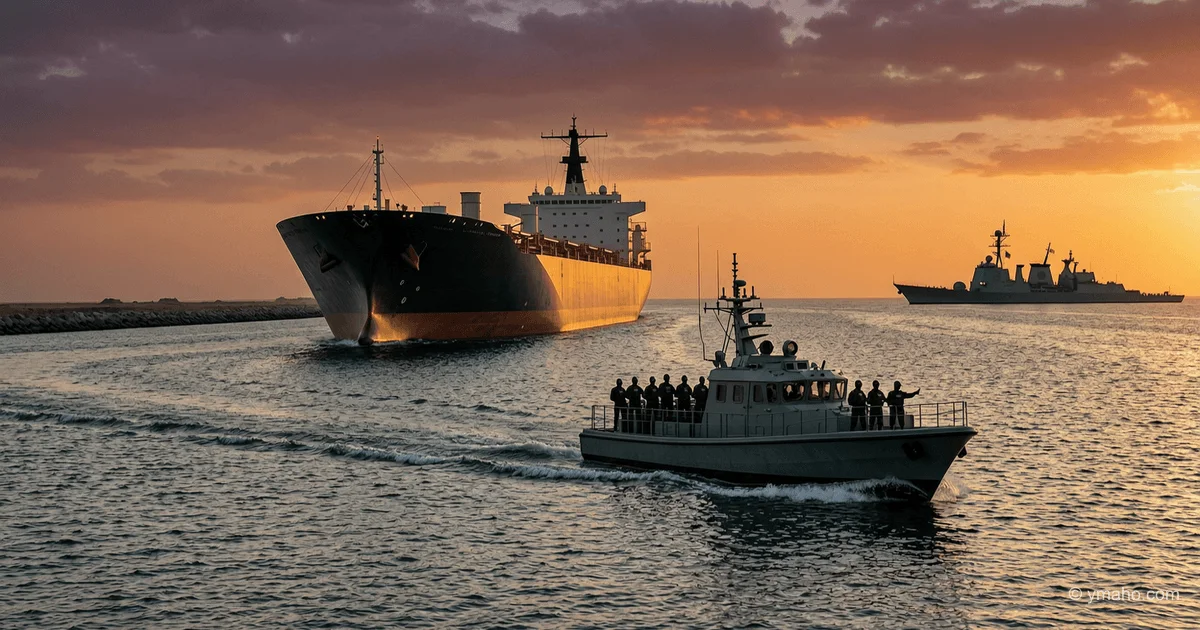
Progress in Nuclear Talks: IRGC Announces Readiness to Ensure Safe Passage of Ships Through the Strait of Hormuz
The IRGC has expressed readiness to restore safe navigation in the Strait of Hormuz after eliminating threats from 'aggressors.' The statement comes amid reports of US-Iran negotiations on a ceasefire memorandum and a moratorium on uranium enrichment.
Below is an analytical article written from the perspective of an insider closely working with the region and tracking the non-public mechanics of the US-Iran track.
A Preemptive Move: Why the IRGC's Statement on Strait of Hormuz Security Is Not Peace, but Preparation for a New Phase of Conflict
The Gist: What Is Really Happening
On May 5, 2026, the naval wing of the Islamic Revolutionary Guard Corps issued a statement that most Western and Asian media immediately headlined as 'de-escalation' and 'a step toward peace.' It concerns the IRGC's public readiness to guarantee safe passage for ships through the Strait of Hormuz. However, behind this wording lies not a goodwill gesture, but a demonstration of total control over a strategic checkpoint worth approximately $1.2 billion in daily oil and LNG transit. In reality, Tehran is not offering freedom of navigation—it is formalizing a monopoly on the logistics corridor in the context of the Americans' de facto lack of a military alternative.
'The elimination of threats from aggressors,' which the IRGC cites, is a euphemism meaning the neutralization of the escort routes that the Pentagon tried to establish under Operation 'Project Freedom.' And here begins the non-trivial part that most observers miss: the IRGC statement was not a Tehran initiative in a vacuum. It is a direct response to the fact that the Trump administration suspended the active phase of tanker escort but did not withdraw strike groups from the Persian Gulf. Iran perceived this not as a goodwill gesture, but as an attempt to take a pause without abandoning military presence.
Timeline and Context
To understand the moment we are in, we need to rewind events from late April 2026.
April 28–29 — Failure of the Geneva round of indirect US-Iran consultations through a Swiss mediator. The IRGC ordered commercial vessels to leave the Persian Gulf—an unprecedented audacious move that effectively paralyzed the southern export hub.
May 1–2 — The UAE suffers a series of kamikaze drone raids. Strikes hit ADNOC infrastructure in Jebel Ali and the port of Fujairah. Despite an official truce, at least 9 aerial targets were recorded over two days. Damage is estimated at over $340 million, including direct damage and temporary shipment suspensions.
May 3 — The Pentagon chief and the Chairman of the Joint Chiefs of Staff issue a joint press release confirming that the ceasefire regime remains in place. The wording is deliberately vague: 'remains in place' does not mean 'is being observed.' On the same day, Trump rejects the Iranian peace proposal, threatening to resume hostilities without even waiting for the consultations to end.
May 4 — Incident with a tanker under a South Korean flag. Iran claims the main target was a US warship in the Strait of Hormuz. The UAE insists an Emirati tanker was hit. Independent maritime traffic tracking records hits on both vessels 12 minutes apart. Likely a salvo launch with cross-targeting. The Pentagon does not comment on losses.
May 5 — The IRGC declares readiness to ensure safe passage, but only through its corridor. Simultaneously, the US administration officially suspends 'Project Freedom.' On the same day, markets see a sharp rise in risk appetite: Brent futures drop 7.3% intraday to $83.6 per barrel, Asian indices hit all-time highs.
And here we come to the main point. The market believed in de-escalation. But what the market interpreted as risk reduction is actually its transformation—from a hot military phase into a phase of asymmetric Iranian dominance.
Who Wins and Who Loses
The direct short-term beneficiary is Iran, specifically the IRGC and its logistics sector. Control over the Strait of Hormuz, even if informal, allows Tehran to decide whose tankers pass, in what volume, and at what insurance cost. Already, war risk premiums for vessels not escorted by Iranian forces have risen to 5–7% of cargo value, compared to 1.5–2% a month earlier. This means it is cheaper to agree to Iranian terms than to pay London underwriters.
Losing primarily is the Sunni Gulf bloc, especially the UAE and Saudi Arabia. Their export logistics become hostage to Iranian maneuvering. Riyadh finds itself in a humiliating position: oil continues to flow through the strait, but every vessel is de facto approved by Tehran. This undermines the sovereignty of the Gulf monarchies more than missile strikes, without a single shot fired.
The US loses strategically, even without an open military clash. The suspension of 'Project Freedom' without a formal agreement means the Pentagon failed to ensure freedom of navigation at the planet's key energy checkpoint. This sets a toxic precedent for all US security guarantees in the Indo-Pacific region. Taiwanese analysts are already closely studying the Hormuz case.
An unexpected winner is China. The tanker fleet under Chinese control (including Panamanian and Liberian flags but with Chinese beneficiaries) continues to pass through the strait without incidents. Beijing has no need to participate in the US operation; it negotiates directly. In effect, while Western carriers pay exorbitant insurance or avoid the route, Chinese imports proceed with a minimal discount.
What the Media Are Not Saying
The first and most acute point that is almost nowhere mentioned: the IRGC's statement does not mention oil tankers. The wording concerns 'all vessels,' which includes civilian container ships. The Strait of Hormuz is not only an oil artery; it is a key node for cargo from Asia to Europe bypassing Suez. Combined with the disruption in the Red Sea, ongoing since 2023–2024, control over Hormuz effectively closes the alternative 'corridor of instability,' leaving global trade without reliable southern routes.
The second untold story is technological. According to insider data from two independent tracking companies, the drones that struck targets on May 4 used an inertial-optical guidance system with correction based on coastal landmarks. This is not GPS guidance, which can be jammed. This means Iran has solved the problem of satellite signal suppression, and US electronic warfare assets in the region have lost significant effectiveness. Meanwhile, this aspect is not discussed in open reports—likely to avoid triggering panic in the maritime defense systems market.
The third point is financial. US sanctions mechanisms against Iranian oil formally remain in place, but three major commodity traders based in Geneva and Singapore have resumed chartering through Iranian intermediaries. The discount rate on Iranian oil has risen to $17–19 per barrel relative to Brent, making it incredibly attractive for independent refineries in India and China. In the absence of 'Project Freedom,' tracking these shipments becomes significantly harder for the US Navy. The IRGC's shadow fleet is growing.
Forecast: Next 30 Days and 90 Days
30 Days (until early June 2026)
Markets will continue for a while to trade the illusion of de-escalation, but the first incident on the Iranian corridor—and it is almost inevitable given the concentration of diverse vessels under one side's control—will send Brent back above $95 per barrel. The IRGC will methodically increase bureaucratic requirements for vessels, creating a two-tier system: 'verified partners' and everyone else. Formally, the strait is open to all; in practice, no one will pass without Tehran's coordination.
The Trump administration will find itself in a trap: resuming 'Project Freedom' means admitting the complete failure of the truce; not resuming it cements Iranian control over the strait. Most likely, within the next month, we will see targeted operations 'outside the strait zone'—attempts to intercept shadow tankers in the Arabian Sea. This creates a risk of new incidents but does not change the fundamental picture.
90 Days (until late July–early August 2026)
By the end of summer, Iran will legally formalize its corridor as a permanent regime, appealing to the need to ensure maritime safety. Bilateral agreements between Tehran and several Asian countries on passage guarantees are likely to emerge—this will de facto split the international consensus on isolating Iran. Japan and South Korea, caught between US pressure and the need to maintain energy supplies worth hundreds of millions of dollars per month, may opt for pragmatic arrangements.
For Europe, the consequences will be severe. If the Iranian corridor becomes the new norm, European refineries will face a permanent premium on Middle Eastern oil, adding 0.8–1.2 percentage points to eurozone inflation by the end of Q4 2026. Lagarde, having already acknowledged stagflationary trends, will have no tools to curb them—ECB monetary policy does not work against geopolitical control over a checkpoint. In this sense, Hormuz is not just a Middle Eastern issue; it is a macroeconomic factor that will weigh on Europe more heavily than Trump's tariff wars in 2025.
The main strategic outcome of the next three months: the world will shift from a model of 'militarized protection of sea lanes' to a model of 'diplomatically formalized control.' Iran, for decades the object of isolation, will become a subject dictating the terms of passage through the planet's most important energy hub. This is not peace. This is a fundamentally different type of confrontation, in which US Navy tools lose effectiveness while IRGC tools only gain it.
— Editorial Team









