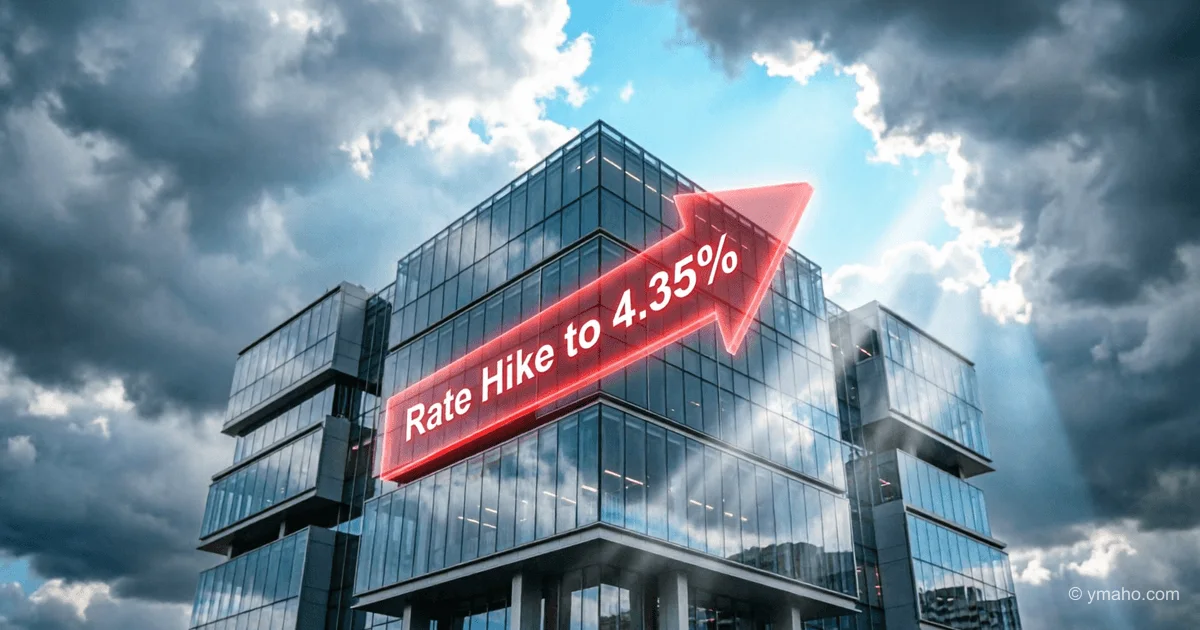
Market Expects Potential Rate Hike by Reserve Bank of Australia
At the upcoming RBA meeting, markets are pricing in an 83% probability of a third consecutive 25-basis-point rate hike to 4.35% amid persistent inflation and rising transport costs.
Rate on the Brink of a Nervous Breakdown: Why Australia Is Set for a Third Straight RBA Rate Hike
Introduction
On May 5, 2026, the Reserve Bank of Australia (RBA) will hold a meeting that risks becoming one of the most tense in the country's recent history. According to futures market data, traders are pricing in nearly an 80% probability that the regulator will decide on a third consecutive key interest rate hike—25 basis points, to 4.35%. If the forecast holds, it would mean Australia has finally abandoned hopes of a soft landing and entered a mode of aggressively suppressing inflation at the cost of slowing the economy. In this article, we break down what led to this turn, how it will affect ordinary Australians, and what signals global central banks will receive.
Event Details and Timeline
The current tightening cycle, which many analysts considered complete just a year ago, has resumed with unexpected force. After the RBA raised the rate from 3.60% to 3.85% in February 2026 and then to 4.10% in March, the market expects a third consecutive step. Thus, in just three months, borrowing costs in Australia could rise by 75 basis points. This completely reverses the cautious cuts undertaken by the regulator in the second half of 2025.
The key trigger for this sharp reversal was the March inflation data released on April 29. The annual consumer price index jumped to 4.6%—the highest level since September 2023 and nearly a full percentage point above February's 3.7%. Meanwhile, core inflation (trimmed mean inflation), which strips out volatile components, remained at 3.3%, still significantly above the RBA's target range of 2-3%.
The structure of price increases looks particularly alarming for the regulator. The largest contribution to inflation came from the transport component, which soared 8.9% year-on-year, with motor fuel alone rising 32.8% month-on-month. This is a direct consequence of the global energy crisis triggered by the blockade of the Strait of Hormuz. However, inflationary pressure is not limited to imported energy: housing rose 6.5%, and food and non-alcoholic beverages rose 3.1%. In other words, price pressures are spreading across the entire economy.
Impact and Significance
For Households: A Blow to Mortgage Holders
A rate hike would be a painful blow to approximately 3.6 million Australian families paying off mortgages. For a borrower with an average loan of AUD 600,000 (about $384,000), a 25-basis-point rate increase means an additional monthly payment of roughly AUD 100 (about $64). Given that this is the third consecutive hike, the cumulative increase in payments becomes quite substantial. Moreover, as Guardian Australia notes, many homeowners are bitterly asking how raising their mortgage costs can stop the rise in petrol prices caused by the war in the Middle East.
For the Currency Market: Australian Dollar on the Rise
The Australian dollar has become the best-performing currency of 2026—since the start of the year, the AUD index has risen 8.00%, while the nearest competitor shows only 2.40% gains. The AUD/USD pair is trading near 0.7215—the highest level in nearly four years. Commerzbank strategists note that the swap market is pricing in not only a rate hike on May 5 but also additional tightening of 64 basis points by the end of the year. This creates a powerful yield differential in favor of Australian assets.
However, a strong currency is a double-edged sword. It curbs import inflation but simultaneously reduces the competitiveness of Australian exports. For a country whose economy heavily depends on iron ore shipments to China (exports amount to about $118 billion per year), an expensive AUD means lower revenues for exporters.
For Global Monetary Policy
Australia finds itself at the forefront of a new global trend—a return to tightening after a short pause. Inflation in the country is now higher than in the US, the Eurozone, Japan, and the UK. If the RBA continues to raise rates, it could set an example for other central banks facing an energy shock. Conversely, if the regulator pauses after May 5, it would signal that even the most resolute central banks acknowledge the limits of monetary tools in combating supply-side inflation.
Reaction of Key Players
Analysts: Caution After the Surge
ANZ Bank, commenting on the prospects for the May 5 meeting, noted that while a rate hike is likely unavoidable, the wording of the accompanying statement will probably be softened. "We expect the language of the statement to be adjusted to open the door for an extended pause," ANZ analysts indicate, adding that their baseline scenario assumes the rate will remain at 4.35% for an extended period after the May hike.
OCBC holds a similar view: "After another rate hike, monetary policy will likely approach a level sufficient to contain inflationary pressures. This will allow the RBA to show more patience."
RBA Governor: Signals Without Commitments
RBA Governor Michele Bullock has not given clear promises about further steps but has consistently maintained a hawkish tone in public appearances. Economists interpret this as a deliberate strategy: to let the market know that the regulator will do whatever is necessary to return inflation to target, but avoid excessive commitments that could trigger panic or, conversely, excessive optimism.
The RBA's Monetary Policy Board, consisting of nine members, voted for the rate hike at the last meeting in March by a narrow margin—five to four. This indicates deep divisions within the regulator and makes the outcome of the May vote even more unpredictable.
Forecast and Conclusions
The most likely scenario is a 25-basis-point rate hike to 4.35%, followed by a prolonged pause. The market has already priced in this outcome, and a failure to hike would be a shock, potentially crashing the Australian dollar by 2-3% in a single session.
The key factor that will determine further dynamics is not so much the RBA's actions on May 5, but the developments around the Strait of Hormuz. If the US operation to escort ships proves successful and oil prices fall below $100 per barrel, inflationary pressure could ease on its own, giving the regulator a breather. If the conflict drags on, the RBA will face a painful choice: continue raising rates, risking a recession, or accept inflation above target.
In any case, Australia is becoming a kind of laboratory testing the main question of modern macroeconomics: can central banks handle inflation caused not by excess demand but by a geopolitical supply shock? We will begin to get the answer to this question on May 5.
— Editorial Team









