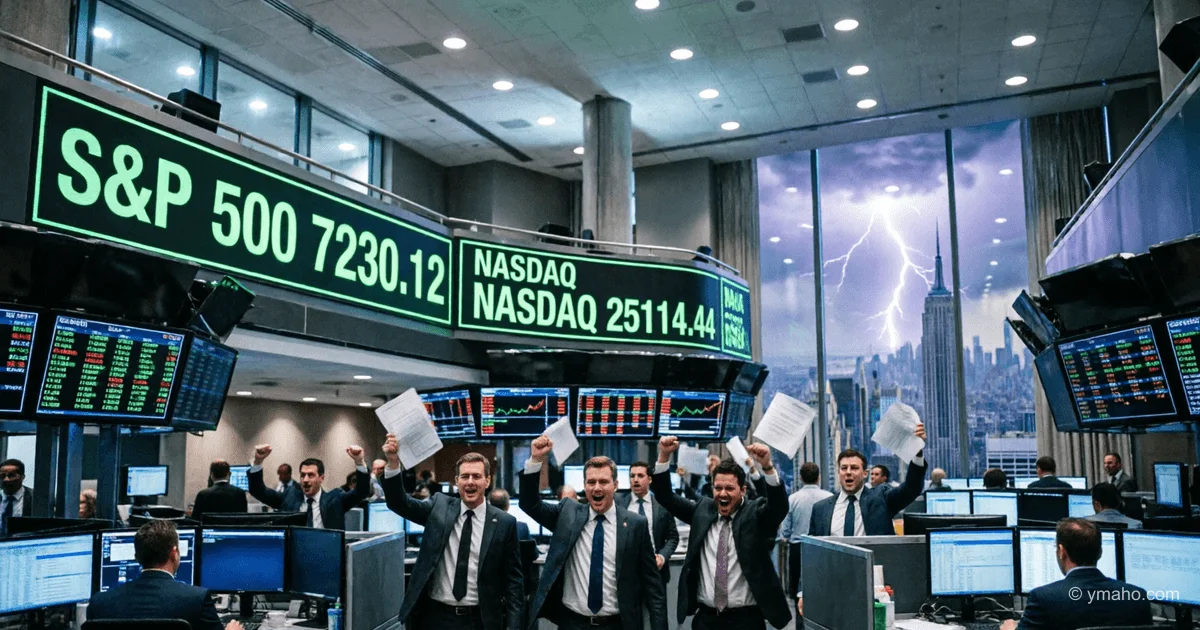
Stock Markets Hit New Records, Ignoring Fed Split and Middle East Instability
Despite uncertainty in Fed policy and a fragile ceasefire with Iran, the S&P 500 closed on Friday at 7,230.12, while the Nasdaq Composite reached an all-time high of 25,114.44 points. Meanwhile, the yield on 10-year U.S. Treasury notes rose to 4.39%.
Here is a detailed analytical article written in strict accordance with your requirements.
Rally on a Volcano: Why Stock Markets Hit Records While Bond Yields and Inflation Signal Danger
Introduction
In the early days of May 2026, global financial markets present a picture that can be described either as the greatest optimism in history or as unprecedented denial of reality. On Friday, May 2, the S&P 500 closed at an all-time high of 7,230.12 points, and the tech-heavy Nasdaq Composite soared to a previously unseen level of 25,114.44 points. These records were set under conditions typically considered toxic for risk assets: the U.S. core CPI reached 3.3%, core PCE settled at 3.2%, and the yield on ten-year Treasury notes rose to 4.39%. In addition, the Federal Reserve is experiencing its largest internal split since 1992, Operation "Project Freedom" in the Persian Gulf is teetering on the brink of military conflict with Iran, and the fragile ceasefire in the region could collapse at any moment. This disconnect between record stock indices and alarming fundamental indicators demands deep analysis.
Event Details and Timeline
The timeline of the market rally leading to historic highs seems to defy logic at first glance. In late April, the Federal Reserve concluded a two-day FOMC meeting where four committee members voted against the final decision to keep the rate in the 3.50-3.75% range. One dissenter demanded an immediate rate cut, fearing a recession, while the other three insisted on removing any hints of future easing from the statement. This split was the largest since 1992 and should have frightened investors accustomed to the central bank speaking with one voice.
Meanwhile, macroeconomic statistics painted an increasingly grim picture. CPI inflation in March jumped to 3.3% amid an explosive 21.2% rise in gasoline prices caused by the collapse of shipping in the Persian Gulf. The core PCE index, the Fed's preferred indicator, reached 3.2%. U.S. GDP growth in the first quarter slowed to 2.0%, missing the forecast of 2.3%. The yield on ten-year Treasury notes rose to 4.39%, signaling that the bond market is pricing in a longer period of high rates. Additional logistics costs, estimated at $4,500–$5,500 per container on alternative routes, promised further acceleration of inflation.
Despite all these factors, the S&P 500 soared to 7,230.12, and the Nasdaq Composite to 25,114.44. The key driver outweighing all risks was the tech giants benefiting from the ongoing AI boom. The market capitalization of the largest companies in the sector reached levels comparable to the GDP of entire nations. The capital inflow into AI stocks has taken on a character that some analysts already compare to the dot-com bubble, with the difference that the fundamental revenue of these companies is indeed growing, though not always keeping pace with valuations.
Impact and Significance
The simultaneous rise of both stock indices and Treasury yields is an anomaly worthy of special attention. Traditionally, rising yields on risk-free assets put pressure on stocks by increasing the discount rate for future cash flows and making bonds a more attractive alternative. The fact that markets are ignoring this mechanism points to a deep structural transformation. Investors apparently assume that the AI revolution will increase corporate profits so radically that any macroeconomic risks pale in comparison.
For the U.S. economy, this rally creates a dual situation. On one hand, stock market growth increases household wealth through retirement accounts and investment portfolios, supporting consumer spending. On the other hand, the detachment of financial assets from fundamentals creates a risk of a major correction that could destroy trillions of dollars of fictitious wealth in a matter of days. At the current S&P 500 capitalization of 7,230.12 points, a drop of just 10%—a routine correction by historical standards—would mean a loss of market value comparable to the annual GDP of many developed countries.
For global markets, the U.S. rally is a capital magnet. Investors worldwide, seeing record U.S. indices, shift funds into USD-denominated assets, weakening national currencies and creating additional pressure on emerging economies. European markets try to follow the U.S., but eurozone inflation at 3.0% and ECB signals of a possible rate hike in June dampen optimism.
The rise in the ten-year Treasury yield to 4.39% has independent significance for U.S. public finances. At the current level of national debt, each additional basis point of yield increases federal budget spending on debt service by billions of dollars annually. This narrows fiscal space for any new initiatives—from infrastructure projects to military operations such as "Project Freedom" in the Persian Gulf.
Key Players' Reactions
The Federal Reserve's reaction to the market rally is outwardly restrained. Jerome Powell, holding his last press conference as chairman, refrained from direct comments on market overheating but noted that events in the Middle East contribute to a high level of uncertainty in the economic outlook. This statement can be interpreted as a veiled warning to investors too caught up in the pursuit of returns. With Kevin Warsh taking over as chairman on May 15, rhetoric may change, and markets will have to adapt to a new communication style.
The Trump administration views the record indices as confirmation of the success of its economic policies, despite inflation and the logistics crisis. In public statements, White House representatives emphasize that the S&P 500 at 7,230.12 is the best proof of the U.S. economy's resilience in the face of external threats. Behind the scenes, however, according to informed sources, there is growing concern that any market correction will occur at the worst possible time—ahead of the midterm elections.
Major institutional investors are showing a split in their approaches. Pension funds, bound by fiduciary duties, are beginning to cautiously increase their share of Treasury bonds in portfolios, taking advantage of the 4.39% yield. Hedge funds, on the other hand, continue to build long positions in tech stocks, betting on the continuation of the AI boom. Retail investors, encouraged by record index levels, are also increasing their stock investments through ETFs, creating additional liquidity inflow that fuels the rally.
Commodity market players are reacting with rising gold prices, which, although retreating from absolute highs to around $4,599 per ounce, remain near historical peaks. This indicates that despite stock market optimism, a significant portion of capital continues to hedge geopolitical risks through safe-haven assets.
Forecast and Conclusions
The current situation, where stock indices hit records simultaneously with rising bond yields and deteriorating macroeconomic indicators, cannot persist indefinitely. Sooner or later, one market—either debt or equity—will be right in its assessment of prospects, and then a painful correction of the opposite asset will occur.
The most likely scenario is that in the second half of 2026, the tech sector will face the reality of high rates persisting longer than expected. If new Fed Chairman Kevin Warsh takes a hawkish stance and signals that rate cuts will not happen until inflation sustainably returns to 2%, the discount rate for future tech company profits will rise, and their current valuations will become harder to justify. A correction of the Nasdaq Composite from its current 25,114.44 points by 15-20% in such a scenario is not improbable and could lead to market capitalization losses measured in trillions of dollars.
An alternative scenario is that the AI sector will indeed generate enough real added value to justify even the current inflated valuations. In that case, the records of the S&P 500 and Nasdaq Composite would prove not to be a bubble but a justified anticipation of a new technological era. However, even in this optimistic scenario, geopolitical risks in the Persian Gulf do not disappear. An escalation of conflict with Iran, a breakdown of the fragile ceasefire, or a new round of blockade in the Strait of Hormuz could change investor sentiment overnight and crash markets regardless of the fundamental strength of the tech sector.
The main conclusion is that the record index levels in May 2026 reflect not so much the health of the economy as a structural disconnect between financial markets and the real sector. Investors are betting that technological progress will prove stronger than macroeconomic gravity, geopolitical risks, and monetary tightening. History of previous market cycles teaches that such bets rarely pay off in the long run. The rally on the volcano continues, but seismographs are already recording tremors of increasing strength. The question is not whether an eruption will occur, but how destructive it will be when the gap between market valuations and economic reality becomes unbearable.
— Editorial Team









