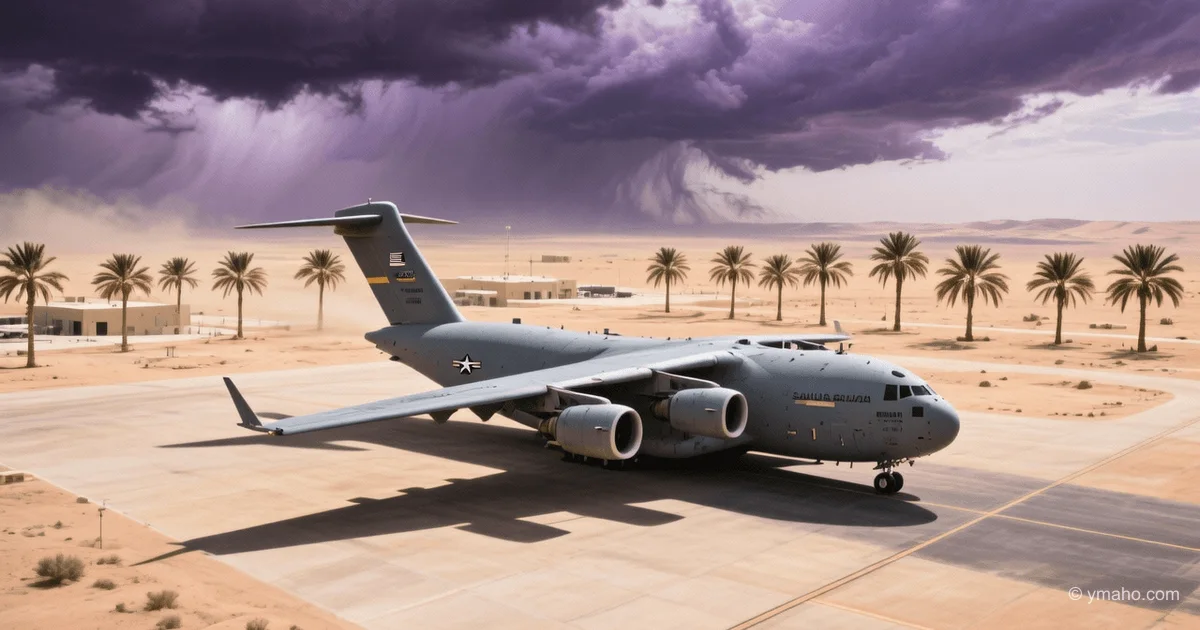
Saudi Arabia Closes Airspace to US Military Aviation
Riyadh's decision to block the use of its bases and airspace forced Washington to suspend the operation to unblock the Strait of Hormuz, affecting the course of negotiations.
Saudi Ultimatum: How Riyadh Rewrote the Rules of the Game in the Persian Gulf
The Gist: What's Really Happening
Saudi Arabia's decision to close its airspace and military bases to US aviation is not a technical pause or a bureaucratic misunderstanding. It is a deliberate act of defiance by America's closest ally in the Arab world, revealing a fundamental shift in the security architecture of the Persian Gulf. Riyadh effectively vetoed a US military operation, and it worked: Trump was forced to back down less than 36 hours after launching "Project Freedom."
The operation, which the Pentagon announced as a groundbreaking initiative to ensure freedom of navigation in the Strait of Hormuz, was paralyzed not by Iranian missiles or IRGC speedboats, but by a phone call from Riyadh. For the first time since US troops were stationed on its soil in 1990, Saudi Arabia used access to bases as leverage to directly pressure Washington—and achieved results. This is a precedent whose consequences will be felt for decades.
Timeline and Context
The chain of events unfolded rapidly. On May 3, Trump announced on his social media platform Truth Social the launch of "Project Freedom"—an operation to provide military escort for commercial tankers through the Strait of Hormuz. This was done without prior consultation with key regional allies. The Saudi leadership was not merely uninformed; it was presented with a fait accompli through a public statement, which in the diplomatic culture of the Middle East is regarded as an insult.
The reaction was immediate. Riyadh notified Washington that US military aircraft were prohibited from taking off from Prince Sultan Air Base, southeast of the capital, and from entering the kingdom's airspace to support the mission. This base is a key element of the US military presence in the region, housing fighter jets, tanker aircraft, and air defense systems, without which an air cover operation becomes virtually unfeasible.
A personal call from Trump to Crown Prince Mohammed bin Salman did not resolve the crisis. The Saudi crown prince, who until recently was considered one of the White House's most reliable partners in the region, did not yield. A day later, Trump announced the suspension of the operation, citing progress in negotiations with Iran—a diplomatic formulation that fooled no one.
By May 7, according to the Wall Street Journal, Saudi Arabia and Kuwait lifted the restrictions, and the Pentagon began preparing to resume the mission. But the political damage had already been done: the Saudi démarche demonstrated that even a 36-hour delay could completely alter the course of a military operation.
Who Wins and Who Loses
Saudi Arabia—strategic winner. With one decision, Riyadh achieved three goals. First, it forced Washington to consider Saudi interests, which differ from Israeli ones. Second, it protected its own territory from the risk of retaliatory Iranian strikes—Tehran had unequivocally warned that it would view US military escort as a violation of the truce, followed by attacks on bases in the Gulf. Third, the Saudi leadership strengthened its authority among Arab states as a force capable of saying "no" to Washington. Equally important is the hidden motive: Riyadh feared that escalation in Hormuz could provoke Yemeni Houthis to attack the Red Sea, jeopardizing the Saudi pipeline to Yanbu, which handles up to 50% of Saudi oil exports bypassing Hormuz.
USA—tactically humiliated, strategically forced to rethink alliances. For Washington, the incident demonstrated that even its closest allies are no longer willing to automatically support US military initiatives. The Pentagon lost operational tempo, and the White House lost face. Trump had to mask the retreat with rhetoric about diplomatic progress, but the reality is that a military superpower could not carry out an operation because its key ally simply refused.
Iran—unexpected beneficiary. Tehran did not have to do anything: the US operation was stopped by someone else's hand. Moreover, Iran immediately used the pause for a diplomatic maneuver. The Ports and Maritime Organization of Iran announced readiness to provide maritime, technical, and medical support to commercial vessels in the Strait of Hormuz—a gesture aimed at the international community to demonstrate that it is Iran, not the US, ensuring navigational safety.
Israel—biggest loser. For Netanyahu, the Saudi démarche was a catastrophic signal. Israel's strategy in recent years has been built on a tacit anti-Iranian alliance with moderate Arab states. Now Riyadh has effectively sided with diplomatic resolution with Tehran rather than military pressure. This shatters Israeli hopes for a united front against Iran.
Pakistan—shadow beneficiary. Islamabad, which acted as a mediator in ceasefire negotiations, gained additional leverage. Saudi Arabia publicly supported Pakistani mediation efforts, meaning Riyadh will advance its terms for a final settlement through Pakistan. For Prime Minister Shehbaz Sharif, whose country depends on $7 billion in annual Saudi financing, this strengthening of position is critically important.
What the Media Isn't Saying
Insight one: The Saudi-US conflict runs deeper than just a consultation issue.
The public version—"allies were not warned"—is only the tip of the iceberg. The real reason for the Saudi démarche is that "Project Freedom" was perceived in Riyadh as an operation with unpredictable consequences, capable of provoking a full-scale war with Iran on the territory of the Gulf states. Saudi intelligence assessed that the Iranian response would target not only US bases but also Saudi Aramco's oil infrastructure—meaning the kingdom would pay the main price for the US initiative.
Insight two: Trump's call to the crown prince contains a detail that is being hushed up.
Two US officials confirmed to NBC that Trump's conversation with bin Salman "did not resolve the problem." But what exactly was discussed? According to a source familiar with the conversation's content, Trump offered the crown prince security guarantees in exchange for restoring access. Bin Salman, in turn, demanded that any military operation in Hormuz be accompanied by written US commitments to protect Saudi facilities from retaliatory strikes—with specific timelines and compensation mechanisms for damages. The White House deemed such conditions excessive and preferred to suspend the operation rather than make unprecedented commitments.
Insight three: Kuwait supported the Saudi démarche but then backed down—a symptom of a rift in the GCC.
The fact that Kuwait lifted restrictions synchronously with Saudi Arabia indicates that the démarche was coordinated. However, the UAE, according to sources, initially took a tougher stance toward Iran and was disappointed by the Saudi decision. This creates a crack within the Gulf Cooperation Council that may become apparent in the coming months as the situation develops.
Insight four: Iran's diplomatic game around the Saudi démarche is masterful.
While Trump tried to negotiate with the Saudis, Iran, through Pakistani intermediaries, intensified contacts with Riyadh, offering guarantees of non-aggression against Saudi facilities in exchange for continued Saudi veto of US military operations. This is a classic Iranian "divide and conquer" tactic applied against the US-Saudi alliance—and this time it worked brilliantly.
Forecast: Next 30 Days and 90 Days
Next 30 days (until June 9):
Operation "Project Freedom" will be resumed, but in a significantly reduced format. The Pentagon, having learned a bitter lesson, will coordinate details with Riyadh in advance this time—meaning the scale and intensity of the mission will be limited by Saudi conditions. The resumption of the operation, which the Pentagon claimed was a matter of "this week," will likely occur in the form of demonstrative escorts of individual vessels rather than a full-fledged military operation.
Concurrently, diplomatic efforts will intensify. Saudi Arabia, having proven its ability to influence US decisions, will now insist on accelerating the negotiation process with Iran. Riyadh has no interest in prolonging the conflict: each extra day of the blockade costs the Saudi treasury approximately $310 million in lost oil revenues, despite high prices (part of Saudi oil simply cannot leave the Gulf).
90-day horizon (until August 9):
The Saudi démarche will have long-term consequences for the security architecture in the Gulf. First, the Pentagon will accelerate diversification of military infrastructure, reducing dependence on Saudi bases. This means additional funding for facilities in the UAE, Qatar, and possibly Oman. Second, within the GCC, disagreements will intensify between hardliners (UAE) and proponents of diplomatic resolution (Saudi Arabia and Kuwait).
For the oil market, the key consequence is this: the Saudi veto reduces the likelihood of full-scale military escalation in Hormuz and, consequently, lowers the risk of a price shock above $130 per barrel. However, it also prolongs the resolution of the crisis, as the diplomatic track takes time, and partial reopening of the strait could take weeks. Brent will remain in the $100-115 range with a downward trend if negotiations progress.
The main strategic takeaway: May 8, 2026, will go down in history as the day Saudi Arabia ceased to be a junior partner of the US and became an independent player capable of imposing its will on Washington in matters of war and peace. For American hegemony in the Persian Gulf, this is perhaps a more significant blow than all Iranian proxy operations combined.
— Editorial Team









