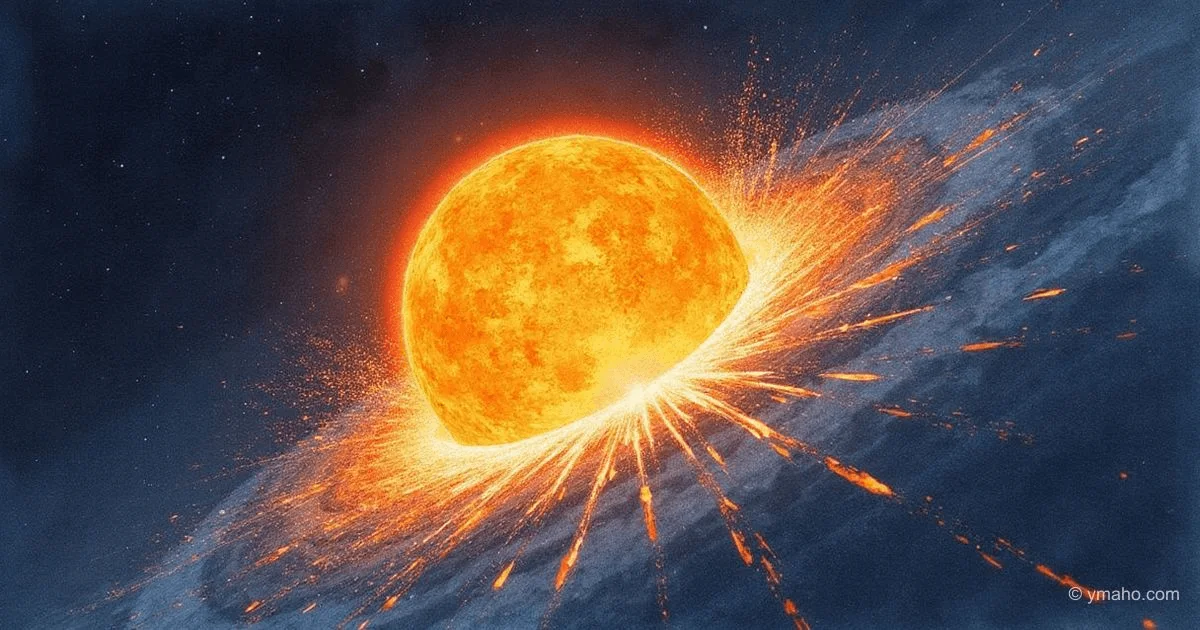
Solar Wind Blows Much Faster Near the Sun Than Scientists Thought
New images from a clever pair of satellites reveal that the so-called “slow” solar wind actually races away from the sun up to four times faster than expected—right where it begins. This discovery matters because solar wind shapes space weather, which can knock out satellites, disrupt GPS, and even cause power blackouts on Earth.
Why the Sun’s Invisible Breath Matters
Imagine the sun constantly exhaling a stream of tiny, electrically charged particles—like an invisible cosmic breeze. That’s the solar wind. It flows through our entire solar system, brushing past Earth and everything else in its path. When this wind gets especially strong or chaotic, it can interfere with technology we rely on every day.
Scientists have long known there are two types: a “fast” wind that zooms out from cooler, darker patches on the sun (called coronal holes), and a “slow” wind that trickles out from other areas near the sun’s surface. Until now, they thought the slow wind moved at about 60 miles per second. But new data shows it can blast off at speeds closer to 300 miles per second—almost as fast as the so-called fast wind.
A Clever Trick to See the Unseeable
Studying the sun’s outer atmosphere—the corona—is incredibly hard. The sun’s bright face drowns out everything around it, like trying to see a candle flame next to a spotlight. For decades, scientists could only get clear views during total solar eclipses, when the moon perfectly blocks the sun’s disk. But those are rare and last just minutes.
Enter ESA’s Proba-3 mission: two small satellites flying in perfect formation, 150 meters apart. The front one acts like an artificial moon, casting a shadow on the back one, which takes pictures. Since launching in late 2024, this duo has created 57 “artificial eclipses,” giving researchers over 250 hours of uninterrupted footage of the inner corona—the birthplace of solar wind.
What the Images Revealed
In these high-resolution videos, scientists saw something surprising: gusts of slow solar wind accelerating far more quickly than models predicted. Instead of a gentle flow, the wind shot out in uneven bursts, like water sputtering from a garden hose with kinks.
This suggests the process that launches solar wind is more dynamic and turbulent near the sun’s surface than previously believed. The leading theory is that magnetic field lines on the sun snap and reconnect—a bit like rubber bands suddenly releasing—which flings particles outward. These new observations support that idea but also show the acceleration happens much closer to the surface and much faster.
Key findings include:
- Slow solar wind reaches speeds up to 300 miles per second (480 km/s) near the sun
- Acceleration begins within just a few thousand miles of the solar surface
- The flow is clumpy and irregular, not smooth
- Magnetic activity likely drives these sudden bursts
What Does This Mean for Regular People?
You don’t need to be an astronaut to care about solar wind. When powerful gusts hit Earth’s magnetic field, they can trigger beautiful auroras—but also disrupt radio signals, damage satellites, and overload power grids. Understanding how and where solar wind speeds up helps scientists build better forecasts, like weather reports for space. That means earlier warnings for airlines, satellite operators, and power companies—potentially avoiding costly outages.
Key Takeaways
- The “slow” solar wind near the sun moves up to 4× faster than scientists expected
- ESA’s Proba-3 mission used two satellites flying in formation to create artificial eclipses
- This revealed rapid, gusty acceleration in the inner corona—where solar wind begins
- Better understanding improves space weather forecasting, which protects technology on Earth
- The discovery challenges old models and opens new questions about the sun’s magnetic behavior
— Editorial Team









