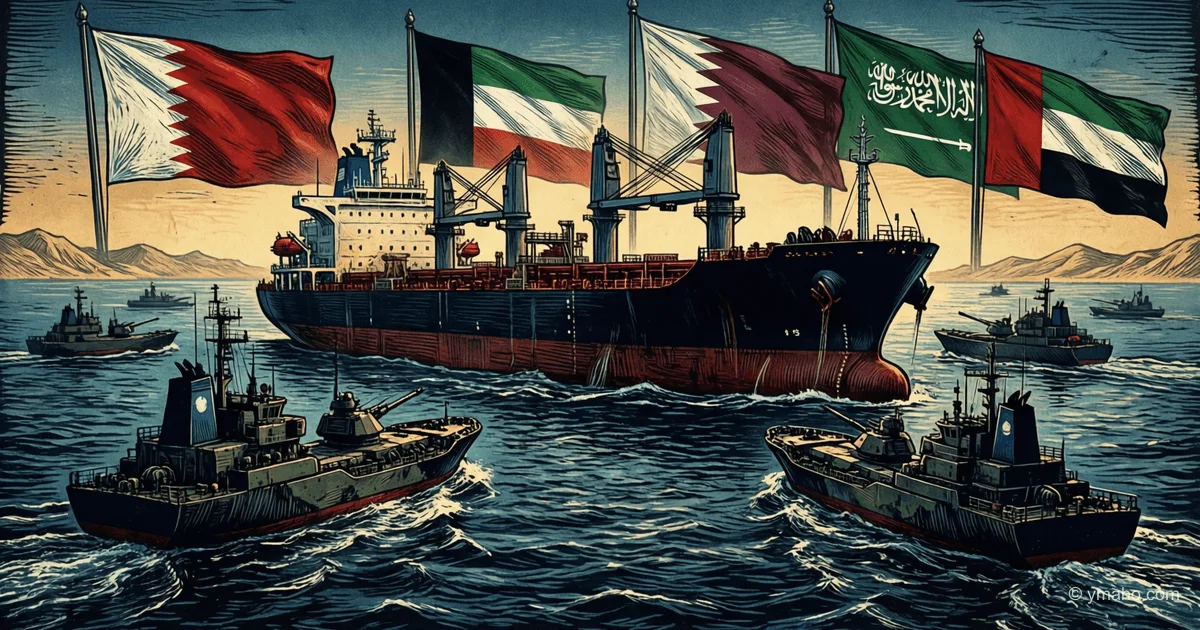
Gulf States Refuse to Recognize Iran's Control Over Hormuz
Bahrain, Kuwait, Qatar, Saudi Arabia, and the UAE sent a letter to the IMO, stating they do not recognize Iran's newly established Persian Gulf Control Authority, calling it an attempt to set a dangerous precedent.
Letter to the IMO: Why the Gulf States' Refusal to Recognize Iran's Control Over Hormuz Is Not Diplomacy, but Shipowner Panic
[The Core]: What Is Really Happening
Five Arab monarchies — Bahrain, Kuwait, Qatar, Saudi Arabia, and the UAE — sent a letter to the International Maritime Organization (IMO) refusing to recognize Iran's newly established Persian Gulf Control Authority (PGSA). At first glance, this appears to be a firm diplomatic stance. In reality, it is a cry of desperation.
As an analyst who sees the real flows of gray-tonnage and insurance premiums, I tell you: this letter is not about politics. It is about money. Specific sums. The point is that Iran already de facto controls the strait, and the Arab states cannot counter it. Their only weapon is a piece of paper at the IMO, while Iranian IRGC speedboats stop tankers and demand permits.
Notice what the headlines omit. Iran published a map showing the PGSA control zone encroaching on the territorial waters of the UAE and Oman. This is not a "disputed area." This is a blatant violation of the sovereignty of two states. The eastern boundary of the new Iranian zone runs from Kuh-e Mobarak in Iran to the south of Fujairah in the UAE; the western boundary runs from Qeshm Island to Umm al-Quwain. This is no longer "transit regulation" — it is annexation of foreign waters.
Timeline and Context
May 4, 2026 — Iran first announced the creation of PGSA and introduced an electronic application system for passage through the strait.
May 18, 2026 — PGSA officially began operations.
May 21, 2026 — Iran publishes a map with expanded boundaries extending into UAE and Omani waters.
May 22, 2026 — Five Gulf states send a letter to the IMO.
A key point that goes unnoticed: the boundary expansion on May 21 occurred after PGSA started operations. Iran did not just create a bureaucratic structure. It is methodically, step by step, expanding its control zone. The ISW analytical center stated outright: "This is a deliberate, phased expansion of territorial claims."
Non-obvious insight: In the letter from the five Gulf states, there is one phrase almost no one quotes, but it is the key. The states warn that recognizing PGSA would "create a dangerous precedent." What precedent? That any state controlling a narrow strait could at any moment impose a "transit fee" and regulation. Imagine if the Strait of Malacca (Malaysia, Indonesia, Singapore) or Gibraltar suddenly followed Iran's example. Global trade would collapse under the weight of exactions. That is what truly frightens the Arab monarchies, not just the loss of a few miles of territorial waters.
Who Wins and Who Loses
The direct loser is the UAE. The Iranian map includes waters directly opposite the emirate of Fujairah — a key port through which the UAE tries to bypass Hormuz. Insurance rates for shipping in the region have already risen 25-50% compared to February, but for vessels heading to Fujairah, the premium is even higher — up to 5-10% of hull value. For a tanker worth $100 million, that is $5-10 million per single passage.
The winner is China — and this is the third non-obvious beneficiary that goes unmentioned. As of now, according to sources, PGSA fees are paid only by vessels of the "shadow fleet" — predominantly those linked to China. No Western operator has publicly acknowledged making payments, fearing US secondary sanctions. Chinese companies, on the other hand, have gained the ability to trade Iranian oil, which no one else buys, at a 30-40% discount to market. Western losses from the strait blockade amount to about $435 million per day, as previously reported, but China is earning that money.
A quiet win — for the Lloyd's insurance sector and P&I clubs. Insurance premiums have risen from 0.15-0.25% of hull value to 5-10%. Major insurers — Gard, Skuld, NorthStandard, London P&I Club, American Club — canceled war risk coverage for Iranian waters and the Persian Gulf as early as March 5, 2026. Now any vessel transiting Hormuz either insures at new, vastly higher rates or goes uninsured. Both pay.
The biggest loser is Qatar. Nearly all of Qatar's liquefied natural gas exports pass through Hormuz. There is no alternative. Saudi Arabia can pump oil via the East-West pipeline with a capacity of up to 5 million barrels per day. The UAE has an oil pipeline to Fujairah that bypasses the strait. Qatar does not. Its LNG is trapped inside the Persian Gulf if the strait is not operational. That is why Qatar is so actively involved in negotiations — it loses the most in dollars per day.
What the Media Leaves Out
The main omission in all news is that the Gulf states' letter to the IMO has no legal force. The IMO cannot compel Iran to do anything. It is an international organization, not a military alliance. The only real mechanism is to bring the issue to the UN Security Council, but Russia and China have veto power there. And both countries have their own interests in Iran and are not keen on a tough resolution against Tehran.
Second omission: vessels are still obtaining permits from PGSA. As of March 2026, some tankers — including Thai vessels — have already passed through the strait after negotiations with Iranian authorities. Other vessels continue to await passage permits. In effect, the system is already working. The letter to the IMO is an attempt to stop what has already happened.
Third: The US cannot protect shipping in the strait without a ground operation. Military escort of convoys requires a constant carrier group presence, which Washington cannot sustain indefinitely. The USS Harry S. Truman aircraft carrier has been in the region since February, but its resources are not infinite. Iran knows this and is playing a war of attrition.
Forecast: Next 30 Days and 90 Days
30 days: Iran will not relinquish control of the strait. PGSA will continue operations. The five Gulf states will initiate discussions at the IMO, but with no real consequences. The US will increase its military presence, but this will only drive insurance premiums higher. Qatar and the UAE will begin secret negotiations with Tehran on "discounts" for their vessels' passage — for money, of course.
90 days: A "gentleman's agreement" will be reached between the US and Iran: US warships pass without permission (a strong signal), commercial vessels pass via PGSA applications. This effectively legalizes Iranian control. The passage fee for a tanker will be $200,000 - $500,000 per voyage. Insurance premiums will remain at 3-5% of hull value, establishing a new normal. The maritime trade world will get used to the "Hormuz tax" as a fact of life.
Editorial Forecast
Asset and direction: Insurance futures on the Lloyd's Maritime Index (short-term rise).
The letter from the five Gulf states to the IMO signals that a diplomatic solution to the strait control issue is absent. This means continued elevated insurance premiums at 3-5% of vessel value per voyage over the next 48-72 hours.
Key benchmarks: Current war risk premium spread — 4.2% of hull value for VLCC-class vessels, expected to rise to 5-6%.
Confidence level: High (75%). Iran expanded its territorial claims on May 21, the Gulf states responded on May 22, and there are no signs of de-escalation.
Main risk to the forecast: A sudden announcement of a breakthrough in US-Iran negotiations under a formula of "partial recognition of PGSA in exchange for unfreezing Iranian assets." If this happens within the next 24 hours, insurance premiums could adjust downward by 30-40%, compressing the spread to 2-3%.
— Editorial Team









