Fed Holds Rate, Signals Possible Hike by Year-End
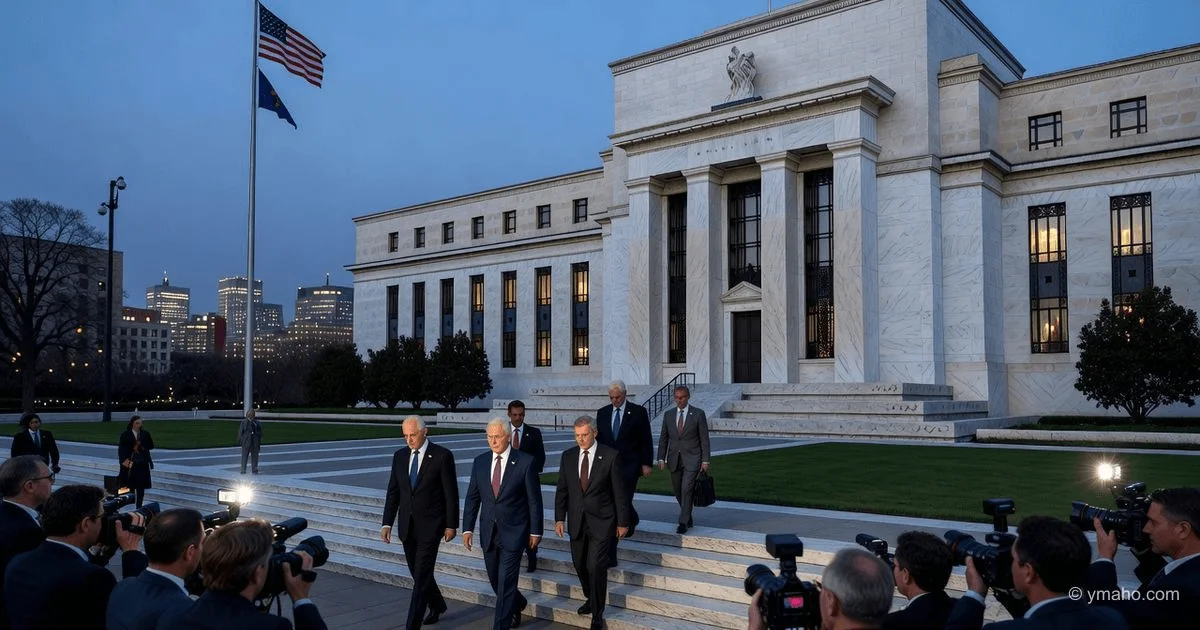
At the first meeting chaired by Kevin Warsh, the Fed kept the rate at 3.50%-3.75% but removed the signal of future cuts from its statement. New projections showed that nine officials expect at least one hike by the end of 2026 due to inflation, which is estimated to rise to 3.6%.
The Warsh Era: Fed Flips Dot Plot 180 Degrees, Markets Haven't Grasped the Scale
Key insight markets are missing: The June FOMC meeting was not just a "hawkish pause" but a fundamental break from the Powell era. In his first meeting, Kevin Warsh not only held the rate but demonstratively removed the dovish bias from the statement and stopped participating in the dot plot, delegating forecasts to the committee. Markets fixated on the 3.8% year-end figure but missed the main point: the Fed has returned to the Greenspan era, where communication matters more than actions, and policy predictability is deliberately undermined. Warsh gives markets fewer guideposts to stop them from speculating on "pauses" and start hedging real risks. This changes everything.
The Core: What's Really Happening
The Federal Reserve, at its June 16–17, 2026 meeting, left the key rate in the 3.50%–3.75% range for the fourth consecutive time. Formally, this is a "hold." But the substance of what happened is radically different from previous meetings, and it's not just a change of chair.
First, the committee voted unanimously (12-0) to hold the rate. The absence of dissenters is an event in itself, given that at the March meeting four members dissented, with three of them demanding the removal of the signal about future rate cuts. Warsh received a blank check from the committee at his first meeting, indicating a high degree of trust or that his predecessor Jerome Powell had already done all the "dirty work" of tightening the tone.
Second, and most importantly, the Fed removed from its statement the wording signaling an easing bias, specifically the word "additional" regarding future adjustments. In practice, this means there is no longer an implied promise that the committee's next move will be a rate cut. Now the next move could be either a hike or a cut—and this fundamentally changes market psychology. For eight months, markets lived with the certainty that the Fed was only waiting for the right moment to ease. That certainty is now gone.
Third, the dot plot delivered a surprise that markets had priced in with only 66% probability. The median rate forecast for end-2026 jumped to 3.8% from March's 3.4%. With the current range at 3.50%–3.75%, this implies the committee expects at least one 25 bps hike by year-end.
But the most interesting part is not the number but the vote distribution. Of the 18 officials who submitted forecasts, exactly 9 see the need for a rate hike by year-end, and 9 do not. Among the hike supporters: three expect +25 bps, five expect +50 bps, and one expects +75 bps. Chair Warsh declined to participate in the dot plot, citing his long-held belief that he does not believe in "formal rate forecasting tied to economic data." This creates a unique dynamic: markets get a forecast from the committee but without a guide from the chair himself, which was previously unthinkable.
Timeline and Context
To understand how we got here, we need to look at the progression of events since late 2025.
In late 2025, the Fed conducted three consecutive 25 bps rate cuts, bringing the rate to the 3.50%–3.75% range where it has since stalled. These were classic "insurance" steps amid an economic slowdown. However, in 2026, the situation changed dramatically.
Key turning point—the Middle East conflict. Escalation in the region led to a sharp spike in energy prices, which immediately impacted US inflation indicators. The May Consumer Price Index (CPI) jumped to 4.2%—the highest level since 2023, driven primarily by the energy shock. The Fed was forced to acknowledge that inflation was not a "temporary phenomenon" but a persistent process fueled by geopolitics.
In response, the committee at the June meeting took the following actions:
| Date of Event | Fed Action | Consequences |
|---|---|---|
| Late 2025 (3 meetings) | Three 25 bps cuts | Rate at 3.50%–3.75% |
| March 2026 | Median forecast: 3.4% for end-2026 | Signal of 1 cut |
| May 22, 2026 | Kevin Warsh confirmed as Fed Chair | New course |
| June 2026 | Median forecast: 3.8% for end-2026 | Signal of 1–2 hikes |
| June 2026 | PCE forecast for 2026: 3.6% (was 2.7%) | Inflation settles above target |
At the same time, the Fed revised its GDP growth forecast for 2026 from 2.4% to 2.2%, while unemployment is expected at 4.3% (even below March's 4.4% forecast), indicating that the labor market remains strong and does not need support from rate cuts.
Who Wins and Who Loses
In this new reality, clear groups of winners and losers are emerging, not always in obvious ways.
Winners: Holders of US Treasury bonds, especially short-term ones. Yields on government securities become more attractive in an environment where the Fed signals "dear money" at least until 2028. Forecasts show the rate at 3.4% persisting into 2028, meaning investors can count on stable income without default risk. In times of uncertainty, this is a safe asset.
Winners: Institutional investors with access to complex derivatives for hedging interest rate risk. Warsh has created an environment where volatility in bond and rate futures markets will only increase, and professional traders thrive on volatility.
Losers: The stock market, especially the tech sector and high-risk companies with heavy debt loads. Inflation at 4.2% with a 3.5% rate means the real cost of borrowing remains negative, but a hike to 3.8% or 4.0% would make debt servicing significantly more expensive. Stocks trading on expectations of future profits will be revalued downward.
Losers: Cryptocurrencies. As long as the Fed keeps rates high and signals hikes, the opportunity cost of holding bitcoin rises. The yield on 10-year Treasuries remains attractive, and institutional investors choose guaranteed returns over speculative ones. Bitcoin's correlation with Treasury yields becomes sharply negative. This means the crypto market will remain under pressure from macroeconomic factors for the foreseeable future.
Losers: China and emerging markets. Dollar strengthening amid hawkish Fed rhetoric will lead to capital outflows from emerging markets, where debt is denominated in dollars. This is a classic "flight to quality" scenario that tightens financial conditions for developing economies.
What the Media Isn't Saying
The vast majority of headlines focus on the fact of "rate forecast hike" or "hawkish pivot." But three insights remain off-screen and explain why Warsh is doing this deliberately.
First: Warsh is deliberately destroying predictability to punish markets for speculation. During his confirmation hearings, he openly stated: "The Fed tells the world what its forecasts will be, and then it clings to those forecasts longer than it should." His refusal to participate in the dot plot and the removal of the easing bias from the statement are not just technical tweaks. They signal that the era of "forward guidance," where markets knew all the Fed's intentions in advance, is over. Warsh is forcing markets to stop reading tea leaves and start hedging real risks, rather than speculating on expectations. Gregory Daco of EY-Parthenon stated outright: "This may be the last time we see a dot plot."
Second: The committee is perfectly split—9 supporters of a hike versus 9 opponents. This is not just a "division" of opinions—it's a split that makes every future meeting unpredictable. Warsh got unanimous support in June, but ahead lies a tough battle. Three of the five members who favored a 50 bps hike could tip the scales at any moment. Investors accustomed to a "hawkish majority" or "dovish majority" under Powell will now face a situation where 9 votes "for" and 9 "against" mean that even one swing member decides the fate of the rate.
Third: The military conflict in the Middle East has become the main driver of forecast revisions. The Fed directly cites "energy price pressures related to the conflict." But the media misses an important detail: the Fed statement says that "economic activity is expanding at a solid pace despite elevated uncertainty, partly related to the conflict." Thus, the Fed acknowledges that an external geopolitical shock has completely altered the domestic economic picture. This is not "inflation expectations" but a real rise in energy prices that the Fed cannot ignore.
Forecast: Next 30 Days and 90 Days
Next 30 days (to mid-July): This is a period of "realization" by markets of the new realities. In the coming weeks, we will see a correction in stock and bond markets as investors shift from risky assets to safe havens. The probability of a 25 bps rate hike in July or September, in my estimation, is at least 40%, although markets currently price in only a 66% probability of one hike by year-end.
The June inflation report will be a critical point. If CPI again shows growth above 4.0%, the Fed will be forced to act, and a July hike will become almost inevitable. But even if inflation stabilizes, Warsh's rhetoric at the press conference will remain hawkish, and Treasury yields will continue to rise, pulling up mortgage and corporate loan rates. Markets will trade in a range but with a pronounced bearish bias. For traders, this is a time for short positions on the Nasdaq and buying short-term Treasuries.
Next 90 days (to September): This is the period when Warsh will begin to build a new communication system without the dot plot. Most likely, he will move to a "meeting-by-meeting" model, where key decisions are made based on fresh data. This means a significant increase in volatility before each meeting, as markets will lack long-term guidance. The committee will remain split 9-to-9, and everyone will watch the position of one moderate member who becomes the "kingmaker."
By the end of September, if energy prices remain high due to the Middle East conflict, the Fed will likely deliver one hike, and the rate will end up in the 3.75%–4.0% range. This will hit the housing market as mortgage rates exceed 7.5% and slow consumer spending. However, GDP will continue to grow, albeit more slowly (forecast 2.2% for 2026), preventing the Fed from easing policy before 2027. The US dollar will strengthen by 2-3% against a basket of currencies, posing an additional challenge for emerging markets.
Editorial Forecast
Asset: BTC/USD. Direction: Short-term decline with a possible bounce on news of a Middle East ceasefire, but the overall trend is bearish. Key levels: Nearest support at $58,000, resistance at $64,500. If geopolitical tensions worsen and 10-year Treasury yields rise, a break below support to $54,000 is possible. Confidence level: Medium (65%). Main risk: A sharp drop in oil prices due to a Middle East détente could reduce inflationary pressure and change the Fed's rhetoric, triggering a strong upward bounce. Watch Brent crude oil dynamics over the next 48 hours—it's the key indicator for the crypto market this week.
Disclaimer: The editorial opinion is not investment advice. Markets are highly volatile; always conduct your own research before making decisions.
— Editorial Team