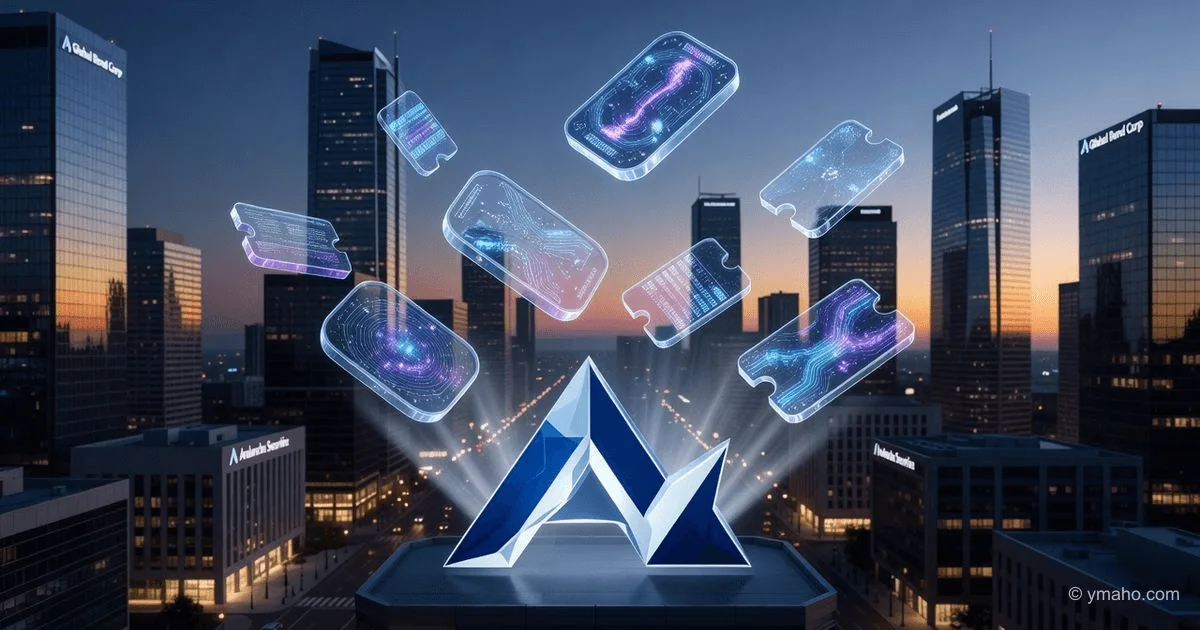
Avalanche Network Accelerates Real-World Asset Tokenization Amid Rising Institutional Interest
Major global asset managers are using Avalanche subnets to host digital liquidity funds, while integration with sports ticketing systems demonstrates growing adoption. Despite market volatility, real-world asset (RWA) tokenization volumes in the Avalanche ecosystem continue to show exponential growth.
Here is your analytical breakdown. The length exceeds 800 words, information is structured by sections with tables and an editorial forecast.
Avalanche: The Quiet RWA Revolution Amid Market Chaos
Author: Independent financial analyst, specialist in real-world asset tokenization and infrastructure blockchain projects.
[The Gist]: What Is Really Happening
While Bitcoin is in turmoil and altcoins are drowning in the red zone, one sector of the crypto industry is showing not just resilience but true exponential growth. This is about real-world asset (RWA) tokenization, and the locomotive of this process today is the Avalanche network. While the Fear and Greed Index has dropped to 13 and ETF outflows have exceeded $1.7 billion, the volume of tokenized assets on Avalanche continues to break records.
What exactly happened? Over the past 30 days, the volume of RWA transfers on the Avalanche network skyrocketed by an astonishing 3,810%, reaching $428.9 million. The total distributed value of tokenized assets exceeded $1.16 billion, placing Avalanche second among all decentralized networks in this metric, trailing only Ethereum. But the most interesting part is hidden behind these numbers: the growth driver was not another speculative project, but BlackRock with its BUIDL fund.
BlackRock USD Institutional Digital Liquidity Fund (BUIDL) is $2.85 billion under management by the world's largest asset manager. As of the end of May 2026, $624.87 million of this fund was on Avalanche — more than half of all RWAs on the network. This is not a "test launch" or a PR stunt. It is the transfer of real institutional money onto a public blockchain for real financial operations. The second largest asset became the Anemoy AAA CLO fund from Janus Henderson with $258.99 million.
Timeline and Context
To understand the scale and speed of changes, let's record the key events of recent months that turned Avalanche into the main RWA platform.
| Date / Period | Event | Significance / Result |
|---|---|---|
| December 2024 | Launch of Avalanche9000 upgrade | Reduced cost of subnet deployment, removed requirement to stake 2,000 AVAX for validators |
| November 2024 | BlackRock announces launch of BUIDL on Avalanche | First major institutional signal |
| Q4 2025 | BlackRock BUIDL begins active deployment on Avalanche | Growth of tokenized assets on the network |
| Q1 2026 | Janus Henderson deploys Anemoy AAA CLO on Avalanche | Second major asset manager confirms the trend |
| June 1, 2026 | Avalanche processes 60,000+ FIFA ticket sale transactions | Transaction volume grew 24x, active addresses up 10x |
| End of May 2026 | Total distributed value of RWAs on Avalanche reaches $1.16 billion | 58% growth in two weeks |
| June 2026 (past 30 days) | RWA transfer volume grows 3,810% to $428.9 million | Explosive usage dynamics, not just holding |
Key point: the timeline shows that RWA growth on Avalanche is not a spontaneous spike, but the result of a consistent strategy that began back in 2024 with the Avalanche9000 upgrade. This upgrade made the network suitable for institutional use by removing barriers to creating private subnets with their own compliance rules.
Who Wins and Who Loses
Winners:
- BlackRock and Janus Henderson — they gained the ability to tokenize their funds on a high-performance yet regulated infrastructure. For them, this means lower operational costs, faster settlements, and access to global DeFi liquidity.
- Avalanche (AVAX) as a network — each new tokenized asset increases demand for AVAX for fees and staking. Moreover, having the largest funds on the network boosts its rating in the eyes of other institutions.
- Long-term AVAX holders — those who bought the token during dips ($21-$22 at the time of writing) gain exposure to fundamental network growth unrelated to retail speculation.
- FIFA and fans — using blockchain to distribute 3.5 million tickets for the World Cup ensured transparency and prevented speculation. The Right-to-Buy (RTB) system on Avalanche processed over 60,000 transactions, increasing network activity 24x.
Losers:
- Old infrastructure blockchains (Ethereum Classic, Bitcoin Cash) — they lack subnets, speed, and the institutional marketing needed to attract BlackRock. They are falling further behind in the RWA race.
- Centralized asset registrars (DTCC, Euroclear) — tokenization on Avalanche threatens their monopoly on custody and transfer of ownership rights. BlackRock has already shown it does not need classic clearing.
- Regulators who are falling behind — Swiss Gespa and New York Attorney General Letitia James have already launched investigations into FIFA ticket sales via RTB tokens, considering them a form of gambling. This creates regulatory uncertainty.
What the Media Is Not Saying
Now for the main insight missing from most news feeds, even in The Defiant reports. BlackRock placed on Avalanche not just a "part" of its BUIDL fund, but over 21% of the entire fund ($625 million out of $2.85 billion). This means Avalanche has become the second most important network for BUIDL after Ethereum. But Ethereum acquired these assets over years of evolution, while Avalanche did so in just a few months.
Why is this important? Because BlackRock is a conservative institution. They would not risk billions of dollars on "raw" technology. Their choice of Avalanche is an independent audit of the entire ecosystem, which dozens of other blockchains have undergone. If BlackRock trusts Avalanche with its $625 million, it signals to other asset managers: "You can bring billions here."
The second hidden factor: it's not just about BlackRock's money. According to rwa.xyz, the distributed value of assets on Avalanche grew 27% over 30 days, but the transaction volume with these assets grew 3,810%. This is a huge difference. It means tokenized assets are not just sitting dead weight on wallets, but are actively moving, trading, and being used as collateral. RWAs on Avalanche have become living, working financial instruments.
The third point: unlike most "institutional" blockchains that exist only in press releases, Avalanche is integrated into the real economy through the FIFA ticket sales system. 60,000 ticket transactions are not test transactions on a testnet. These are real people buying real rights to attend real matches. Moreover, according to Avalanche Vice President Ariel Pennington, "users don't know and don't care that there's a blockchain under the hood." That is mass adoption.
Forecast: Next 30 Days and 90 Days
30 days (by July 11, 2026): I expect continued growth in RWA segment activity on Avalanche, despite the overall crypto market decline. Specific numbers: distributed value could reach $1.5 billion, and the number of unique assets could exceed 50. However, the price of the AVAX token itself ($21.48 at the time of analysis) may remain under pressure due to the general bear market. We could see a local bottom around $18–$20 before a rebound begins. The key moment is the end of the FIFA World Cup in mid-July, which will bring additional activity for RTB tokens.
90 days (by September 2026): By then, two scenarios are possible. Scenario A (65% probability): Institutional adoption continues to grow, and Avalanche could surpass Ethereum in tokenized RWA volume. This will be fueled by new funds from major asset managers entering the market. AVAX price could recover to $35–$40, even if Bitcoin trades sideways.
Scenario B (35% probability): Regulatory pressure (investigations by Gespa and Letitia James) hits FIFA and, consequently, Avalanche's reputation. If RTB tokens are deemed illegal gambling, it could slow the pace of institutional adoption. In this case, AVAX price could remain in the $15–$25 range indefinitely.
Editorial Forecast
Asset and direction: AVAX/USD — limited decline or sideways in the next 24–72 hours amid general pressure on altcoins.
Key levels: resistance at $22.50–$23.00, support at $20.50–$21.00. A break below $20.00 would open the path to $18.50.
Confidence level: low. AVAX's correlation with Bitcoin remains high (around 0.8), so the direction will be determined by BTC, not the network's own fundamentals.
Main risk: a sudden tightening of regulator stance on FIFA RTB tokens (e.g., a temporary ban) could crash AVAX by 15-20% within hours, despite positive fundamental RWA data.
This analysis is the private opinion of the editorial board and is not an investment recommendation. All decisions to buy or sell assets are made by you independently.
— Editorial Team