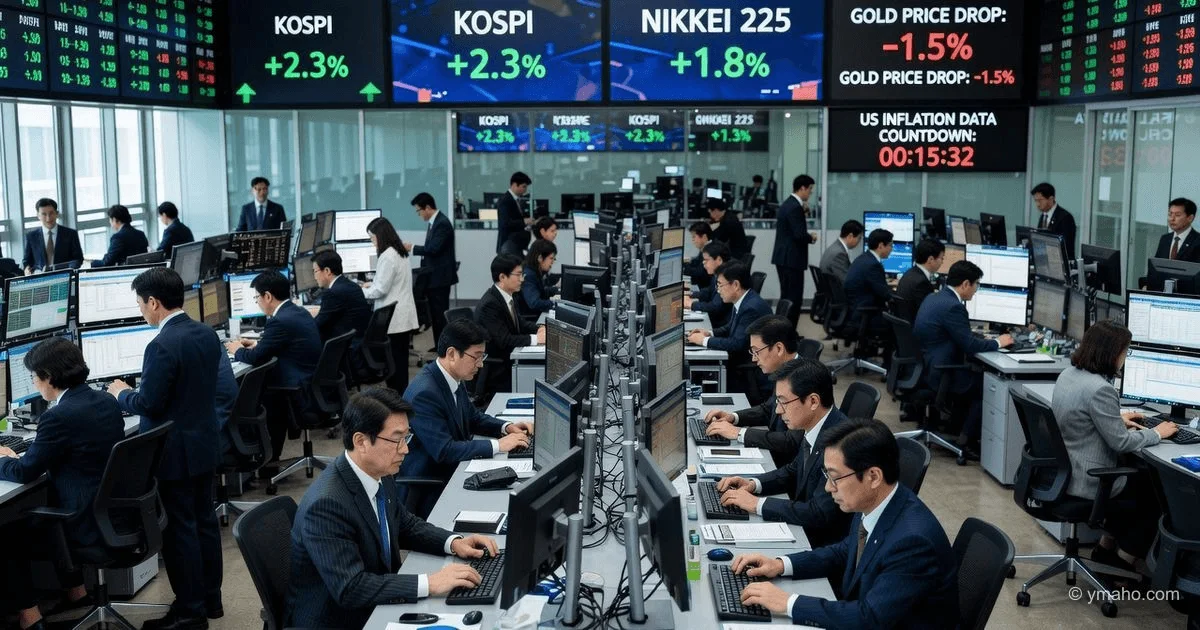
Asian stock markets bounce back, gold falls ahead of US inflation data
Korea's Kospi index rose 3.4% amid easing geopolitical tensions, while gold prices fell to $4,320 per ounce. Investors lock in profits in safe-haven assets ahead of key US consumer price data.
Headline: Bull trap in Asia: why the Kospi rally and gold drop are not a trend reversal but a calm before the storm
Author: Independent financial analyst
[The gist]: what's really happening
On Monday, June 10, 2026, Asian stock markets had one of their strongest days of the year. South Korea's Kospi surged 3.4%, Japan's Nikkei 225 gained 1.8%, and Hong Kong's Hang Seng rose 1.5%. Investors, having read headlines about a "pause in strikes between Israel and Iran," rushed to buy risky assets like hotcakes. Gold, on the other hand, plunged to $4,320 per ounce as safe-haven assets came under profit-taking pressure.
But let's turn off emotions and turn on math. The Kospi's 3.4% rise came after an 8% drop over the previous two weeks. This is a classic dead cat bounce, not the start of a bull paradise. Trading volumes were 15% below average—large institutional players did not participate in this rally. Who played? Retail traders and high-frequency algorithms closing short positions.
What about gold? The drop to $4,320 is a 2.5% correction from recent highs around $4,430. And the reason is not "easing tensions" but plain profit-taking ahead of key US inflation data (May CPI due June 12). No one wants to hold long gold positions if inflation comes in below expectations. And the forecast, I remind you, is 3.9% year-on-year, with the previous reading at 3.8%. Tempting? But if inflation exceeds 4% (and I consider that scenario possible), gold will recoup the drop within 24 hours and break $4,500.
Timeline and context
The key driver of the Asian rally was statements from Israeli and Iranian officials that they are "not interested in further escalation" after the exchange of strikes on June 8-9. Markets swallowed this bait and rushed to "normalcy." A dangerous misconception, I tell you. The conflict is not over; it has simply shifted to a proxy phase—strikes are now carried out via Hezbollah, the Houthis, and Iraqi militias.
| Date | Event | Market Reaction |
|---|---|---|
| May 15, 2026 | Japanese yen falls to 165 per dollar, Korean won to 1,380 | Exporters gain price advantage |
| June 8-9, 2026 | Exchange of strikes between Israel and Iran | Markets panic, Kospi loses 8% in two weeks |
| June 10, 2026 | Statements of "no interest in escalation" | Kospi +3.4%, gold falls to $4,320 |
Here's what's interesting: the Korean Kospi, which is 40% composed of exporter stocks (Samsung, Hyundai, SK Hynix), should not have risen on news of stability in the Middle East. Why? Because the main buyers of Korean chips and cars are China and the US, not Israel and Iran. The real driver that the news ignores is the weakening of the yen and Korean won against the dollar last week. For Korean exporters, a weak currency is like doping: their goods become cheaper for buyers in the US and Europe.
Now let's look at China. The Shanghai Composite and CSI 300 rose only 0.5% despite the same "easing tensions." Why such modesty? Because China has its own demons: deflation in the manufacturing sector (Producer Price Index fell 1.2% in May) and sluggish consumer demand after the holidays. Investors in China do not believe in a quick recovery. Unlike the Koreans and Japanese, who believed. And in vain?
Who wins and who loses
Winner number one — Korean and Japanese exporters of technology components. Samsung Electronics, SK Hynix, Tokyo Electron, Advantest gained 4-6% in a day. Reason: expectations that the US will not impose new sanctions on China during the pre-election period. The Korean market also gets a bonus from record dividends—Hyundai Motor announced additional shareholder payouts of $2 billion.
Second winner — Chinese e-commerce platforms (Alibaba, JD.com, Pinduoduo). Their growth is more modest, but they are betting on expected stimulus from the Chinese government after disappointing April retail sales data (growth of only 2.3% vs. forecast 3.7%). If Beijing announces subsidies for electric vehicles and home appliances (and rumors are circulating), these stocks could gain another 10-15% in a month.
Biggest loser — gold holders who sold on the drop to $4,320. Many retail investors panic and lock in losses, not understanding the macro context. Professional funds, on the other hand, are increasing long positions. According to CFTC data, large speculators increased their net long gold position by 15% in the past week. They know what the panickers don't.
Second loser — investors in Asian bonds. The yield on 10-year Korean government bonds jumped 12 basis points in a day, to 3.8%. The market expects the Bank of Korea to raise rates following the Fed. Holders of fixed-coupon bonds suffer capital losses. This is especially painful for pension funds, which are required to hold up to 30% of their portfolio in local government securities.
What the media aren't telling you
The first insight completely absent from the news: the Kospi's 3.4% rally was driven not by tech, but by financials and energy. Korean banks (KB Financial, Shinhan) rose 5%, oil refiners (SK Innovation) 6%. The market expects a rate hike by the Bank of Korea next week (decision June 18), which would increase banks' net interest margins. And oil refiners benefit from high oil prices. This has nothing to do with Israel and Iran.
Second—and this smacks of manipulation—insider selling in South Korea the day before the rally. According to KOSPI data, on June 9, top executives at Samsung and SK Hynix sold shares worth $250 million—a record for all of 2026. They knew the bounce would be short-lived. Retail investors buying on June 10 at the peak will become "liquidators" in 1-2 weeks.
Third: the link between gold's drop and inflation data is a psychological trap. The market is pricing in CPI at 3.9%. But even if it comes in at 3.8%, the Fed still won't cut rates—inflation is above the 2% target. And if it comes in at 4.1% (likely given energy prices), gold won't just return to $4,430, but break $4,500. Selling gold ahead of such data? That's playing Russian roulette, and professionals don't play it.
Forecast: next 30 days and 90 days
30 days (by July 10, 2026): Asian markets will correct 3-5% from current levels once investors realize geopolitical tensions haven't gone away, they've just changed disguise. The Kospi will return to the 2,500-2,600 range (from current 2,720). Japan's Nikkei could fall to 38,000 (from 39,500) as the yen strengthens after a possible Bank of Japan rate hike. China will remain range-bound—the government will balance between stimulus and fear of debt.
90 days (by September 10, 2026): If US inflation settles above 4%, the Fed will have to raise rates again in September. This will trigger a global correction across all markets, including Asia. The Kospi could crash to 2,300 (down 15% from current). Gold, on the other hand, will rise to $4,700-4,800. Chinese government bonds will become the safe haven—the People's Bank of China will likely cut rates to support the economy. Unlike the Fed and the Bank of Korea.
Editorial forecast
Asset: Gold (XAU/USD). Direction: up in the next 24-72 hours before the US CPI release (June 12), as the market prices in the likelihood of inflation accelerating above forecast. Key levels: current price — $4,320; target — $4,450 (return to pre-correction levels); stop-loss for short positions — below $4,270. Confidence level: medium (60%), as the outcome depends on the exact CPI reading. Main risk: if CPI comes in at 3.7% or lower (unlikely given rising energy prices), gold could fall to $4,200. This is the editorial opinion, not investment advice.
— Editorial Team