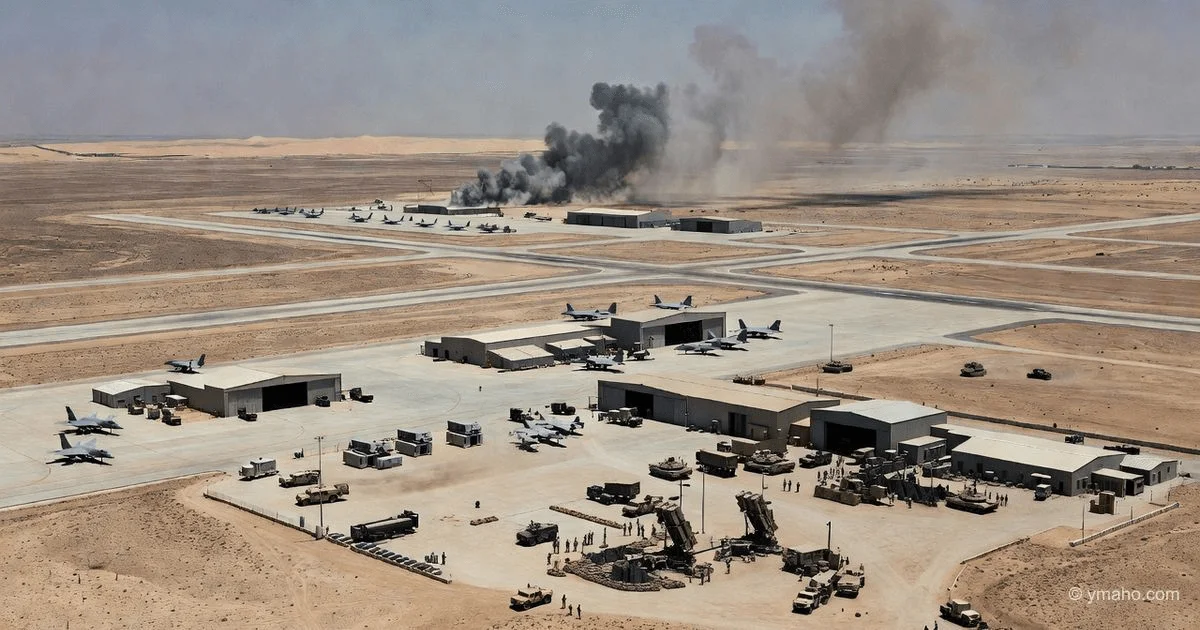
Iran's IRGC Strikes US Base in Jordan and Targets in the Persian Gulf
The Islamic Revolutionary Guard Corps claimed an attack on the US Air Force base Al-Azraq in Jordan using long-range missiles, as well as strikes on 21 targets, including bases in Kuwait and Bahrain. Iranian military officials called this retaliation for US strikes on air defense positions in the Strait of Hormuz.
Headline: Whose Escalation? The Balance of Power After the IRGC Strike on US Bases
Author: Independent Financial Analyst
[The Gist]: What's Really Happening
Headlines scream: "Iran attacked US bases in retaliation for the strike on air defense." Beautiful, dramatic — and that's just the tip of the iceberg, polished for mass consumption. The reality on the battlefield and behind closed doors at the Pentagon looks different. This isn't just escalation. It's more like the final act of testing air defense systems and political will, where neither side can afford to lose face, but both desperately want to avoid a full-scale war with unacceptable losses.
Officially, Iran is retaliating for US strikes on air defense positions in the Strait of Hormuz. But look at the timing. The US struck after an Iranian drone shot down a US Apache helicopter. That's the trigger. And here's a curious detail that gets lost in the news noise: Iran, through its controlled media, called the incident "unintentional." Tehran essentially threw Washington a lifeline: "Guys, we didn't mean to, it was an accident." But Trump, who desperately needs to look strong before the elections, struck anyway.
So the current IRGC attack on 21 targets is not so much a military necessity as a tough public spectacle. Judge for yourself: Jordanian air defenses shot down five missiles before they even reached their targets. The US reports intercepting "almost all" missiles and drones, claiming no casualties. Iran, in turn, claims to have destroyed F-35 hangars. Who to believe? Here's the thing: both sides are deadly interested in the narrative "we struck, but damage was minimal." Iran doesn't want a full-scale war with the NATO bloc; the US doesn't want to get bogged down in a ground operation a month before key elections. This, folks, is a war of narratives, not missiles.
Timeline and Context
The conflict has been simmering since April, when a shaky truce was reached after an initial exchange of strikes between the US, Israel, and Iran. But on June 8-9, 2026, there was a qualitative leap. Here's how events unfolded:
| Date | Event |
|---|---|
| June 8-9, 2026 | An Iranian kamikaze drone destroys a US Apache over the Strait of Hormuz. Pilots evacuated by a naval drone. |
| Next few hours | Trump says "the response must be very strong." |
| June 9-10, 2026 | CENTCOM strikes Iranian air defenses, control stations, and radars on Qeshm Island and in the port of Sirik. |
| June 10-11, 2026 | IRGC retaliates with strikes on 21 targets at US bases in Jordan, Kuwait, and Bahrain. |
A typical "counter-battery" response — destroying means of attack. Then things get interesting. Look at the results of the attack: Kuwait reports intercepting "hostile aerial targets," Bahrain sounds sirens, Jordan shoots down five missiles and collects debris. No reports of dozens of casualties, no video of burning F-35 hangars. Either the missiles were low-precision, or the targets were purely symbolic. And you know what? Both.
Who Wins and Who Loses
At first glance, the biggest loser is the oil market, which has already jumped to $94 per barrel for Brent. But dig deeper: there are more losers, and they're not on the battlefield.
The first and most obvious loser is the Trump administration, but with a twist. Trump publicly promised a peace deal with Iran "in two or three days." Instead, his administration is embroiled in an exchange of strikes. This undermines his "peacemaker" image a month before the November elections. Every new headline about an attack on a base in Kuwait loses votes among moderate voters.
The second loser is the small Gulf monarchies (Bahrain, Kuwait, Jordan). They are caught between a rock and a hard place. On their territory are US bases, which become legitimate targets for Iran. Their air defenses are working overtime. Their economies depend on stability. Iran is telling the US in plain language: "Leave our region if you want to be safe." But these countries can't "ask" the Americans to leave. The result: reputational losses (inability to protect their skies) and economic losses (decline in tourism and investment).
The main winner is China and Russia, even though they're not in the news. They watch as the US gets bogged down in an expensive proxy conflict. One Tomahawk missile costs $1.5-2 million — resources that could have gone to deterrence in the Pacific or Europe. For Beijing, this is great news: the US fleet is distracted by blocking the Strait of Hormuz, not patrolling the South China Sea.
What the Media Isn't Saying
The media writes about "retaliatory strikes," missing the technological war. Iran claims to have hit F-35 hangars at the Al-Azraq base. Fifth-generation stealth fighters are the most protected and valuable assets of the US Air Force. If Iran had actually destroyed or damaged an F-35, the Pentagon would have had to invade Iran to "save face." That's not happening. Why? The uncomfortable answer: maybe there was no strike on F-35s at all.
But what Iran did demonstrate is the ability to coordinate a massive missile launch across three different countries simultaneously. And most of the warheads still reached their targets despite air defenses. Patriot, THAAD, and Israeli Iron Dome systems are working at their limit. And here's the question: how much does this cost? Intercepting one Iranian missile costs $1-3 million (interceptor missile). The Iranian missile itself costs $100-200 thousand. See the difference? Iran is playing the economics of war, forcing the US to spend gold and foreign exchange reserves on protecting allies. This isn't discussed on TV news. But it should be.
The second omission is Israel's uncertain position. In the current attacks, Israel is not directly involved. But news from June 7 mentioned that Israel struck Hezbollah in Beirut, which triggered the previous round. A tough question: will Netanyahu step in for the US by launching a preemptive strike on Iran's nuclear facilities while the Americans "tie up" Iranian air defenses? This risk is silently ignored, even though it could blow up the entire Middle East in 48 hours.
Forecast: Next 30 Days and 90 Days
30 days (by July 10, 2026): A tactical pause will set in. The US will regroup forces; Iran will assess damage. We'll see increased diplomatic activity through intermediaries (Oman, Qatar) — an attempt to return to negotiations. Oil prices will stabilize in the $88-92 range once the market realizes that supplies from Saudi Arabia and the UAE are not physically disrupted. However, the risk of a sudden attack on tankers will persist, keeping insurance premiums high.
90 days (by September 10, 2026): If Republicans use the conflict as an election tool, Trump may go for unprecedented escalation in August, trying to secure a "victory" before the elections. Options: cyberattacks on Iran's oil exchange or a limited strike on the Abadan refinery. Iran's response will be asymmetric — a massive attack on Saudi oil infrastructure through Houthi proxies. In this scenario, Brent will break $120, and global stock markets will enter a 10-15% correction due to stagflation fears. Gold will rise above $2600.
Editorial Forecast
| Asset | Direction | Key Level | Confidence Level | Main Risk |
|---|---|---|---|---|
| Brent Oil (XBR/USD) | Sideways with increased volatility in the next 24-72 hours, likely pullback from $91-92 | Resistance: $94.5; Support: $89.0 | Medium (55%) | Fake news about a US ship or tanker being sunk on social media — could spike the price $5-7 upward, creating a panic spread that will retrace just as quickly |
This is the editorial opinion, not investment advice.
— Editorial Team