South Korean Police Raid Bithumb Exchange on Suspicion of Lobbying
Law enforcement is investigating ties between lawmaker Kim Byung-gi, who allegedly used his influence to get his son a job at Bithumb and Dunamu (operator of Upbit). The exchange is already under pressure after a recent $24.5 million fine.
Bithumb Raid: Political Scandal as a Trigger for Reshaping South Korea's Crypto Market
Author's Analytical Review
[The Core]: What's Really Happening
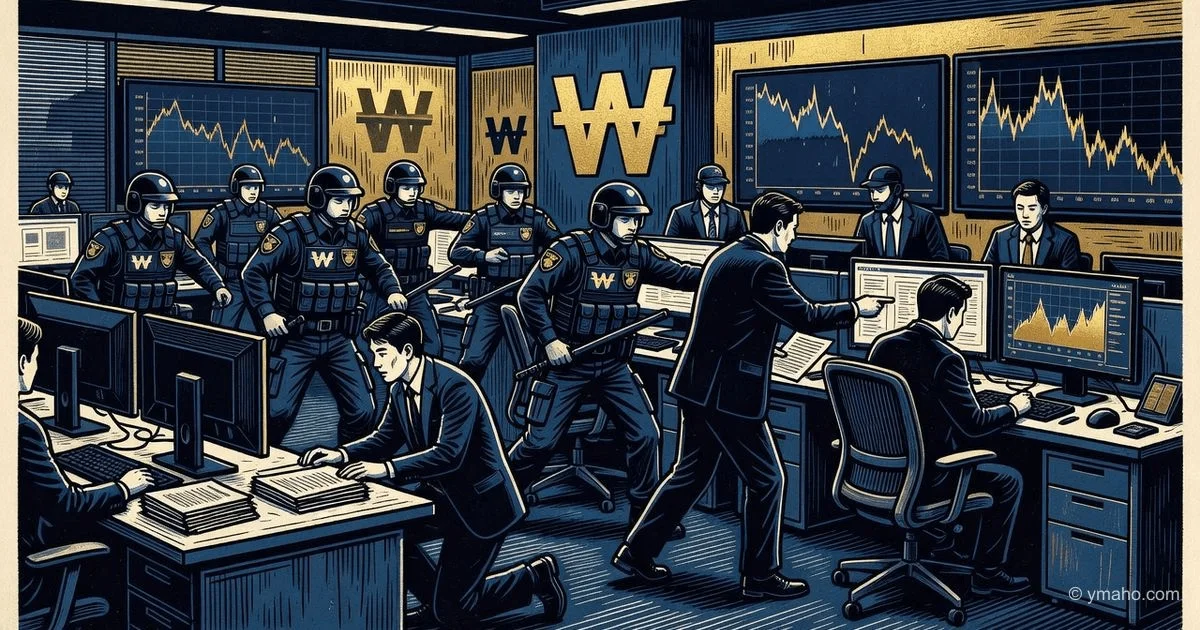
Headlines about a "police raid on Bithumb over a lawmaker's son's employment" are just the tip of the iceberg. The real story is a struggle for control over the world's second-largest crypto market after regulators dealt Bithumb a devastating blow. When Seoul police entered Bithumb's headquarters in Gangnam for the second time in four months on June 9, 2026, they weren't just looking for evidence of nepotism. This is about a systemic attempt to uncover how political power is converted into corporate privileges in an industry that is formally under strict oversight. And you know what? Such schemes have worked for decades—until someone goes too far.
Let's look at the timeline and key players. Lawmaker Kim Byung-gi, an independent parliamentarian, sits on the National Assembly's Political Affairs Committee, which directly oversees South Korea's financial regulator. His son was hired at Bithumb in January 2025 and worked for about six months. Meanwhile, Kim systematically sent parliamentary inquiries to Dunamu, operator of rival exchange Upbit. Prosecutors are now checking: was this pressure, or a signal of "support" in exchange for employment? The list of suspicions in Kim's case already includes 13 counts—from receiving bribes for nominations to illegally facilitating his son's transfer to another university.
But there's a deeper layer. Bithumb is trying to appeal a record $24.6 million fine and a six-month partial ban on serving new clients, imposed in March. The court case is running parallel to the criminal investigation. So the exchange is literally fighting for survival on two fronts—legal and regulatory. In such a situation, any negative signal, like a new raid, reduces its chances of a lighter penalty. The market feels this.
Timeline and Context
The critical moment came on June 9, 2026, when investigators from the Seoul Metropolitan Police's Public Crime Investigation Division arrived at Bithumb's Gangnam office in the morning. This was the second wave of raids: the first took place on February 24, 2026. Between these events, in April, witnesses from the exchange were again called for questioning, and lawmaker Kim gave testimony for the seventh time in nine months. Seven times—that's no longer "cooperation" but a full-fledged interrogation under scrutiny.
A few days before the new raid, on June 5, technical news emerged: Bithumb announced it would suspend deposits and withdrawals of Cosmos (ATOM) from June 10 due to a network upgrade. A routine procedure? Yes. But in a crisis of confidence, even such announcements can trigger a liquidity outflow.
At the same time, in early June 2026, the crypto market experienced a general cooldown: Bitcoin fell from $80,000 in early May to around $60,000, causing a massive "dump" of open interest in futures. In such an environment, any negative news about a specific exchange amplifies panic—like gasoline poured on smoldering embers.
It's important to understand the background: On March 15, 2026, South Korea's Financial Intelligence Unit (FIU) imposed a fine of 36.8 billion won (about $24.6 million) on Bithumb and banned new clients from withdrawing crypto to external wallets for six months. The reason: 6.65 million violations of AML/CFT (Anti-Money Laundering/Countering the Financing of Terrorism) rules, including 45,772 transactions with 18 unregistered crypto services. The exchange filed a lawsuit, and in late April 2026, the court suspended the ban pending a final decision. However, the investigation into the violations continues.
In short: the June 9 raid is an attempt by police to gather additional evidence in a criminal corruption case, which could later be used in the regulatory process against the exchange. Convenient, isn't it?
Who Wins and Who Loses
| Player | Market Share | Status | Key Factor |
|---|---|---|---|
| Upbit | 63–80% | Main Beneficiary | Capital inflow from traders fleeing Bithumb |
| Bithumb | 15–20% | In the "Red Zone" | Risk of losing license and banking partner |
| Coinone | ~5% | "Clean" Player | Potential growth from institutional investors |
Winners: Upbit already controls 63-80% of the South Korean market, depending on the calculation method, leaving Bithumb with only 15-20%. Each new scandal around Bithumb means migration of traders and capital to a more stable platform. And since the South Korean market is one of the few where the "kimchi premium" (price difference of cryptocurrencies relative to global markets) persists, Upbit gets an additional liquidity boost. The second winner is Coinone. It has only about 5% of the market, but it is perceived as a "cleaner" player without major scandals. If Bithumb starts losing its license, Coinone could become a third force, especially attracting institutional clients who need flawless compliance. The third winner is international arbitrageurs. Instability at Bithumb can create temporary price anomalies between the Korean won and the dollar. Professional traders don't miss such opportunities.
Losers: Bithumb and its shareholders. The exchange is already in the "red zone." Even if the court overturns the fine, the reputational damage from a second raid in four months is done. In conservative South Korean culture, ties to corruption are a stain for years. Moreover, the list of suspects includes not only the lawmaker but also Bithumb's top management, who were called for questioning back in February. The second loser is holders of altcoins actively traded on Bithumb. Korean traders are known for their appetite for high-risk altcoins. If the exchange starts experiencing liquidity problems or imposes withdrawal limits, prices of these tokens on Bithumb could crash, triggering a cascade of liquidations. The third loser is lawmaker Kim Byung-gi himself. He faces criminal charges that could end his political career. If it is proven that he used his position to get his son a job, it will set a serious precedent.
What the Media Isn't Saying
The main non-obvious insight: Is the Bithumb scandal a planned attack or a "leak" from competitors? The story of the lawmaker's son's employment has been going on since 2024. Why now, on June 9, 2026, did the police conduct a second raid? The timing raises questions. It comes a few weeks before the court may issue a final decision on Bithumb's appeal of the fine. New compromising material in the media creates a negative backdrop that could influence judges. Additionally, Upbit, the main competitor, has enormous political influence and resources. Conspiracy theory? Possibly. But in South Korea's business environment, such scenarios are not uncommon—rather, they are routine.
The second hidden factor: impact on negotiations to acquire Korbit. The Korea Times reported that Mirae Asset Financial Group is in talks to buy the Korbit exchange. The success of this deal depends on the stability of the entire market. If Bithumb weakens, regulators may tighten requirements for all exchanges, including the potential buyer of Korbit. This could delay the deal or even force Mirae Asset to abandon the purchase—thus changing the entire balance of power.
The third insight: the real risk is not the raid itself, but a possible "freeze" of Bithumb's accounts in Korean banks. South Korean exchanges are required to use real bank accounts in the client's name for fiat transactions. If Bithumb's partner bank (NongHyup Bank or similar) decides to terminate the contract amid the corruption scandal, the exchange will lose the ability to conduct won operations. That would be fatal. This is the regulator's "nuclear" weapon. But the media is silent about it, focusing on police reports.
Forecast: Next 30 Days and 90 Days
Next 30 days (until mid-July): Expect high volatility on Bithumb itself. Trading volume could drop by 30-40% within a week—institutional and large retail traders will move funds to Upbit. Bitcoin on Bithumb may trade at a 1-2% discount to global exchanges due to withdrawal concerns. Watch court hearings on the fine case: any decision against the exchange will trigger a new crash. Low-cap altcoins actively traded on Bithumb (e.g., Loom Network, eCash, Flow) could lose 20-40% of their value due to market maker flight.
Next 90 days (until September): The key factor is the court's decision on Bithumb's fine and possible indictment of lawmaker Kim. If the court upholds the fine and/or Kim is arrested, Bithumb could lose its license. In that case, its market share (15-20%) would go to Upbit and Coinone, strengthening Upbit's monopoly to 85-90% of the market. This would be a disaster for competition: traders would face higher fees and worse conditions. If Bithumb manages to clear itself (or find a "scapegoat"), it will survive but lose its "top-2" status for a long time. In the second scenario, shares of Bithumb's parent companies (if traded over-the-counter) could recover by 10-15%.
Editorial Forecast
Asset: Altcoins with a high share of trading on Bithumb in total volume (e.g., Loom Network, eCash, Flow; specific tickers in CoinMarketCap reports on the KRW market)
Direction: Decline in the next 24-72 hours.
Key Targets: Expected drawdown of 15-25% from current prices. Support levels—local lows of June 2026.
Confidence Level: High (70%).
Main Risk: If Upbit announces a program to attract users from Bithumb (e.g., zero transfer fees), the decline will accelerate. If the court unexpectedly rules in Bithumb's favor, a bounce is possible but short-lived.
In the next three days, the market will continue to digest the news of the second raid. Liquidity will flow from Bithumb to Upbit, increasing pressure on altcoin prices whose liquidity is concentrated on the troubled exchange. We recommend reducing the share of assets held on Bithumb and moving them to cold wallets or more reliable platforms until the license situation becomes clear. Trading on Bithumb in the near term carries the risk of forced liquidation due to potential technical glitches or withdrawal restrictions. Need it be said that long-term altcoin investors should avoid tokens with an extremely high share of the South Korean market?
— Editorial Team