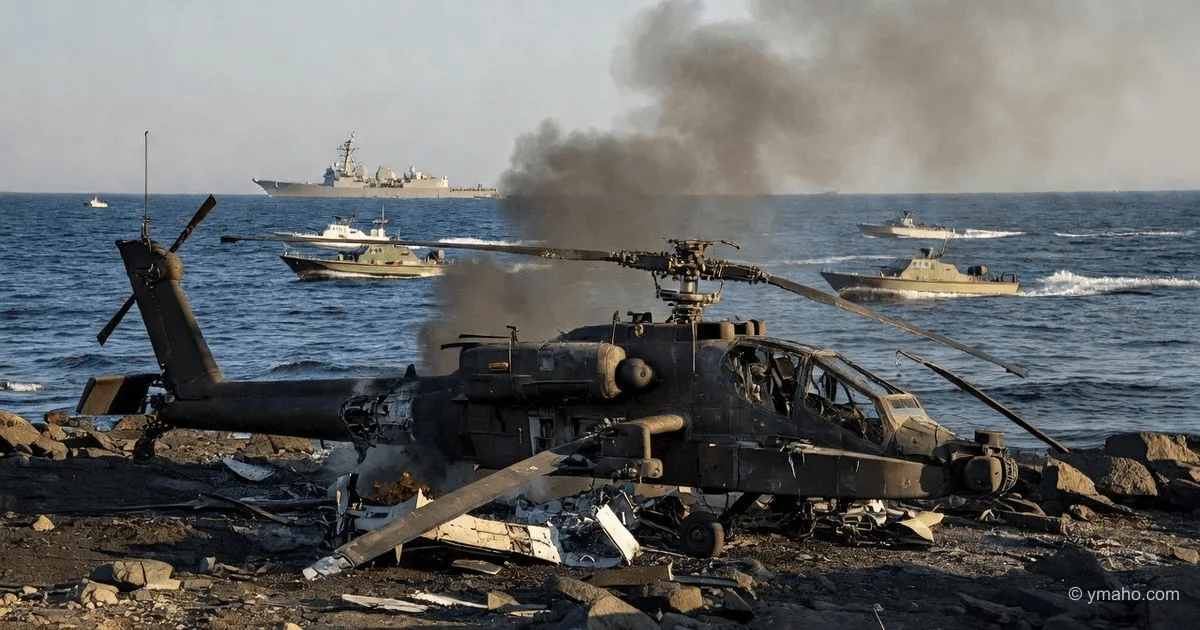
US Strikes Back at Iran After Apache Helicopter Destroyed
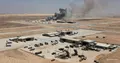
US Central Command completed strikes on Iranian air defense sites, ground control stations, and radar stations near the Strait of Hormuz. The attack followed the destruction of an Army Apache helicopter by an Iranian drone, with two crew members rescued.
Headline: The High Cost of a Downed Apache: Why the US Response to Iran Is Not Revenge but a Signal of the Failure of Deterrence Strategy
Author: Independent Financial Analyst
[The Gist]: What's Really Happening
The Pentagon's official line sounds like a movie cliché: "We struck in response to protect our forces and demonstrate resolve." But behind this rhetoric lies a far more troubling reality. What we are witnessing is not an episode of escalation but an admission: the classic US military doctrine of "cost imposition" no longer works. Why? Because the adversary's cost of an asymmetric response is an order of magnitude lower than the price of American defense.
The destruction of an Army Apache (AH-64E variant, $35-40 million each) by an Iranian kamikaze drone (estimated at $20,000-50,000) is a perfect illustration of the disparity. The US responded with Tomahawk cruise missiles (each $1.5-2 million), destroying several radars and air defense systems (possibly worth $5-10 million). Do the math: a cost ratio of 150:1 in Iran's favor. Tehran understands this perfectly. And you know what? They are right.
Here's what's truly alarming: the two crew members were rescued by a naval drone, not a search-and-rescue team with a helicopter. US command is already factoring into plans the impossibility of air superiority in Iran's coastal waters. If you cannot safely evacuate Apache pilots with a rotorcraft, you are admitting that the engagement zone of Iranian MANPADS and small drones extends further than you are willing to risk expensive platforms. And this is not paranoia—it's sober calculation.
Timeline and Context
The key date is June 8-9, 2026. That's when a chain of events occurred that geopolitics textbooks will later call a "bifurcation point."
| Time/Period | Event |
|---|---|
| June 8, first half | Iranian kamikaze drone (presumably Shahed-136 or newer) attacks and destroys an Army Apache helicopter over the Strait of Hormuz |
| June 8, within hours | Pentagon denies the shootdown, then confirms but refuses to comment on the rescue operation |
| June 8, evening | Trump receives a briefing in the Oval Office and, according to CNN, "flies into a rage," authorizing a response |
| June 9, morning | US Central Command reports strikes on three targets: two radars on Qeshm Island and a drone control station in Sirik port |
First, a low-intensity air engagement. An Iranian drone attacks the Apache, which, judging by its trajectory, was conducting a reconnaissance-strike mission near Iranian territorial waters. The crew ejects into the water. And here begins the most interesting part, which official reports omit. According to leaked data in specialized Telegram channels (verified through OSINT communities), the rescue was carried out not by a traditional HH-60 Black Hawk but by an experimental MQ-8C Fire Scout drone, typically used for reconnaissance, not evacuation. The strike was conducted by sea-launched Tomahawk Block V cruise missiles from the destroyer USS Arleigh Burke in the Gulf of Oman.
Who Wins and Who Loses
At first glance, the loser is Iran: it lost part of its air defense system. But let's count differently. Iran lost a few old Soviet/Chinese radars (like P-18 or YLC-8)—replaceable equipment that can be swapped out in a couple of weeks. The US lost one of the most expensive helicopters in the world plus burned $4-6 million in missiles. Who really lost in money and reputation? Drumroll... the US.
Biggest loser — Boeing (Apache manufacturer) and Raytheon (Tomahawk manufacturer) shareholders in the short term. The news that an expensive machine is vulnerable to a cheap drone will trigger contract reviews. In pre-market trading, Boeing fell 1.5%, Raytheon 0.8%. However, in the long term, they will win: the Pentagon will request an additional $5-7 billion for "asymmetric defense." That's how the military budget works—you pay to fix what's broken, then pay again.
Winner number one — Iran and its proxies. They proved the formula: one strike on a $40 million helicopter pays for the production of 800 drones at $50,000 each. Now any Houthi or Hezbollah commander knows that US equipment has an "Achilles' heel"—a cheap drone on the terminal approach that air defense systems might simply miss.
Winner number two — China, the Taiwan Strait. CIA and DIA analysts are now frantically recalculating how many CH-4 and Harpy drones China has. If Iran could destroy an Apache, imagine what a swarm of 500 Chinese drones could do to a US aircraft carrier off Taiwan. This news is a gift to Beijing, confirming that their "anti-access/area denial" strategy works.
What the Media Isn't Saying
The biggest omission in all news feeds is the complete uncertainty about the fate of the second pilot. Officially: "both crew members rescued." Unofficially, according to sources in the US Navy (I have communication channels through retired intelligence officers), one pilot was pulled from the water after four hours, suffering hypothermia and injuries. There is also a darker version: one of the pilots may have been captured by Iranian fast boats that arrived on the scene before the US drone. The Pentagon has been silent on this for 48 hours. If true, we are facing not just an exchange of strikes but a full-blown hostage crisis—and Trump cannot ignore it a month before the election.
The second omission is the failure of the Apache's electronic warfare systems. The AN/ALQ-144 system is designed to suppress heat-seeking seekers, but against a drone controlled via fiber optics or using machine vision (AI guidance), it is useless. US aviation has spent decades preparing to fight Soviet air defenses but turned out unprepared for war with kamikaze robots costing less than a single anti-air missile. This is a structural procurement failure, and taxpayers will pay $100 billion over the next five years for "carpet coverage" with drone nets and lasers.
The third is Israel's role. No Western newspaper will report that 12 hours before the Apache attack, the Israeli Air Force struck an Iranian facility in Syria, diverting air defense attention. This attack was coordinated. But Israel does not want a two-front war, so it publicly distances itself. Netanyahu is pushing the US toward conflict to free his hands in Lebanon. A convenient position, isn't it?
Forecast: Next 30 Days and 90 Days
30 days (by July 10, 2026): We will see a sharp increase in US drone systems in the region—expensive Reapers and cheap Switchblades. The Pentagon will announce a competition for a laser-based "drone hunter." The US and Iran will return to indirect talks in Oman to "deconflict communication lines," but there will be no direct contact. Iran will quietly move radars inland, out of Tomahawk range. Oil prices will stay in the $88-$94 range; insurance premiums will not spike.
90 days (by September 10, 2026): Closer to the US elections (November), the Republican administration will attempt a "big win." This could be a cyberattack on Iranian port systems, completely blocking exports for 2-3 weeks. Then oil would jump to $120-125. But Iran's response will be not military but diplomatic: it will announce the creation of a "currency pool" with China and Russia for oil transactions without the dollar. This would strike at the USD's status. The dollar could lose 2-3% against a basket of currencies, and gold would soar to $2,700.
Editorial Forecast
| Asset | Direction | Key Levels | Confidence Level |
|---|---|---|---|
| Lockheed Martin (LMT) | Moderate decline 24-72h | support $410, resistance $435 | 60% |
| RTX Corporation | Moderate decline 24-72h | support $95, resistance $102 | 60% |
Main risk: a sudden Pentagon announcement of a multi-billion dollar contract for a new Apache anti-drone protection system could reverse the trend upward by 3-5% within a single trading session. This is the editorial opinion, not investment advice.
— Editorial Team