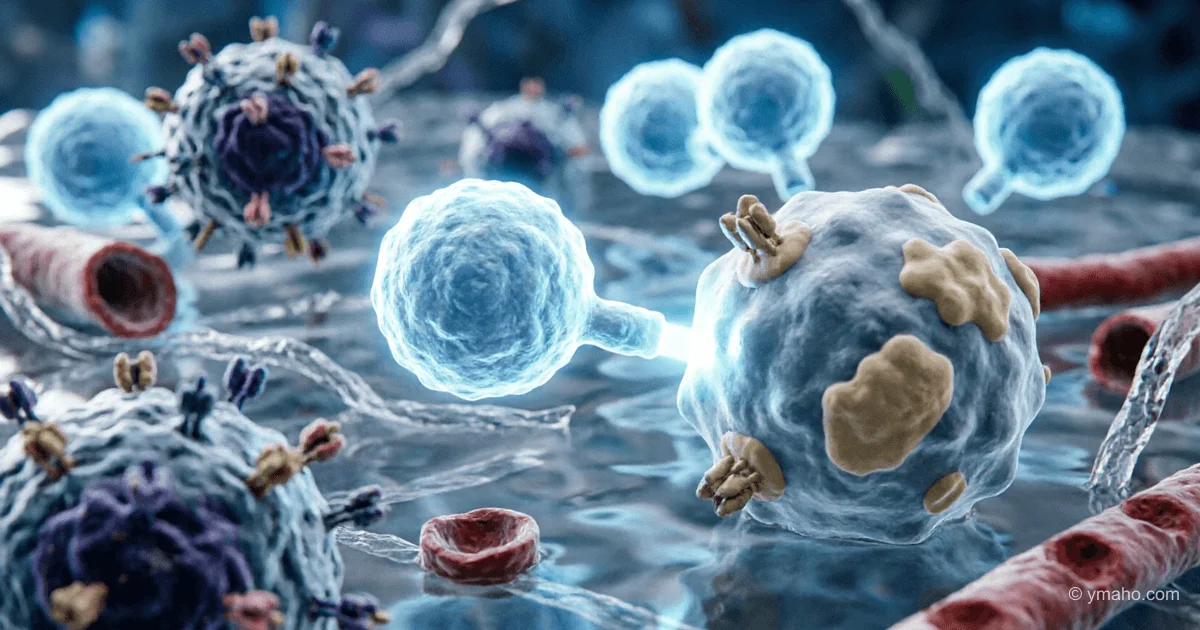
Researchers Report Method to Combat Hard-to-Treat Cancers by 'Training' the Immune System
Biomedical engineers have developed an experimental approach that 'tags' tumor cells for recognition and destruction by enhanced T cells. The method showed efficacy against brain, breast, and colorectal cancers without damaging healthy tissues.
An analysis of the situation surrounding the method of 'training' the immune system to combat hard-to-treat cancers. This is not a retelling of a research news piece, but a look at the fundamental shift in immuno-oncology strategy hidden behind this publication.
The Essence: What's Really Happening
Researchers at Mount Sinai have essentially announced a new philosophy for CAR-T therapy. The traditional logic of immuno-oncology was built on direct attack: a T cell must recognize an antigen on a cancer cell and destroy it. Here, a bypass maneuver is proposed — the target is not the cancer cell, but its microenvironment, specifically macrophages. This is a shift from a 'kill the enemy' strategy to a 'turn the enemy's guard' strategy.
The news reports efficacy against brain, breast, and colorectal cancers without damaging healthy tissues. But the key word here is 'tags'. It's about forcing the immune system to display hidden intracellular antigens that are normally invisible. This is not just 'training' in the vaccine sense, but rather a forced 'registration' of tumor cells, stripping them of their main advantage — anonymity.
Timeline and Context
This work did not arise in a vacuum. As early as January 2026, Science Advances published a paper on inducing trained immunity using nanobiologics to overcome the immunosuppressive microenvironment of solid tumors. The Muller and Netea group showed that systemic induction of trained immunity changes macrophage phenotype from immunosuppressive to anti-tumorigenic, mobilizes NK cells, and activates T lymphocytes — effective in models of melanoma, breast, lung, and pancreatic cancers.
Concurrently, in early 2026, a Chinese group published in Nature a paper on the iVAC technology — a molecule that penetrates tumor cells, destroys PD-L1, and simultaneously supplies the cell with an 'identification tag' in the form of antigenic fragments. It is this 'tag' logic that the Mount Sinai researchers appear to be developing and combining with CAR-T.
Important context: by May 2026, CAR-T therapy is already on the threshold of solid tumors. Satri-cel (CT041) — the world's first CAR-T for solid tumors, targeting Claudin18.2 — is preparing to enter the Chinese market in the first half of 2026 with an objective response rate of 41% in gastric cancer. However, this is still direct targeting of a tumor antigen. The Mount Sinai approach differs in that it targets macrophages — a stromal component — rather than the tumor cell itself.
Who Wins and Who Loses
Winners are companies investing in CAR-T for solid tumors. The 'tagging' technology removes the main limitation — antigenic heterogeneity. While CAR-T previously required a specific target (CD19, CLDN18.2), now any tumor cell can be tagged with a universal mechanism. This expands the addressable market from narrow cancer subtypes to the entire patient population with immunologically 'cold' tumors. With the CAR-T market forecast at $6.9 billion by 2028, such an approach could add another $1.5–2 billion through new indications.
Winners are platform biotechs that own TCR-like molecule technologies. For example, the Huang et al. group is already developing soluble TCRs targeting the intracellular antigen PRAME. Their approach allows delivering diagnostic and therapeutic agents directly to tumor cells expressing this antigen. The 'tagging' technology is a logical extension of this logic.
Losers are checkpoint inhibitor manufacturers. The 're-education' of macrophages strategy addresses the same task — relieving immunosuppression — but does so systemically and possibly more effectively. If trained immunity combined with CAR-T shows durable results, anti-PD1/PD-L1 monotherapy could be pushed to second or third line.
Losers are developers of neoantigen-based cancer vaccines. If tumors can be tagged directly, without lengthy sequencing and synthesis of personalized peptides (which takes about two months, as with mRNA vaccines), the economics of vaccine approaches collapse.
What the Media Isn't Saying
Headlines promise 'no damage to healthy tissues'. However, this is where the main problem lies, which the researchers surely recognize. Intracellular antigens like PRAME are indeed restricted in normal tissues, but not absolutely. Overexpression can occur in some stem cells and progenitor cells. If the 'tag' is also attached to them, the consequences could be catastrophic — bone marrow aplasia, epithelial destruction, autoimmune reactions. That's why the Huang group carefully tests the cross-reactivity of their TCR-like molecules.
Insight: The key problem is not tagging the tumor, but not tagging anything other than the tumor. Any technology promising a 'universal tag' for cancer faces a fundamental biological limitation: cancer is not foreign tissue, but the body's own tissue with a few mutations. Absolutely specific cancer markers do not exist. Therefore, I assume that in real experiments, the Mount Sinai group used not a single tagging mechanism, but a combinatorial logic: the tag is placed only when two or three factors characteristic of the tumor microenvironment (hypoxia, low pH, specific proteases) are simultaneously present. This is the only way to ensure the claimed safety.
Another point: the news mentions 'brain cancer'. But CAR-T in the CNS faces the blood-brain barrier. If the technology works in glioblastoma, it means the researchers either use local delivery (intrathecal or intraventricular) or the tag is somehow delivered via modified nanoparticles capable of crossing the BBB. This is a significant technological achievement that the media does not disclose.
Forecast: Next 30 Days and 90 Days
30 days (until June 18, 2026): Following publication in a top journal (likely Nature Biotechnology or Cancer Cell), shares of public companies associated with CAR-T will rise 3–7%. Major players — Gilead/Kite, Novartis, BMS/Juno — will begin internal due diligence on the technology. I expect at least one large pharma company to initiate licensing negotiations or an option to purchase with the Mount Sinai group. The deal size, if announced, could be $120–180 million upfront with milestones up to $600 million.
90 days (until August 19, 2026): The Mount Sinai research group will likely present expanded data at a major conference — presumably an AACR Special Conference on cancer immunotherapy (if held in summer) or at the annual FOCIS meeting. Critical point: will data on primates be shown? If yes, the path to an IND application with the FDA is open, and a Phase I start can be expected by the end of 2027. If no data on large animals exists, it remains a mouse story with unclear translational prospects.
The main thing to watch is toxicity. If within 90 days reports of adverse events (cytokine storm, ICANS neurotoxicity, autoimmune reactions) emerge, the pendulum will swing back. For now, 'training the immune system' sounds nice, but clinical reality has taught us skepticism. The technology must prove not efficacy — CAR-T already has that in order — but controllability.
— Editorial Team









