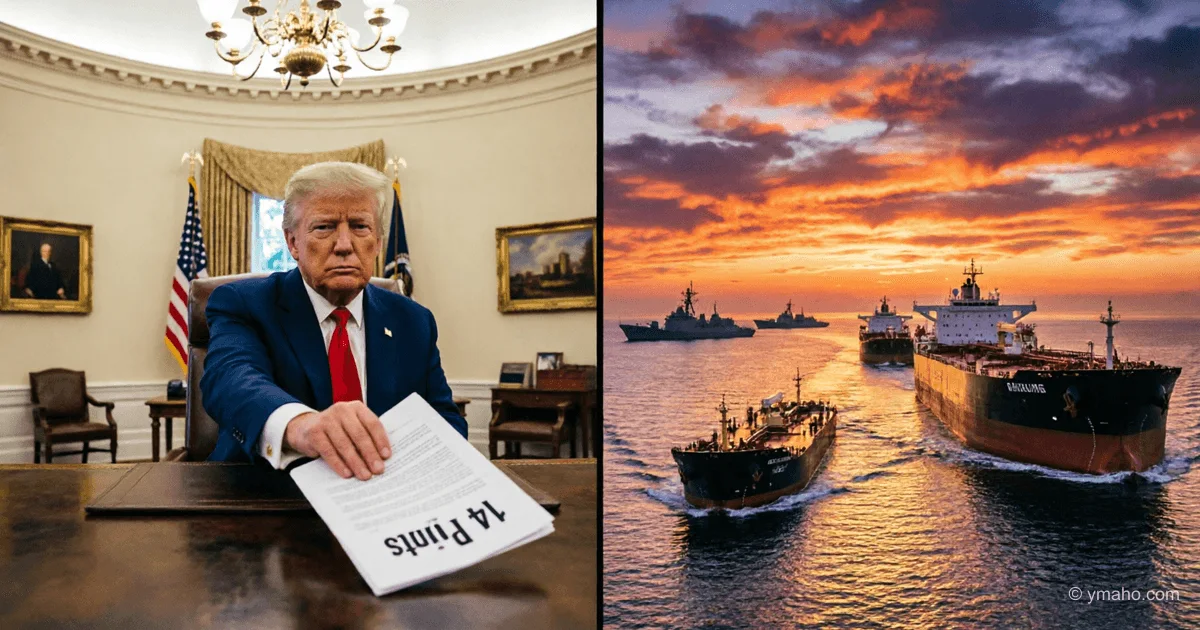
Trump Rejects Iranian Peace Proposal, Threatens Resumption of Military Action
U.S. President Donald Trump said he was "not satisfied" with Tehran's proposal, conveyed through Pakistani intermediaries and containing 14 points, including a call for an end to the war in Lebanon and the creation of a new mechanism for the Strait of Hormuz, and warned that military options remain on the table.
Donald Trump's public and dismissive rejection of Iran's 14-point peace proposal is not a failure of diplomacy but cold calculation. Behind the scenes, something far more cynical is happening than simply a reluctance to negotiate. Trump has just deliberately stripped Iran and international mediators of any hope for a settlement, and there is a specific financial and domestic political reason for this that most commentators miss, focusing instead on the loud rhetoric.
The Core: What's Really Happening
At first glance, it seems Trump is acting like a hawk unsatisfied with concessions. In reality, by rejecting the 14 points, he is shifting to a doctrine of "managed destabilization." The essence of his strategy is not to start a blitzkrieg war against Iran (that would be too costly, around $3-4 trillion in indirect losses for the global economy), but to force the Arab monarchies of the Persian Gulf to pay significantly more for their security. Every day that Iran's proposal remains rejected on the table, insurance premiums, commodity prices, and military expenditures of the GCC states skyrocket.
The Iranian proposal included a clause on creating a new mechanism for controlling the Strait of Hormuz with the participation of the IRGC. Accepting this would have meant legitimizing Tehran's role as the gendarme of the Gulf and breaking the monopoly of the U.S. Fifth Fleet on ensuring freedom of navigation. Trump cannot hand over control of a key artery of global trade to a country against which he has imposed a policy of "maximum pressure." However, the real reason runs deeper. Adopting the plan would have led to an immediate drop in oil prices of $15-20 per barrel and nullified the geopolitical risk premium. This would have hit ExxonMobil and Chevron, whose shares had just peaked, and also reduced Saudi Arabia's revenues from expensive oil, which it is currently redirecting to purchase American weapons.
Trump is using this proposal as a smokescreen. He says, "I could make a deal, but they're not offering enough." This shifts the blame for future chaos in the ports onto Tehran while maintaining turbulence that benefits the U.S. economy.
Timeline and Context
The timeline demonstrates the complete predictability of the breakdown. On May 3-4, 2026, Pakistani Prime Minister Shehbaz Sharif conveyed a message from Iran's Supreme Leader. Iranian diplomats took the unprecedented step of consolidating their demands into 14 specific points, which is unusual for the typically amorphous Persian diplomacy. They demanded: an immediate ceasefire in Lebanon (where Israel had resumed bombings), the creation of a joint committee for incidents in the Gulf, and most interestingly, the restoration of access to European and Asian financial channels for paying for humanitarian imports, which would have allowed the unfreezing of some assets in the Bank of England and Deutsche Bank totaling about $7 billion.
Trump rejected this on the evening of May 5, and on the morning of May 6, strikes on Fujairah continued. The context of Trump's actions is the November midterm congressional elections. He needs the image of a "strong leader" challenging a "hostile Islamic regime." Any compromise with Iran, even a reasonable one, would be immediately used by Democrats, who would cry betrayal of Israel and appeasement of terrorists before the elections. Trump is operating within the logic of the fight for the House of Representatives, not the logic of global stability.
Who Wins and Who Loses
The absolute loser is Pakistan. Islamabad invested enormous diplomatic capital in mediation, hoping to secure $3 billion in IMF assistance and political recognition from the U.S. for its role as a "bridge." Now Pakistan looks like a courier whose letter was thrown in the trash, weakening the position of the pro-American lobby within the Pakistani army.
The winner is the U.S. military-industrial complex, both in the short and medium term. When Trump rejects the proposal as "unsatisfactory," he signals to the Saudis and Emiratis: "A diplomatic solution is impossible; your only chance is massive arms purchases." According to unofficial data from the Congressional office, the total value of three packages for the sale of aircraft, air defense systems, and electronic warfare equipment awaiting approval exceeds $45 billion. For Raytheon and Boeing, this is a goldmine that would simply evaporate under budget pressure if a diplomatic settlement were reached.
The European economy also loses. Rejecting the Iranian point to "end the war in Lebanon" means continued escalation in the Eastern Mediterranean. This dashes hopes for the summer tourist season in Greece, Cyprus, and Turkey (risk of missile attacks and refugee flows). The European Union loses potential revenues of about €15-18 billion, and Turkey, which also participated in shuttle diplomacy, faces a new wave of inflation due to rising energy prices.
What the Media Isn't Saying
The media focuses on the dramatic description of the "14 points" and the image of a decisive Trump. They fail to mention that the Iranian proposal contained a secret appendix that was deliberately left unanswered. It concerns the fate of 5 American citizens with dual citizenship held by the IRGC on espionage charges. Iran, through Pakistani intermediaries, signaled its willingness to discuss their release in exchange for the return of Iranian funds from South Korea (about $6.7 billion).
The Trump administration deliberately hid this humanitarian aspect from the press because any "money for hostages" exchange would repeat the mistakes of the Biden administration, which Democrats would use as a club against Trump. In the corridors of the State Department, it is said that the families of the detainees were privately informed that "the time for a deal has not yet come" and "the regime must collapse for them to be freed." This is ruthless pragmatism, placing domestic political interests above human lives, which will never appear in official press releases.
Forecast: Next 30 Days and 90 Days
30-day horizon (by June 5, 2026).
With the diplomatic path blocked, Iran is no longer bound by any hope for negotiations. The next 30 days will be a time of "creeping escalation." The IRGC, receiving no signal of de-escalation, may strike higher-level infrastructure. At risk is the emirate of Ras Al Khaimah or offshore oil platforms of Saudi Arabia. Iran must demonstrate that the rejected peace proposal has a cost. Brent markets will rise above $115 as traders realize diplomacy is dead. Trump will announce the imposition of secondary sanctions on Pakistani banks, suspecting them of cooperating with Iranian schemes to bypass restrictions.
90-day horizon (by August 2026).
Rejecting the peace plan will inevitably confront the U.S. with a dilemma: either back down completely (impossible for Trump) or launch a surgical strike. I expect that by August 2026, if the White House does not receive a new package of compromise proposals through the Sultan of Oman (who operates much more professionally than the Pakistanis), the U.S. Air Force will be forced to carry out a "preemptive strike" on drone infrastructure in Chabahar or Jask. This would instantly escalate the conflict from a proxy war to a direct limited conflict. Brent oil would spike to $130. However, by that time, Trump himself may face a revolt in the House of Representatives, as American businesses losing billions on logistics begin to conspire against his hardline stance. The key takeaway: Trump's rejection of the deal has extended the conflict by at least a quarter, burying hopes for normalization in 2026 and turning the Middle East into a protracted war of attrition with no exit strategy.
— Editorial Team









