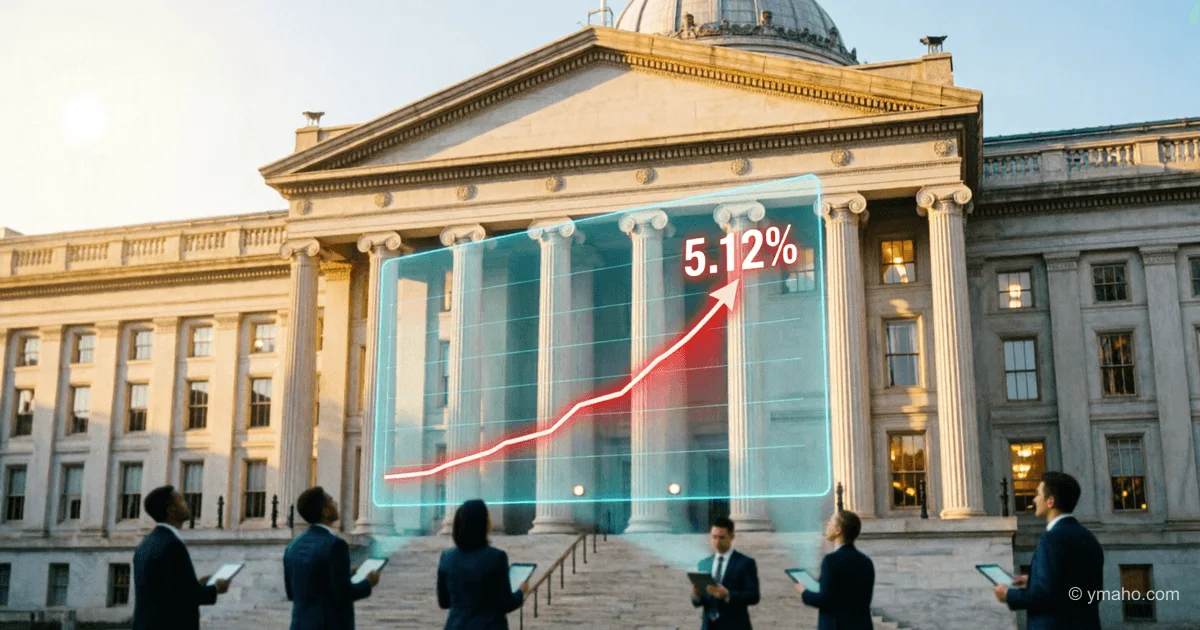
30-Year US Treasury Yields Hit 5.12% — Highest Since 2007
The yield on 30-year US government bonds rose to 5.12%, the highest level since June 2007. Analysts at Apollo and Deutsche Bank note that G7 countries are collectively approaching 5% yields on long-dated securities amid rising fiscal deficits.
[The Gist]: What's Really Happening
The US sovereign debt market is undergoing a tectonic shift, and 5.12% on 30-year bonds is not just a headline-grabbing number. We are witnessing the unraveling of the classic "risk-free rate" model that has underpinned the entire global financial architecture for the past 40 years. With Kevin Warsh poised to take the Fed chair on May 22, 2026, and 5-year inflation expectations anchored at 2.7%, the market no longer believes the central bank can return inflation to target without triggering a full-blown debt crisis.
An overlooked connection that mainstream media misses: the current yield spike is nearly synchronized with the launch of the Ondo Global Markets protocol, which attracted over $1 billion in tokenized Treasury obligations in three weeks. Institutional capital is not just fleeing long Treasuries — it is shifting into their on-chain counterparts, creating a parallel pricing system for government debt. This is the first time in history that DeFi protocols are influencing the yield curve of sovereign bonds issued by the reserve currency country.
Timeline and Context
The trajectory of 30-year Treasuries over the past 60 days looks like a classic "bear steepening." Yields broke through the psychological 5% mark on May 8, when the US Treasury announced plans to issue $385 billion in new debt in the second quarter — $40 billion more than the consensus forecast of primary dealers. The reaction was immediate: Apollo Global Management increased its short position in long Treasuries by $2.3 billion, and Deutsche Bank recorded the highest volume of interest rate hedging among corporate clients since 2023.
Meanwhile, the CLARITY Act was approved by the Senate Banking Committee on May 15. The bill creates a legal bridge between traditional Treasuries and their tokenized counterparts, allowing custodian banks to count on-chain bonds as Tier 1 liquidity assets. J.P. Morgan conducted a test transaction with Mastercard on May 17 — $50 million in tokenized Treasuries moved between jurisdictions in 12 seconds. This is a technological shock for primary dealers, whose business has for decades relied on the bid-ask spread in off-chain T+1 settlements.
Jerome Powell's term expired on May 15, 2026, and the Senate confirmed Kevin Warsh with a 62-38 vote. Warsh is known for his stance: he believes the Fed should allow a "controlled squeeze" in the Treasury market to discipline Congress on fiscal spending. This is a tectonic shift from the "Fed as buyer of last resort" paradigm to "Fed as observer."
Who Wins and Who Loses
Winners:
Pension funds with aggressive liability-driven investing (LDI) strategies finally see light at the end of the tunnel. After a decade of negative real rates, they can buy 30-year bonds yielding 5.12% against long-term liabilities priced at 3.5-4%. CalPERS last week increased its allocation to long Treasuries by $7 billion — its largest purchase since 2009.
Ondo Finance and the tokenized asset ecosystem get a double tailwind: rising base yields and regulatory clarity. Inflows into Ondo Global Markets reached $1.1 billion in three weeks, and daily secondary trading volume in tokenized Treasuries exceeded $180 million. The protocol's fee income is growing non-linearly with TVL.
Global carry traders, borrowing in yen at 0.5% and investing in 30-year Treasuries at 5.12%, earn a spread of 462 basis points before currency hedging. This is a classic widowmaker trade that might play out differently this time.
Losers:
Traditional primary dealers — BofA Securities, Goldman Sachs, Citadel Securities — are losing exclusivity. When tokenized Treasuries trade 24/7/365 with instant settlement, their market-making model based on phone calls and blotter trading becomes archaic in months, not years.
The Nasdaq tech sector faces dual pressure: discounting future cash flows at 5.12% instead of 3.5% reduces the fair value of growth stocks by 30-40%, while a $1.039 billion weekly outflow from spot Bitcoin ETFs signals a flight from risky assets.
The Bank for International Settlements reports growing duration mismatches at 47 European banks holding $2.3 trillion in US Treasuries with losses in their available-for-sale portfolios. When these bonds are marked to market, capital holes reach $120-150 billion.
What the Media Isn't Saying
The first non-obvious insight concerns settlement mechanics. Traditional Treasuries trade on a T+1 cycle, while tokenized ones settle atomically. When yields broke 5% on May 16, primary dealers physically could not deliver bonds to some hedge funds due to settlement fails reaching $78 billion in a single day. At the same time, Ondo executed a $50 million transaction in 12 seconds — instant settlement versus a fail. Institutional investors noticed this gap, and liquidity is now flowing on-chain at $40-50 million per day.
Second insight: Kevin Warsh, at a closed-door meeting with primary dealers on May 14 (before his confirmation), allegedly said a phrase that leaked through two sources: "We will not repeat the mistake of 2020 — the Treasury market must find its own price, even if that means 6% on thirty-year bonds." If true, the classic "Fed put" model is dead.
Third: Chinese state funds, through Luxembourg SPVs, reduced their long Treasury positions by $23 billion in April-May, rotating into gold and the Swiss franc. This is the largest outflow from UST by China's official sector since 2016, but it is masked through multi-jurisdictional structures.
Forecast: Next 30 Days and 90 Days
30-day horizon (through June 20, 2026):
The FOMC meeting on June 10-11 will be a turning point. Warsh will hold his first press conference, and the market expects the median rate dot plot for 2027 to be raised to 4% — 50 basis points above March projections. The 30-year yield will test 5.35-5.40% before the meeting, then possibly pull back to 4.90-5.00% on profit-taking. Critical factor: the Treasury's quarterly refunding on June 2 with $410 billion in issuance — any hiccup in the auction will instantly send yields to 5.50%.
Tokenized Treasury volumes will reach $18-20 billion by June 20 if Ondo and competitors (BlackRock USD Institutional Digital Liquidity Fund, Franklin Templeton) maintain their pace. J.P. Morgan and Mastercard will announce full commercial launch of cross-network settlement on May 25.
90-day horizon (through August 20, 2026):
By late summer, the Treasury market will face an existential stress test. If primary dealers continue to lose market share to on-chain protocols, the Treasury will be forced to recognize tokenized platforms as qualified dealers. This would open the floodgates for $100-150 billion in institutional capital currently waiting for regulatory clarity.
Base case: 30-year yields stabilize in the 5.00-5.50% range through autumn, provided CPI consumer inflation does not exceed 3.2% year-over-year. Bear case: a breakout above 5.75% on inflation above 3.5%, triggering margin calls at pension funds with LDI strategies and a systemic crisis akin to the UK's in September 2022, but on a $3-4 trillion scale.
Editorial Forecast
Asset: 30-year US Treasury yield (inverse view — TLT bond price). Direction: short-term pressure on bond prices (rising yields) with potential reversal after the FOMC meeting on June 10-11. Key level: 5.25% yield acts as technical resistance; if broken, move toward 5.50%. Confidence level: medium. Main risk: unexpectedly dovish rhetoric from Warsh at the FOMC press conference, which could trigger a Treasury rally and crash yields back to 4.75% within 48 hours. This editorial opinion is not investment advice.
— Editorial Team









