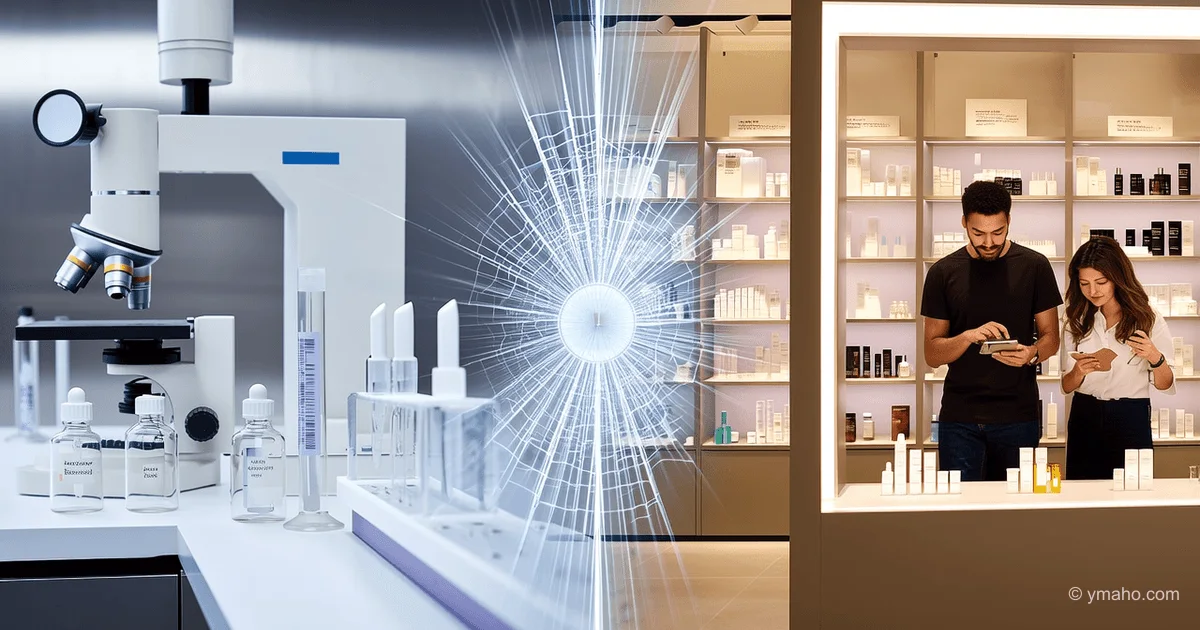
US Beauty Industry Shows Steady Growth in Q1 2026
Analytics show that the mass and prestige segments of the US beauty market have posted equally strong results for the first time in several years, driven by demand for affordability and quality.
US Beauty Market in Q1 2026: Synchronous Growth of Mass Market and Prestige — and Why It's a Warning Sign for Luxury
The Bottom Line: What's Really Happening
On May 12, 2026, Circana released its quarterly report on the US beauty market, and headlines were brimming with positivity: the prestige segment grew 6% to $8.1 billion, the mass segment grew 7% to $18.1 billion, sales are up, consumers are active.
At first glance, it's a success story. But let's look at the numbers the press releases don't mention. Dollar sales growth outpaces unit growth in both segments. Translating from analyst-speak to plain English: people are buying fewer products but paying more for them. This isn't organic demand growth. It's inflationary price growth disguised as market optimism.
Moreover, for the first time in five years, the mass and prestige segments are growing at nearly the same rate. For those who understand the mechanics of the beauty market, this isn't a celebration. It's a symptom of a deep structural shift where the traditional divide between "prestige" and "mass" is losing meaning. Consumers no longer go to Sephora for status and Walmart for savings. They hunt for efficacy — and they don't care which shelf it sits on.
Larissa Jensen, Circana's global beauty industry advisor, puts it diplomatically: consumers are looking for "accessible yet highly effective products that are enjoyable to use and deliver results." Let me translate from diplomatic to direct: the era of status consumption in beauty is over. The era of clinical efficacy and value hunting has begun.
Timeline and Context
The story of this quarter has its roots in 2025. Back then, the market was already signaling: prestige cosmetics grew 4% in the first nine months, mass grew 5%. The gap was narrowing. In January 2026, Daash Intelligence forecast flat growth for Q1, and Prosper Insights projected a modest 2-2.5%. Reality turned out slightly better than forecasts — but structural problems haven't gone away.
Meanwhile, throughout 2025, the masstige segment — brands straddling mass and prestige, offering clinical formulas at affordable prices — gained momentum. Their sales grew 14% over the first nine months of 2025, significantly outpacing both mass and prestige. This isn't a niche phenomenon. It's the new mainstream.
By early 2026, US consumer confidence had fallen to its lowest level since May 2016 — worse than during the pandemic. While 41.4% of American adults still feel confident about the economy, that's three percentage points lower than a year ago. Beauty spending holds up not because people are getting richer, but because beauty has become the last affordable "emotional refuge." When you can't afford a new car, you buy a serum. Or — increasingly — its more affordable alternative.
And here's the key turning point: only 14% of beauty buyers today believe that a high price means better quality. For an industry that has built its pricing on prestige and status for decades, this is a tectonic shift. It didn't happen in Q1 2026. But it was in Q1 2026 that it first became visible to the naked eye.
Who's Winning and Who's Losing
Winners: masstige brands. These are the true winners of the quarter. Brands like REMEDY, which launch dermatologically-backed formulas for $17.99 at Target, or YSE Beauty, operating in Sephora with an accessible-prestige positioning and projecting around $30 million in revenue for 2026. These players aren't just growing — they're redefining the rules of the game. They've proven that clinical credibility, ingredient transparency, and fair pricing beat both expensive luxury and faceless mass.
Winner: Amazon. Circana's report notes that e-commerce now accounts for nearly half of prestige sales and the majority of units sold. Social commerce — especially TikTok Shop — has already captured 10% of all US beauty e-commerce. Platforms that were considered "testing grounds for indie brands" just three years ago have turned into full-fledged commercial machines. Amazon itself launched Mamonde exclusively last quarter — and that's just the beginning.
Winners: clinical brands. The phrase "clinical brands captured more than a third of dollar sales in prestige skincare" from Circana's report is perhaps the most important line in the entire document. It means that every third dollar in prestige goes to a brand with a scientific, dermatological positioning. Not fragrance, not texture, not packaging — but proven efficacy has become the main currency.
Losers: traditional luxury. The prestige segment grew 6% — but this growth is driven by down-trading: products at the lower end of the prestige price point, "minis," whose share grew by double digits. This isn't luxury in the classic sense. It's consumers who want to touch prestige through the cheapest entry ticket. Large formats, high-margin launches — under pressure.
Losers: makeup. While skincare, fragrance, and hair care are growing steadily, makeup is stagnating: modest dollar growth with declining units. Mass makeup is particularly struggling — people are simply buying fewer makeup products, even if they spend a bit more on each. The only growth points are hybrid products with skincare benefits: tints, balms, lip oils.
Losers: brands without a clinical story. If you don't have a dermatologist at the foundation, no studies, no data-backed claims — you're losing share. Consumers have learned to read ingredient lists. 56% of US consumers use and prefer dupes — products that are analogs of expensive brands. This isn't fringe behavior. It's the new normal.
What the Media Isn't Saying
Insight #1: Synchronous growth of mass market and prestige is not a sign of market health, but a symptom of blurring boundaries.
All headlines present "growing equally for the first time in five years" as good news. But think about it: if two segments behave identically, does that mean both are healthy? Or that the difference between them is disappearing? I argue the latter. Consumers no longer choose "prestige or mass." They choose "works or doesn't." And that works — both at Sephora for $65 and at Target for $17.99. The traditional market architecture is cracking at the seams.
Insight #2: TikTok Shop is no longer an experiment — it's 10% of all US beauty e-commerce.
Circana published this figure in its report, and it deserves special attention. TikTok Shop launched in the US in late 2023. In just over two years, a platform many considered "entertainment for teens" has captured a tenth of the country's entire beauty e-commerce. In Q1 2026, beauty accounted for 20% of all TikTok Shop spending. This isn't a channel. It's a new retail reality. Brands that still treat TikTok Shop as an "additional" platform are losing to those who have made it core.
Insight #3: Dupes are no longer a "shameful" alternative — they've become the preferred choice.
Previously, buying a dupe meant "I can't afford the original." Today it means "I'm smarter than those who pay for the brand." Mintel, McKinsey, Circana — all report the same shift: from a third to two-thirds of young buyers actively choose dupes. They compare ingredients, not packaging. For brands built on prestige storytelling, this is an existential threat. If consumers don't care whose logo is on the bottle, what do you base your price on?
Forecast: Next 30 Days and 90 Days
30 days (by June 13, 2026):
In the coming month, we'll see the first reactions from major players to the quarterly report. Sephora and Ulta will start promoting masstige brands more aggressively within their portfolios — Circana's data leaves them no choice. Expect also that several prestige brands will announce the launch of "affordable" mini-collections or travel-size versions of flagship products. This is a direct response to the double-digit growth of minis in Q1 — brands are trying to capture consumers who want a luxury experience but aren't willing to pay full price.
TikTok Shop will continue to grow its share. June sales and promotions will be a stress test for the platform — if the beauty category maintains 20% of GMV, it will cement its status as a must-have channel for the second half of the year.
90 days (by mid-August 2026):
By the end of summer, two important trends will emerge. First, we can expect a wave of M&A in the masstige segment. Large corporations — L'Oréal, Estée Lauder, Unilever — see the same numbers we do. 14% masstige growth amid stagnation in traditional segments is a signal to buy. Expect at least one notable masstige brand to be acquired by a strategic player in the next 90 days.
Second, we'll see rebranding of several prestige brands toward a "clinical" positioning. The figure "clinical brands account for a third of dollar sales in prestige skincare" is too strong an argument to ignore. Brands that yesterday talked about "luxury" and "sensorial experience" will start talking about "proven efficacy" and "dermatologically tested." Not all will succeed convincingly — consumers have learned to distinguish marketing from science.
Separately, keep an eye on fragrance. 16% growth in prestige looks impressive, but digging deeper, nearly 40% of that growth comes from fragrances under $50. This is a warning sign for niche perfumery. When consumers are willing to buy a prestige fragrance but choose the cheapest format — a mini or travel-size — it's not loyalty, it's a compromise.
Conclusion. Q1 2026 will go down in the history of the US beauty market not for record growth numbers, but as the moment when it became definitively clear: the old market map no longer works. There is no longer "prestige" and "mass" as two non-overlapping worlds. There is a consumer with sharp eyes who knows how to read ingredient lists, compare prices, and find efficacy without regard to the price tag.
Brands that continue to bet on status and prestige storytelling will find themselves in a shrinking niche. Those who understand that the new currency is proven efficacy, clinical credibility, and honest pricing will grow. And masstige, which yesterday was the industry's "middle child," is becoming its new center of gravity. 2026 is the year the beauty market stopped pretending that price equals quality. And consumers are applauding.
— Editorial Team









