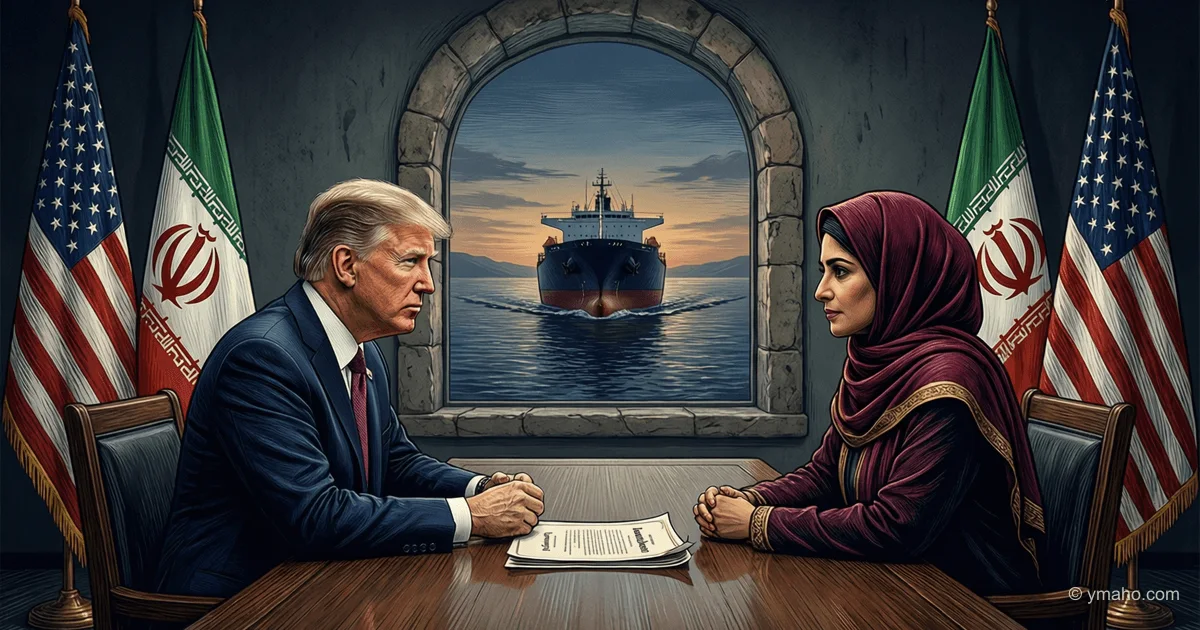
Media Reveals Draft of US-Iran Peace Agreement
Al-Arabiya TV published a new draft agreement proposing a full ceasefire, freedom of navigation, and gradual sanctions relief without mentioning Iran's nuclear program.
Islamabad Declaration: Why the Leak of the Draft Agreement Is a Signal to the Market, Not a Deal
[The Gist]: What Is Really Happening
Al-Arabiya TV published a draft peace agreement between the US and Iran. The document includes a ceasefire, freedom of navigation in the Strait of Hormuz, and gradual sanctions relief. The key detail that mainstream media stubbornly ignores: the draft says nothing about Iran's nuclear program.
This is not an accidental omission. It is the key to everything.
As a financial analyst who has watched Middle Eastern deals for decades, I'll tell you: when the most painful issue disappears from a draft agreement, it means one thing — the parties have agreed to postpone it. Iran keeps its uranium. The US retains the right to return to the issue later. And the Strait opens now.
The document featured in the leaks is called the "Islamabad Declaration." It is a framework agreement, not a final peace. And its main function is to provide political cover for both sides to unblock Hormuz and stop the bleeding of the region's economies.
Behind this leak is a clear calculation. Someone in the negotiation process — almost certainly Pakistani mediators — decided to make the document public to create an effect of irreversibility. When a draft is already in the news, it's harder to back down. This is a classic "present the opponent with a fait accompli" tactic.
Timeline and Context
It's important to understand the timeline, because it shows how quickly events have unfolded in the last 72 hours.
May 21, 2026 — Al-Arabiya publishes nine points of the draft agreement. Main provisions: immediate ceasefire on all fronts, freedom of navigation, mutual non-aggression against infrastructure, creation of a monitoring mechanism, and gradual sanctions relief.
May 22, 2026 — Official Tehran gives a restrained reaction. Iranian Foreign Ministry spokesman Esmail Baghai tells state television: "We cannot say that we have reached a point where an agreement is close. That is not the case." At the same time, he confirms that Iran's nuclear program is not currently on the negotiating agenda.
May 23, 2026 — Axios publishes new information. The agreement will be a 60-day truce, not a permanent peace. Iran will clear mines from the Strait and allow ships to pass freely. In response, the US lifts the blockade of Iranian ports and grants limited sanctions relief on oil sales.
Non-obvious insight: The 60-day period is not a random number. It aligns with the US electoral cycle. The midterm elections are in November 2026. If Trump signs a 60-day truce now, at the end of May, it will expire by late July to early August. He will have the entire summer to either conclude a permanent peace or return to a military scenario. Both are politically manageable options ahead of the elections.
Note the parallel process. In New York, the review conference of the Nuclear Non-Proliferation Treaty (NPT) is wrapping up. The latest draft of the final document — eight pages, significantly trimmed — contains no direct mention of US attacks on Iranian nuclear facilities. UN diplomats are also preparing the ground for a deal by removing the most explosive topics from the table.
Who Wins and Who Loses
Trump wins in the short term. A president who promised to open the Strait and lower gas prices gets a political victory. Freedom of navigation is a point that can be sold to voters. The White House hopes the remaining issues could be resolved within hours.
Iran wins economically. 60 days of free oil sales amount to roughly 90–120 million barrels at current prices. Even with sanctions restrictions, Tehran will receive $9–12 billion in revenue. That's enough to stabilize the collapsing rial and give the regime a breather.
Israel loses, and that's the main intrigue. Prime Minister Netanyahu expressed concern to Trump in a phone call. Israel wants uranium out of Iran. A deal that is silent on uranium and gives Iran 60 days to sell oil is a nightmare scenario for Tel Aviv. The US assured Israel that it could act against Hezbollah if it tries to rearm. But that's a cold compromise.
Quiet win for Pakistan. Islamabad becomes a central player in Middle Eastern diplomacy. It is Pakistani mediator Field Marshal Asim Munir who travels to Tehran. Pakistan gains leverage and likely financial perks from both sides.
What the Media Isn't Saying
The main lie being circulated in the news is headlines like "US and Iran Agree on Peace." They have not agreed on peace. They have agreed on a pause. The Iranian Foreign Ministry spokesman explicitly said negotiations are not close to an agreement.
Second omission: The uranium hasn't gone anywhere. The 440 kg enriched to 60% remain in Iran. The draft agreement published by Al-Arabiya makes no mention of the nuclear program at all. According to Axios, negotiations on uranium and enrichment will take place during the 60-day truce. That is, the key issue is postponed until later, when military pressure has already eased.
Iran gets oil revenues without giving up uranium. Then, after 60 days, it will have money and leverage for new bargaining. This is a classic trap for Washington.
Third, and most dangerous omission: The deal is temporary, and US troops remain in the region. American forces are not withdrawn during the 60 days. This means any incident — accidental or provoked — could reignite the conflict. And the IRGC has every motive for provocation if uranium talks go against Tehran's wishes.
Forecast: The Next 30 Days and 90 Days
30 days: The agreement will be signed within 24–72 hours. I'm betting on Sunday, May 24, 2026. It will be a 60-day truce. The Strait will open within a week. Brent crude will lose $5–8 of the war premium in the first 48 hours after the announcement. The market has already started pricing this in.
90 days: The main question is what happens on day 61. If Iran seriously sits down at the negotiating table on uranium and enrichment, the truce will be extended. If not, Trump will face a choice: either a military strike right before the elections, or de facto recognition of Iran's nuclear program. I believe the administration will choose a third option — a quiet extension of the truce "for another 30 days" without formal commitments. This will allow postponing the tough decision until November. Oil prices will stay in the $85–95 range until the end of summer, then start rising if uranium talks hit a dead end.
Editorial Forecast
Asset and direction: Brent crude — short-term decline (3–5%) on news of the truce signing.
The leak of the draft agreement and information about a 60-day truce with the unblocking of the Strait of Hormuz reduce the war premium in oil prices. We expect a pullback from current levels to the $98–102 per barrel range within 24–48 hours after the official announcement.
Key levels: Current resistance at 108.30, support at 102.50. If the deal is confirmed, we test 100.00.
Confidence level: Medium (60%). Too many conflicting signals: Iran says "an agreement is not close," but leaks and Axios sources claim the opposite.
Main risk to the forecast: If the truce falls through at the last moment (as happened on May 18, when Trump called Iran's proposal "ABSOLUTELY UNACCEPTABLE"), Brent will jump to $115–118 within 24 hours. Watch for official statements from the White House and Tehran in the next 24 hours — that's where the final decision will be made.
— Editorial Team









