What Caused The 2008 Financial Crisis? A Detailed Look
What Caused The 2008 Financial Crisis? A Detailed Look
The 2008 financial crisis stands as the most severe economic contraction since the Great Depression, a global meltdown that erased trillions in wealth and pushed millions into unemployment . While the immediate trigger was the collapse of the U.S. housing market, the true answer to the question of what caused the 2008 financial crisis lies deeper: a dangerous confluence of deregulation, reckless financial innovation, global imbalances, and catastrophic regulatory failure. Understanding this complex chain of events is essential to comprehending the fragile architecture of the modern global financial system and the origins of the Great Recession.
What You'll Learn
By the end of this article, you'll understand the intricate, multi-layered chain of events that led to the global financial meltdown. You'll move beyond the simple narrative of "subprime mortgages" and grasp how deregulation, flawed risk models, and global imbalances created a system primed for collapse. You'll gain a framework for analyzing systemic financial risk and be able to distinguish between the crisis's immediate triggers and its fundamental, long-building causes.
The Foundation: A Perfect Storm of Deregulation and Cheap Money
To understand what caused the 2008 financial crisis, we must first examine the financial and regulatory environment that set the stage. Two significant pieces of legislation in the late 1990s essentially dismantled the safeguards put in place after the Great Depression.
In 1999, the Gramm-Leach-Bliley Act repealed the Glass-Steagall Act, allowing commercial banks, investment banks, and insurance companies to merge and engage in a wider range of speculative activities . This effectively removed the firewall that had separated Main Street banking from Wall Street risk-taking. A year later, the Commodity Futures Modernization Act exempted over-the-counter derivatives, including credit default swaps, from any form of regulation . This created a massive, unregulated market where massive amounts of risk could be traded, bundled, and hidden from oversight.
This deregulatory push occurred within a broader context of global imbalances. The United States was running persistent fiscal and current account deficits, fueled by enormous foreign borrowing from nations like China, Japan, and oil-exporting countries . This influx of cheap foreign capital created a "credit bubble," flooding the U.S. financial system with liquidity and keeping interest rates artificially low .
The "Great Moderation" and Its Complacency
During Alan Greenspan's tenure as Federal Reserve Chair (1986-2006), the U.S. experienced a long period of economic stability and low volatility known as the "Great Moderation" . This period led investors, financial institutions, and regulators to become dangerously complacent, believing the central bank would always step in to prevent any severe economic shock . As economist Jeremy Siegel noted, this belief "led to lower risk premiums and increasing leverage," and even encouraged "swindlers who engage in Ponzi schemes" . This complacency was a key reason why so few red flags were raised as the housing bubble inflated.
The Housing Bubble: Fueling the Fire
The combination of cheap money and a deregulated financial sector created the perfect conditions for a massive asset bubble in real estate. Low interest rates in the early 2000s, designed to counteract the 2001 recession, made borrowing incredibly cheap, driving up demand for housing and pushing home prices to unsustainable levels . Home prices rose each year from the mid-1990s to 2006, moving far out of line with fundamentals like household income . This self-reinforcing cycle—expectations of future price increases attracting more buyers, further inflating prices—created a classic bubble mentality .
Securitization: Spreading the Risk (and the Poison)
A crucial innovation that amplified the crisis was securitization. Banks no longer kept mortgages on their books; instead, they bundled thousands of loans into complex financial products called mortgage-backed securities (MBS) and collateralized debt obligations (CDOs) . These securities were then sold to investors worldwide, from pension funds to hedge funds, in a process that was supposed to spread risk. However, the system became a ticking time bomb when combined with subprime lending .
The Subprime Mortgage Explosion
The rapid expansion of subprime lending—mortgages given to borrowers with poor credit histories or low incomes—was central to what caused the 2008 financial crisis . Lenders, no longer bearing the risk of defaults because they could sell the loans, aggressively pushed these products. They created "innovative" loans like adjustable-rate mortgages (ARMs) with low "teaser rates," no-down-payment options, and interest-only periods . These mortgages were predicated on the assumption that home prices would continue to rise, allowing borrowers to refinance or sell their homes at a profit . This created a massive moral hazard, where lenders had little incentive to check a borrower's ability to repay.
The Ratings Agency Failure
A critical failure in this chain was the role of the credit rating agencies—Standard & Poor's, Moody's, and Fitch. They gave their highest, AAA ratings to billions of dollars worth of mortgage-backed securities and CDOs . These ratings were based on flawed assumptions, including the belief that nationwide real estate prices would never fall significantly and that bundling mortgages from different regions would reduce risk . These "triple-A" ratings misled investors into believing these complex products were as safe as government bonds, leading to their widespread purchase by risk-averse institutions like pension funds .
The Trigger: The Fed Raises Rates
As the economy began to overheat, the Fed raised its key interest rate from a historic low of 1% to 5.25% between 2004 and 2006 . This increase was directly reflected in the variable interest rates of the subprime mortgages. Millions of homeowners suddenly faced monthly payments that skyrocketed, often doubling or tripling, making them impossible to afford . As a result, subprime borrowers began defaulting in massive numbers. Simultaneously, the housing supply caught up with demand, and home prices began to fall in 2007 . Homeowners could no longer sell their homes for more than they owed on them, trapping them in loans they couldn't afford and leading to a wave of foreclosures .
The Collapse: Contagion, Panic, and "Too Big to Fail"
The bursting housing bubble sent shockwaves through the entire financial system. As defaults mounted, the complex mortgage-backed securities and CDOs that held these toxic assets became essentially worthless . Major financial institutions like Bear Stearns, Lehman Brothers, and AIG were found to be holding billions in these assets, massively leveraged with very little capital to absorb the losses . The securitization model, which was supposed to spread risk, had instead concentrated it and made it opaque.
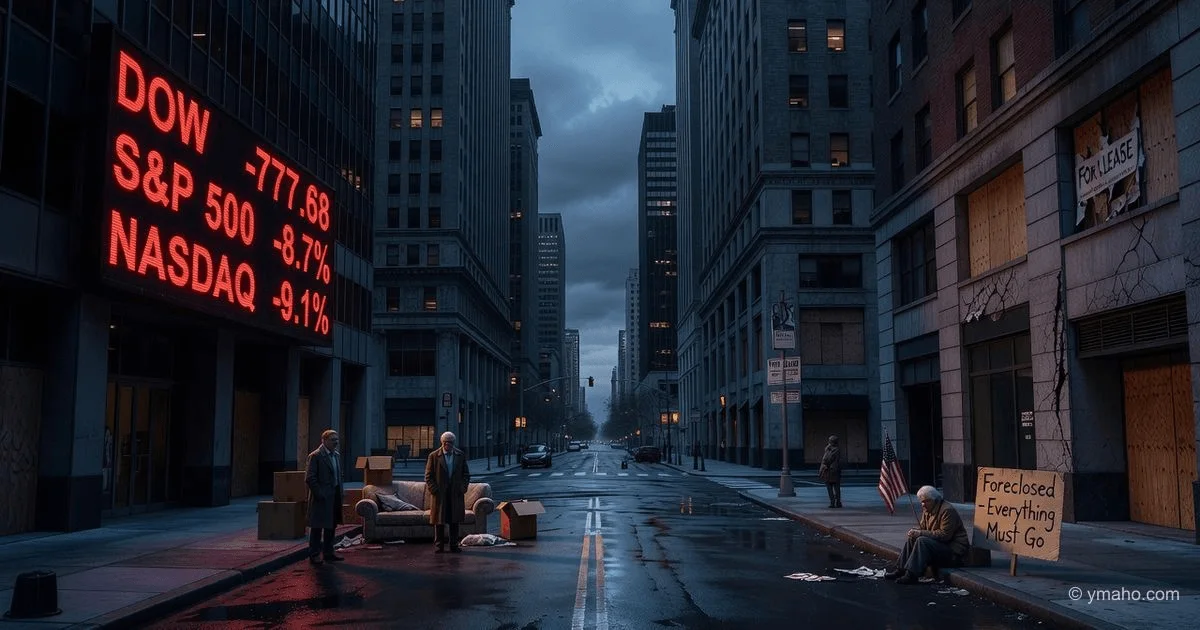
Panic ensued. Trust evaporated among banks, effectively paralyzing the interbank lending market . Banks refused to lend to each other for fear of counterparty risk—the risk that the other bank might be holding toxic assets and could collapse. This credit freeze spread to the real economy, as banks cut off loans to businesses and consumers . The crisis reached its zenith in September 2008 when Lehman Brothers, a Wall Street giant, filed for bankruptcy, triggering a global stock market crash . The government was forced to bail out other "too big to fail" institutions, including AIG, to prevent a complete collapse of the financial system .
Sources
- Jeremy Siegel, "Stocks for the Long Run," cited in Yahoo Finance
- Duke University Library, "What caused the financial crisis"
- Andorran Financial Authority (AFA), "The 2008 crisis"
- The Balance, "Causes of the 2008 Financial Crisis"
- UK Parliament, Written evidence from Boston University
- Brookings Institution, "The Origins of the Financial Crisis"
— Editorial Team