What Is the Balance of Power in International Relations?
The balance of power is the oldest and most fundamental concept in international relations theory, describing how nations seek security by preventing any single state from achieving overwhelming dominance . To answer the question of what is the balance of power in international relations, one must understand it not as a fixed state but as a dynamic process of checking and countering power to prevent hegemony and maintain stability .
What You'll Learn
You'll understand the core mechanics of balancing, from military alliances to economic statecraft, and see how this classic theory explains everything from the Cold War to today's U.S.-China rivalry. By the end, you'll be able to analyze current events through the lens of power politics and recognize when nations are acting to preserve an equilibrium—or challenge it.
How It Works — The Mechanics of Global Equilibrium
The concept of a balance of power implies an equilibrium of force between states or groups of states, preventing any one actor from seeking hegemony . The theory rests on the realist premise that, in an anarchic international system with no supreme authority, states must look after their own survival . When one state grows too powerful, it threatens others, prompting them to take action. This is the balancing process.
Balancing: Internal and External
States have two primary mechanisms to restore equilibrium :
- Internal Balancing: Building up one's own military and economic power to match a rising rival. This is the classic arms race dynamic.
- External Balancing: Forming alliances and coalitions with other states to pool power against a common threat .
The Role of Polarity
The form balancing takes depends heavily on the system's polarity—the distribution of power among the great powers.
- Bipolarity: In a system with two dominant powers, like the United States and the Soviet Union during the Cold War, they tend to balance primarily through internal military buildup. The arms race between the two superpowers was a classic example .
- Multipolarity: When power is distributed among three or more states, as in 19th-century Europe, balancing occurs more through flexible, counterbalancing alliances .
- Unipolarity: After the Cold War, the United States emerged as the sole superpower. This situation is inherently unstable, as one would expect other states to band together to create a new equilibrium .
Co-Binding: A Liberal Alternative
Liberal theory offers a different mechanism: "co-binding." Instead of balancing through countervailing power, states can tie one another down through mutual institutional constraints. NATO is a prime example. While it was formed to counter the Soviet threat, it also served to "keep the Russians out, the Germans down, and the Americans in" by locking its members into a semipermanent, predictable relationship . This mutual binding reduces the risks of anarchy without creating a formal hierarchy .
Why It Matters — Real-World Impact
The balance of power is not just an academic theory; it shapes the decisions of statesmen and affects global stability. For a historical example, we can look to the Cold War, where the United States and the Soviet Union maintained a "balance of terror" through mutually assured destruction, which paradoxically kept the peace .
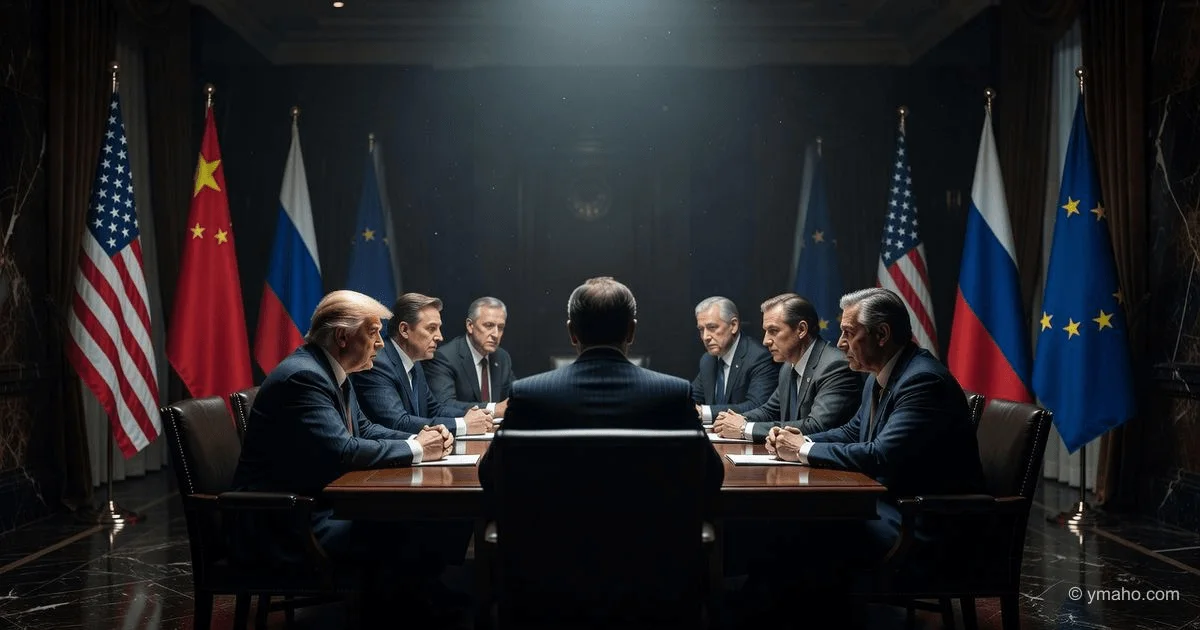
More recently, the concept helps explain the evolving global order. While some see the world coalescing into three spheres of influence centered on the U.S., China, and Russia, power is not absolute . This is why economic and technological competition have become central to the new global chessboard. The U.S.-China rivalry is being waged through tariffs, technology restrictions, and a "technological self-reliance" strategy from Beijing, showing that nations are using economic leverage as a political tool to shape the balance without direct military conflict .
A contemporary example of shifting regional balance can be seen in Europe, where the war in Ukraine has prompted Germany to revitalize its military and Poland to become a key logistics hub and security partner . "The balance of power has changed in Europe in recent years," notes Justyna Gotkowska, a Polish analyst, pointing to the rising importance of Poland alongside Germany's revitalized ambitions to build the strongest conventional army on NATO's European side .
By the Numbers — Key Stats and Milestones
| Milestone / Statistic | Year(s) | Significance |
|---|---|---|
| Peace of Westphalia | 1648 | The traditional starting point for the modern balance of power system, recognizing coexisting sovereign states . |
| Treaty of Utrecht | 1713 | Explicitly stated the goal of establishing "an equal balance of power" as the foundation for peace . |
| Congress of Vienna | 1815 | Reconstructed the European order after Napoleon's defeat, creating the Concert of Europe to maintain equilibrium . |
| Cold War Bipolarity | 1947-1991 | The U.S. and USSR balanced through nuclear arms races and alliances like NATO and the Warsaw Pact . |
| U.S. Military Expenditure | Present | The U.S. spends more on its military than the rest of the world combined, a key factor in its unipolar power position . |
| China's Rare Earth Dominance | Present | China accounts for 70% of global production of rare earths, using economic leverage as a tool in the modern balance of power . |
Common Myths vs. Facts
| Myth | Fact |
|---|---|
| The balance of power is a law that ensures peace. | It is not a law. It is a "slippery, murky, and protean term" . Even Immanuel Kant dismissed "universal peace on the basis of the so-called balance of power...as a mere chimera" . |
| Balancing always leads to stability. | While some see balancing as a path to stability, it can also be a source of tension and conflict. For instance, the "balance of terror" during the Cold War kept the peace, but the arms race also brought the world to the brink of nuclear war . |
| State behavior is only about great powers. | Realist theory has a strong bias towards great powers, but it is increasingly inadequate. "Regional realism" argues that for most states, the primary driver of politics is the regional balance of power, not the global one . For example, Pakistan's balancing efforts are focused largely within South Asia, not against the U.S. . |
| The balance of power is automatic. | Some versions of the theory describe an "automatic" process. However, many argue it is "semi-automatic" and requires a "balancer" state, or even "manual" and depends on skilled diplomacy . Britain played the role of the balancer in Europe for centuries, intervening to prevent any single power from dominating the continent . |
What You Should Do With This Knowledge
Understanding the balance of power helps you see through simplistic explanations of world events. When you read a news headline about a new arms deal, a trade war, or a military alliance, ask: Who is trying to balance whom?
- Analyze rhetoric: When leaders claim they are acting for "national security" or "to maintain stability," consider if they are framing a balancing move to gain domestic support.
- Look beyond the great powers: Recognize that regional dynamics are often more important than the global picture. A conflict between India and Pakistan, for example, is driven by a regional balance of power that cannot be explained solely by U.S.-China rivalry .
- Distinguish tactics from strategy: In the new global order, economics and technology are powerful tools. The U.S.-China strategic competition is not only about military might but also about who controls key technologies and supply chains . This demonstrates that the answer to "what is the balance of power in international relations" has evolved beyond just military force.
Frequently Asked Questions
Is balance of power theory still relevant today?
Yes, but its form is changing. While some argue that the post-Cold War unipolar era is stable, others point to the U.S.-China rivalry, the rise of multipolarity, and the use of economic and technological tools as evidence that balancing is still a key dynamic. The theory itself has evolved to include concepts like "soft balancing" and "regional realism" .
What is the difference between balancing and bandwagoning?
Balancing means aligning with a weaker power to counter a stronger one. Bandwagoning is the opposite—joining the more powerful state or coalition to gain advantages. Most balance of power theory focuses on balancing, but in practice, weaker states often bandwagon, making the theory an ongoing subject of debate .
What is "regional realism"?
It's an extension of realist theory that argues the primary driver of politics for most states is the regional balance of power, not the global one . This helps explain the behavior of states like India, Pakistan, and South Africa, which are major powers in their regions but not dominant globally.
What are the mechanisms for restoring the balance of power?
Key mechanisms include internal military buildup, forming counterbalancing alliances, "passing the buck" (shifting the responsibility of balancing to another state), partition and compensation in peace treaties, and emulation (adopting the successful strategies of a more powerful state) .
What is a "balance of power" system?
It is an international order where power is checked and balanced such that no single state can dominate the others . It requires at least two or more actors of roughly equal strength, states that are motivated to survive and preserve their autonomy, flexibility in alliances, and the potential to go to war if necessary .
Sources
- Sage Publishing: "Balance of Power"
- Oxford Public International Law: "Balance of Power" (Detlev Vagts)
- Carnegie Endowment for International Peace: "Security Studies Seminar with Rajesh Rajagopalan"
- Vietnam.vn: "Are the global chessboard and strategic triangles changing shape?"
- ScienceDirect: "Balances of Power"
- Oxford Research Encyclopedias: "The Balance of Power in World Politics" (Randall L. Schweller)
- Kellogg Insight (Northwestern University): "The New Global Order" (Lisa Röper)
- Columbia University Press: "Unipolar Politics: Chapter 4" (Daniel Deudney and G. John Ikenberry)
- AP News: "Germany and Poland to sign a new defense deal as balance of power in Europe shifts"
- Oxford Bibliographies: "Balance of Power Theory"
— Editorial Team