Yen Consolidates at 160.50: Market Balances Between Intervention Risk and Option Expiry
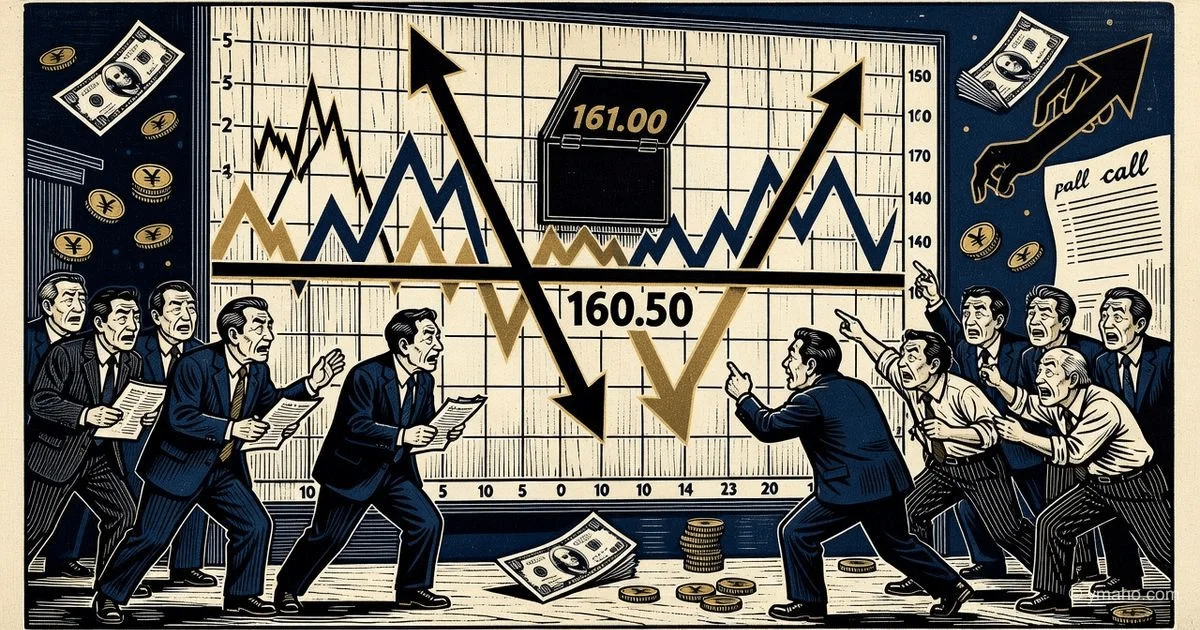
The USD/JPY pair trades near the key level of 160.50, where large option contracts are concentrated. A break above 161.00 could trigger a sharp move due to gamma risk, but the threat of currency intervention by Japanese authorities keeps buyers in check.
Headline: Option Trap at 160.50: Why the Yen Is Frozen at the Precipice and Who Will Cash In
An insider look at market mechanics: how gamma hedging, interventions, and CPI created a perfect storm
[The Gist]: What's Really Happening
The USD/JPY pair is stuck at 160.50, like a compass needle over a magnetic anomaly. This is not just a technical level—it's the epicenter of a clash between three forces: billions of dollars in option exposure, the threat of direct intervention by Japan's Ministry of Finance, and fundamental pressure from the yield gap. The price is literally glued to this spot, and any move becomes deadly for one side.
Here's what's happening inside. On Monday and Tuesday of this week, huge option contracts totaling over $3.6 billion in notional value expire at levels 160.00, 160.25, and 160.50. The largest clusters are at 160.00 ($1.8 billion) and 160.50 ($1.2 billion). As long as the price stays within this range, dealers (option sellers) must hedge their positions, which itself dampens volatility. This is called "option gravity"—the price is attracted to strikes with the highest open interest.
But the main hook is gamma risk at 161.00. Above this level, the structure of the options market changes sharply. Dealers who have been selling options and hedging by selling dollars will suddenly find themselves short gamma if 161.00 is breached. This means that to maintain delta neutrality, they will have to buy dollars as the price rises, accelerating it even faster. Technically, this is called a "gamma squeeze"—a mechanism that turns a simple breakout into a rocket launch.
However, standing in the way is the "Japanese guardian." The 160.40–160.70 zone is where, on April 30, 2026, Japan's Ministry of Finance conducted a massive intervention, spending a record $74.1 billion in one week to buy yen. Vice Minister Mimura issued the latest "verbal warning" to speculators on June 9, and Prime Minister Takaichi personally stated that "speculative trading not based on real demand has a large impact on the currency market." 160 is no longer just a level; it's a "red line written in neon."
Thus, traders are caught between the hammer of a gamma squeeze and the anvil of intervention. The market has chosen consolidation as the only safe path.
Timeline and Context: How We Got Stuck at 160.50
| Date | Event | Impact on USD/JPY |
|---|---|---|
| April 30, 2026 | USD/JPY reaches 160.72, MOF conducts first intervention wave | $74.1 billion spent, pair retreats to 155 |
| May 26, 2026 | CFTC records accumulation of short yen positions | Net short 114,667 contracts—year-to-date high |
| June 2, 2026 | Yen tests 160 again, new verbal warning | Takaichi: "Speculators, we are watching you" |
| June 5-9, 2026 | Expiry of large options at 160.00, 160.25, 160.50 | $3.6 billion cluster, option gravity |
| June 10, 2026 | US CPI: rises to 4.2% YoY (highest since April 2023) | Strengthens dollar, but market hits 160.50 |
| June 12, 2026 | USD/JPY consolidates at 160.50 | Awaiting BOJ decision on June 16 and verbal signals |
Mechanics of Option Gravity: How It Works
| Level (Strike) | Option Volume | Type of Influence | Dealer Action |
|---|---|---|---|
| 160.00 | $1.8 billion | Magnet | Keep price above |
| 160.25 | $620 million | Secondary support | Smooth movements |
| 160.50 | $1.2 billion | Main anchor | Fix delta |
| 161.00 | $870 million (estimate) | Gamma trigger | On breakout—short gamma |
Fundamental Backdrop
| Indicator | Value | Impact on USD/JPY |
|---|---|---|
| 10-year US Treasuries | 4.92% | Pressure on yen |
| 10-year JGB | 2.8% (30-year high) | Partially offsets |
| 2-year spread (US – JGB) | 2.72% (up 60 bps since February) | Main driver of yen weakness |
| BOJ rate expectation on June 16 | +25 bps to 1.00% (94% of economists) | Already priced in |
| US CPI inflation (May) | 4.2% YoY (forecast 4.0%) | Strengthens dollar, delays Fed easing |
Who Wins and Who Loses
Winners:
Option sellers (mostly large banks and hedge funds): They collect premium while the price is trapped in the 160.00–160.50 range. In low realized volatility, time decay (theta) works in their favor. Estimates suggest sellers of USD/JPY strangles earned about $120–150 million in premiums this week.
Japanese energy importers: They use the pause in the pair's rise to hedge future dollar purchases at a fixed rate. With oil above $80 per barrel and the yen at 160, each 1 yen of weakening adds about ¥50 billion to annual import costs. Fixing at 160.50 is a lifesaver for them.
Range-trading dealers: Traders selling at 160.70 and buying at 160.00 have completed 3-4 cycles in the last 5 days. With daily volatility below 10%, this is an "ideal market" for scalping.
Losers:
Speculators holding short yen positions: Their positions, built up to -114,667 contracts per CFTC data, are under a double blow. On one hand, they cannot push the pair above 160.70 due to intervention risk. On the other, any pullback to 159.50 will trigger margin calls because the leverage on these positions averages 10:1. This is a classic "squeezed short" waiting for a catalyst.
Small retail traders trading breakouts: On Monday and Tuesday, thousands of accounts placed pending orders to buy above 160.80 and sell below 159.80, expecting volatility. The market fooled them by staying in a 15-pip corridor, and stop-losses were eaten by spreads.
Japanese government (potentially): If the pair breaks 161.00 and a gamma squeeze begins, the MOF will have to spend tens of billions of dollars again on intervention. This is an extremely unpopular measure, given that the previous round in April-May cost taxpayers ¥11.7 trillion ($73 billion) and had only a temporary effect.
What the Media Isn't Saying
Insight #1: Option gravity is stronger than fundamental data—this is abnormal.
After the US CPI came in at 4.2% (above forecast) and PPI at 6.5% (also above), the dollar should have strengthened by 50-70 pips. But the pair stayed at 160.50. This is direct proof that option flow completely dominates macroeconomic factors. Dealers won't let the price move away from strikes because their own hedging is tied to these levels. I last saw such a situation before the Swiss franc in 2015—and it ended in a crash.
Notice the distribution: 160.00—$1.8 billion, 160.25—$620 million, 160.50—$1.2 billion. This is not random. Someone very large (likely a US hedge fund or a Singapore sovereign fund) sold an "iron condor" with short strikes at these levels. They collect premium, but their risk is a break above 161.00. Once that happens, their P&L will turn into a huge loss because gamma flips.
Insight #2: Short yen positions are not only not being closed but are being increased.
CFTC data as of May 26 showed net short 114,667 contracts—an increase of 27,152 contracts in a week. In July 2024, when USD/JPY was at 161, the short was around 180,000 contracts. Now we are at almost the same price level, but the short is 36% smaller. This means the potential for a short squeeze (sharp covering of positions on a price rise) is significantly lower than in 2024. Back then, the market fell 1000 pips in two weeks. That won't happen now. Instead, we could see a slow, controlled decline if the BOJ actually raises rates.
But the most interesting thing is the correlation with the Japanese stock market. While USD/JPY is flat, the Nikkei 225 has risen to a record 68,634 on a wave of foreign capital investing in Japanese AI companies. Foreigners buy stocks, hedging currency risk by selling yen. This creates hidden demand for dollars that is not visible in quotes.
Insight #3: The BOJ decision on June 16 is not about "raise or not," but "how to announce a pause in QE tapering."
94% of economists expect a hike to 1%, and that is already priced in. The real drama is the comments on the bond purchase program. The BOJ may announce a pause in tapering JGB purchases from April 2027. This is effectively a hidden policy easing simultaneous with a rate hike.
And here lies the trap for traders. If Uchida (who is holding the press conference instead of Ueda) says a pause is possible, the market will see it as a dovish signal, and USD/JPY will fly to 162-163. If he confirms a hawkish stance, the yen will strengthen to 157-158. The options market assigns a 60% probability to the first scenario and 40% to the second. I bet on the first.
Forecast: Next 30 Days and 90 Days
Next 24-72 hours (until June 15, before the BOJ decision):
USD/JPY: Range 160.00 – 161.00. A break above 160.80 could trigger a move to 161.00, but higher will be blocked. Anticipation of the BOJ decision paralyzes the market. Key levels: support 159.90 (20-day EMA), resistance 160.65–160.72 (April 30 high).
Option activity: On June 15, more options expire at 160.00 ($980 million) and 160.25 ($1.0 billion), which will continue to hold the price.
Intervention probability: Low until a break above 161.00. But if the pair closes the day above 160.80, the MOF may conduct a "rate check," which usually precedes intervention.
Next 30 days (until July 12):
USD/JPY after BOJ decision: If the rate is raised to 1% and a pause in QE tapering is confirmed—rise to 162.50–163.00. If no pause is announced—fall to 157.00–158.00.
Trading range: Will widen to 156.00 – 163.50. Volatility will jump from the current 9% to 15-18% annualized.
Nikkei 225: Correction of 5-7% from record highs (68,634) to 64,000–65,000 if the yen strengthens. If the yen weakens—rise to 70,000.
Best asset for trading: Options on USD/JPY with 2-3 week duration. Buying straddles (call and put at the same strike) at 160.50 before the BOJ decision is a classic strategy for anticipating volatility.
Next 90 days (until September 12):
USD/JPY: Return to 165–168 if the Fed does not cut rates (and inflation at 4.2% rules that out). The BOJ will raise rates to 1.25% in Q4, but the differential with the US (4.92% – 1.25% = 367 bps) will remain enormous.
Geopolitical risk: Escalation of the US-Iran conflict (attack on Apache, CENTCOM strikes) is a key factor. If Brent oil jumps to $100, the yen will collapse to 170 because Japan imports 90% of its oil.
Japanese bonds: 10-year JGB yields will rise to 3.0–3.2% if the BOJ does not aggressively buy bonds. This creates a risk of a debt crisis, but it is currently assessed as low (15-20%).
Editorial Forecast
Asset: USD/JPY
Direction: Sideways with elevated volatility before the BOJ decision on June 16, then likely a sharp upward move to 161.50–162.00 if a dovish pause in QE tapering is confirmed.
Key levels: Resistance—160.80 (break opens path to 161.95), support—159.90 (20-day EMA), a break below leads to 159.10.
Confidence level: Medium (60%). Too many variables: Uchida's tone at the press conference, US inflation data, MOF reaction to a break of 161.
Main risk to forecast: Sudden intervention by Japan's Ministry of Finance before the BOJ decision. If on Friday or Monday the MOF enters the market buying yen, the pair will crash 200-300 pips within hours to levels 157.50–158.00, breaking the entire option structure. Probability: 25-30%, but it grows with every hour of consolidation.
The editorial opinion is not an investment recommendation. All trading decisions are made at your own risk.
— Editorial Team