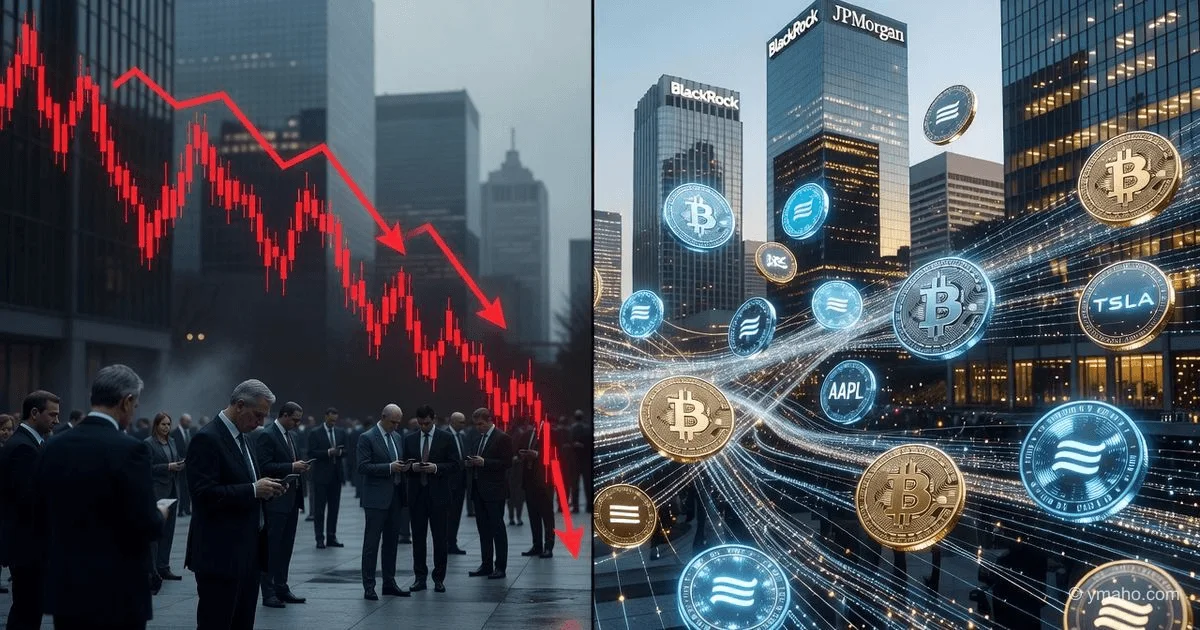
Institutional Interest Shifts Toward Stablecoins and RWAs as Bitcoin Weakens
Bloomberg notes that despite Bitcoin's price decline, the stablecoin and real-world asset (RWA) tokenization sectors continue to grow due to real demand for payments, settlements, and on-chain transfer of traditional assets.
Headline: The Great Divergence: Why Bitcoin's Decline No Longer Kills the Crypto Industry
Author: Independent Financial Analyst, Digital Assets Specialist
Date: 2026-06-12
[The Gist]: What's Really Happening
Bloomberg is right about one thing: stablecoin and RWA tokenization sectors are indeed growing amid Bitcoin's decline. But calling it a "shift in interest" is an understatement. What we're actually witnessing is a structural decoupling unseen in any previous cycle. For the first time in crypto history, two parallel universes—speculative (memecoins, zero-utility altcoins) and infrastructure (payments, RWAs, institutional settlement)—are moving in opposite directions.
Sergey Nazarov, co-founder of Chainlink, recently stated that the RWA industry has "decoupled" from crypto prices. And the data backs this up: the tokenized RWA market has reached $33.6 billion, tokenized US Treasury bonds have surpassed $15 billion, and tokenized equities have grown 422% over the past 18 months. All this while Bitcoin loses 15-20% from its highs.
Insider insight that goes unspoken: BlackRock, Franklin Templeton, and JPMorgan aren't just "interested" in RWAs. They are restructuring their business models around blockchain. BlackRock recently filed for two new tokenized Treasury funds, and its BUIDL has already exceeded $2.85 billion in AUM across nine blockchains. Franklin Templeton held a roadshow at the Louvre (which I covered separately). JPMorgan launched MONY, a tokenized money market fund on Ethereum. These aren't experiments. These are production systems.
The most important point: this shift doesn't require a Bitcoin price rally. Stablecoins enable transactions, RWAs generate yield, and institutions gain operational efficiency. Bitcoin's price may fall, but USDC and USDT transaction volumes continue to rise—in January 2026 alone, stablecoins processed over $10 trillion in on-chain volume.
Timeline and Context
To grasp the scale of the divergence, look at the dynamics of three key metrics over the past 18 months. I've compiled data from multiple sources to show how the speculative and infrastructure layers move in opposite directions.
| Metric | Jan 2025 | Jun 2026 | Change | Comment |
|---|---|---|---|---|
| Bitcoin (BTC/USD) | ~$75,000 | ~$63,500 | -15% | Decline amid macro headwinds and ETF outflows |
| RWA Market (tokenized assets) | ~$2B | ~$33.7B | +1,585% | Explosive growth driven by institutional demand |
| Tokenized US Treasury Bonds | ~$1.5B | ~$15.5B | +933% | Fastest-growing RWA segment |
| Tokenized Equities | ~$200M | ~$1.4B | +600% | After Ondo Global Markets launch |
| Stablecoin Market Cap | ~$200B | ~$316B | +58% | USDT ~$184B, USDC ~$78B |
| Stablecoin Transaction Volume (Jan 2026) | — | $10T | — | Comparable to Visa |
Table 1: Divergence of speculative and infrastructure layers in the crypto market (Jan 2025 – Jun 2026)
What these numbers mean. While Bitcoin falls (painful for holders), the RWA market has grown 17x. Stablecoins added 58% in market cap. Tokenized Treasury bonds—nearly 10x.
Key context often missed: this growth occurred amid tight Fed monetary policy and outflows from crypto ETFs. Typically, the crypto sector only rallies on cheap money and retail enthusiasm. Now we see the opposite: rates are high, liquidity is squeezed, but infrastructure projects thrive. This anomaly signals a shift in growth drivers.
Another crucial context: in July 2026, DTCC launches limited production activity for tokenized securities, with full deployment expected in October. This means the world's largest securities depository (DTCC processes quadrillions of dollars) is officially integrating blockchain into traditional financial infrastructure. After this, "tokenization" will cease to be an option and become the standard.
Who Wins and Who Loses
The shift from speculation to infrastructure creates clear winners and losers. But it's not as straightforward as it seems.
Winners:
Stablecoin Issuers (Tether, Circle): Their business model is to hold reserves in US Treasury bonds and earn interest income. With Fed rates at 3.5-4.5%, this generates massive profits. Tether, with a $184B market cap, earns ~$7-8B annually from coupons alone. This income is independent of Bitcoin's price.
RWA Infrastructure Providers (Chainlink, Securitize, Tokeny): Chainlink has become the de facto standard for oracles and cross-chain interoperability in institutional projects. CCIP (Cross-Chain Interoperability Protocol) is already used by DTCC, SGX, and Fidelity International. Securitize, which helped BlackRock launch BUIDL, is likely an acquisition target for a major bank.
Blockchains with RWA Ecosystems (Ethereum, Avalanche, Solana): Ethereum remains the dominant settlement layer for tokenized assets, accounting for 55-65% of all RWA volume. Avalanche is widely used in institutional subnets (e.g., JPMorgan Onyx). Solana shows record RWA activity growth in holder count and lending volume, despite SOL's price drop to $65.
Traditional Asset Managers (BlackRock, Franklin Templeton, Fidelity): They were first to market with tokenized products and are now capturing liquidity that previously flowed to unregulated DeFi protocols. BlackRock's BUIDL ($2.85B) is the largest tokenized fund and will only grow, especially after the expected SEC approval for trading tokenized equities on DeFi platforms.
Losers:
Speculative Altcoins with No Fundamental Utility (most of the top 100 by market cap): Capital is flowing out of memecoins and "next big L1" into RWAs and stablecoins. This rotation is not temporary—it's structural. Institutions won't return to tokens without yield or regulation.
Decentralized Exchanges (DEXs) Without Institutional Liquidity: The rise of RWAs means liquidity concentrates around tokenized Treasury bonds and equities traded on permissioned DEXs or through institutional market makers. Uniswap and Curve will capture some of this flow, but not the majority.
Unregulated Crypto Exchanges (KuCoin, MEXC, Bitget): They cannot offer access to tokenized equities and bonds due to lack of licenses. All RWA traffic goes to Coinbase Institutional, Kraken, and OKX, which hold the necessary licenses (ATS or equivalents).
What the Media Isn't Saying
Bloomberg writes about a "shift in interest." But they don't mention three things that change everything.
Insider #1: The SEC is preparing an "innovation exemption" for trading tokenized equities on DeFi. According to a Bloomberg report from May 18, the SEC under Paul Atkins is preparing a 12-36 month regulatory sandbox that would allow tokenized equities to trade on DeFi platforms subject to KYC and anti-fraud requirements. Crucially, third parties will be able to issue tokens tied to public equities without the issuer's permission. This means anyone can tokenize Apple, Nvidia, or Tesla and launch trading on Uniswap. This kills the monopoly of traditional exchanges on listings.
Insider #2: The $33.6B RWA market is just the tip of the iceberg, as it excludes private, permissioned blockchains. Data from RWA.xyz and similar aggregators only covers public blockchains. But JPMorgan, DTCC, and Euroclear operate on private or hybrid networks. By my estimates, the real volume of tokenized assets (including repos, commercial paper, and loans on private blockchains) is $100-150B. Official figures are understated by at least 3-4x.
Insider #3, the most cynical: The rise of RWAs and stablecoins is not a "crypto victory." It's a victory of Traditional Finance (TradFi) over crypto-native. BlackRock and Franklin Templeton aren't building a decentralized utopia. They're using blockchain as a more efficient database for their existing products. They don't use DAOs, conduct token sales, or airdrop. They simply issue tokens representing Treasury bonds and sell them through Coinbase. This is Finance 2.0, not a crypto revolution. And the biggest losers in this game aren't memecoins, but crypto-native projects that tried to build a parallel financial system and lost the battle for institutional capital.
Forecast: Next 30 Days and 90 Days
Next 30 Days (July 12, 2026):
The divergence will continue. Bitcoin will likely test $58,000-$60,000 amid anticipation of the FOMC meeting on June 17 and hawkish rhetoric from Kevin Warsh. But tokenized Treasury funds (BUIDL, Benji) will keep growing: I expect their combined AUM to exceed $20B by mid-July. Stablecoins will also show growth: USDC's market cap could reach $85B due to capital inflows from risky assets.
Key date: end of June, when the SEC is expected to officially announce the "innovation exemption" for tokenized equities. This will trigger a sharp spike in interest for tokenized equities and supporting platforms (Ondo, Backed, Swarm). Tokens tied to RWA infrastructure (Chainlink, Avalanche) will get a 15-20% boost.
Next 90 Days (September 2026):
By fall, the market structure will fundamentally change. If DTCC launches tokenized securities into production in October as stated, this will be the moment when "crypto" and "traditional finance" merge into a single system. I expect major banks (JPMorgan, Citi, BNY Mellon) to announce their own tokenization initiatives using DTCC's infrastructure.
For the crypto market, this means a final split into two asset classes. Class A—infrastructure assets (stablecoins, RWA tokens, tokenized equities)—will grow independently of Bitcoin. Class B—speculative altcoins without utility—will continue to decline as capital does not return. I predict Bitcoin's dominance index will rise to 58-60%, but its absolute price may remain in the $60,000-$75,000 range.
Long-term conclusion: by end of 2026, the "crypto industry" will cease to be a monolithic concept. There will be "digital assets" (tokenized traditional products under SEC/CFTC regulation) and "speculative crypto" (Bitcoin, Ether, memecoins). And these two worlds will intersect less and less.
| Asset/Sector | Current Value | Forecast Jul 12, 2026 | Forecast Sep 12, 2026 | Key Driver |
|---|---|---|---|---|
| Bitcoin (BTC/USD) | ~$63,500 | $58,000 - $60,000 | $60,000 - $65,000 | Fed rhetoric, ETF outflows |
| RWA Market (tokenized assets) | $33.7B | $40-42B | $50-55B | Institutional demand, DTCC |
| Tokenized Treasury Bonds | $15.5B | $18-20B | $25-30B | High Fed rates, safety |
| Stablecoin Market Cap | $316B | $330-340B | $360-380B | Capital parking, payment services |
| SOL Price (Solana) | ~$65 | $55-60 | $50-70 | RWA activity, but alt pressure |
Table 2: Forecast of key metrics amid divergence of speculative and infrastructure layers
Editorial Forecast
Asset: Chainlink Token (LINK/USD) — up in the next 24-72 hours as the market re-evaluates LINK's role as an infrastructure layer for institutional tokenization (oracles, CCIP for DTCC and Euroclear).
Key Levels: current support at $14.50 USD, resistance at $16.20 USD. If it holds above $16.50 USD, we expect a move to $18.00-19.00 USD within 5-7 days.
Confidence Level: moderate (55%), as the overall crypto market decline could outweigh the positive RWA fundamentals, but the structural trend remains bullish for LINK.
Main Risk: Unexpected hawkish Fed rhetoric on June 17, triggering panic and liquidations across the market, including RWA tokens, despite their fundamental independence.
Editorial opinion is not investment advice.
— Editorial Team