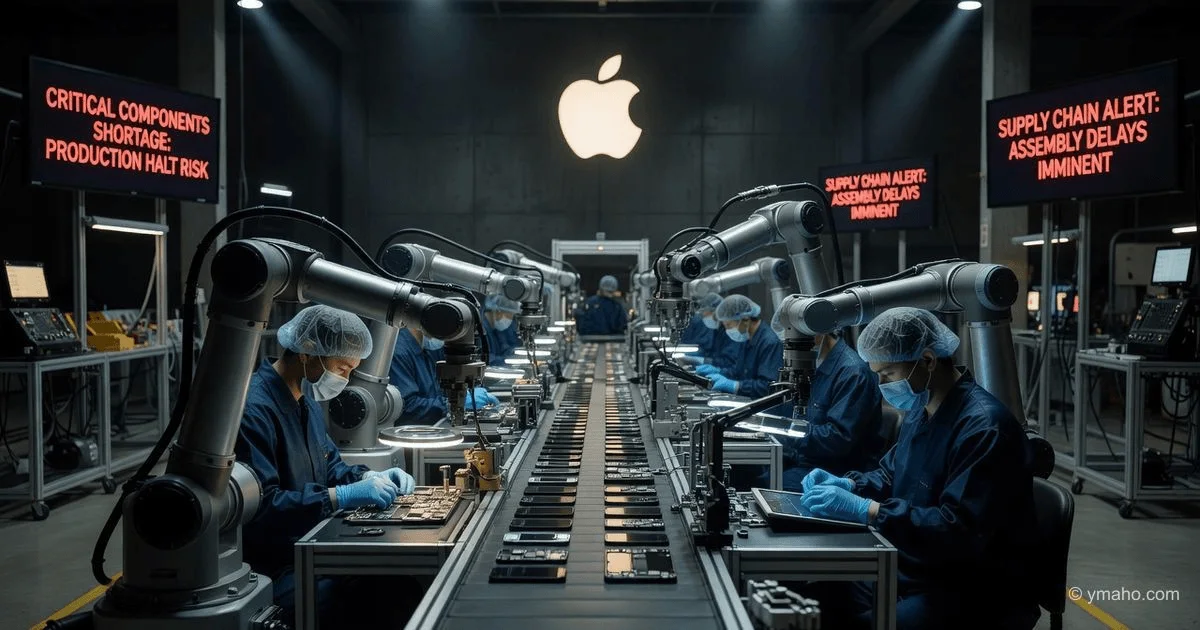
Apple Lowers iPhone 17 Shipment Forecast Due to Asian Supplier Issues, Shares Drop 3.2%
The company reported that shipments in the September quarter will be 5-7 million units below expectations. Goldman Sachs analysts downgraded AAPL to 'hold'.
Apple Lowers iPhone 17 Shipment Forecast: Anatomy of a Crisis You Won't Notice in the Headlines
[The Gist]: What's Really Happening
You see the numbers: Apple shares fell 3.2% after the company reported a 5-7 million unit reduction in iPhone 17 shipments for the September quarter. Goldman Sachs downgraded the stock to 'hold'. It seems obvious: problems with an Asian supplier mean fewer phones, less revenue, falling shares. But that's just the surface.
The real story is a tectonic shift in the global semiconductor supply chain that Apple, the company with the best supply chain in the world, cannot control. For the first time in a decade, Apple faces a situation where its 'persuasion power' and 'ability to buy whatever it needs' have stopped working. The cause is not a single failure at one supplier, but a systemic crisis affecting both advanced SoCs (systems on a chip) and basic components like DRAM simultaneously.
Tim Cook, during the Q2 2026 earnings call, admitted what was previously unthinkable to discuss publicly: 'our supply chain flexibility is below normal levels,' and 'bottlenecks are concentrated on advanced process nodes for SoCs.' Apple, which for decades dictated terms to its suppliers and maintained months of inventory, now must not only pay more but pay astronomical sums with no guarantee of results.
My insider take: This situation has been brewing for two years, since the start of the AI boom. Nvidia and its clients (Microsoft, Google, Amazon) have bought up virtually all of TSMC's advanced process capacity for 2025 and 2026. Apple, accustomed to being TSMC's first customer, suddenly found itself in line. Now, even for its own A19 chips made on the 3-nanometer process, Apple competes with AI accelerator manufacturers willing to pay any price.
Timeline and Context
The table below maps how Apple has gradually lost control of its own supply chain over the past six months and how the market reacted to each signal.
| Date | Event | Impact on Apple | What's Hidden |
|---|---|---|---|
| April 2026 | Tim Cook warns of chip shortage on earnings call | Shares lose 2% | First public acknowledgment of problems |
| Early May 2026 | Apple begins talks with Intel and Samsung about new foundries | Shares fluctuate, news doesn't cause panic | Company desperately seeks TSMC alternatives |
| Mid-May 2026 | Samsung bills Apple 100% more for DRAM — Apple agrees without negotiation | Volatility spike in semiconductor sector | 'Seller's market' confirmed: Apple can no longer dictate prices |
| June 1, 2026 | Bank of America raises AAPL target to $380, forecasting AI revenue growth | Short-term positive, shares test $300 | Analysts haven't fully accounted for supply chain issues |
| June 8-9, 2026 | WWDC 2026: Siri AI presentation, shares initially rise to $317, then drop 5% | Two consecutive days of decline, $320 billion in market cap wiped out | Market disappointed by lack of concrete AI rollout timeline |
| June 10, 2026 | Apple officially lowers iPhone 17 shipment forecast | Shares fall 3.2%, Goldman downgrades to 'hold' | Crystallization of all previous risks |
| June-September 2026 | Expected DRAM and SoC shortage for iPhone 17 Pro | Forecast: potential loss of 5-7 million units | The hardest part is yet to come |
| 2027 (forecast) | Bank of America expects 5% iPhone shipment growth after supply stabilizes | Long-term positive | But only if the supply chain holds up |
Note the chronology of May events. Apple first announced talks with Intel and Samsung, then, just a couple of weeks later, meekly agreed to Samsung's doubled DRAM prices. This isn't just 'market conditions.' It's a signal that Apple can no longer use its traditional suppliers to keep second- and third-tier prices in check. When you pay Samsung double without negotiation, the whole market knows you're desperate for components.
Who Wins and Who Loses
Winners:
Samsung and SK Hynix: Memory manufacturers are in a position they could only dream of. SK Hynix's DRAM and NAND inventories have shrunk to about four weeks. Samsung billed Apple with a 100% markup and got agreement without negotiation. SK Hynix, Micron, and others are expected to follow Samsung's lead, raising prices for all major buyers. This isn't a temporary spike — it's a structural shift in favor of memory makers.
Intel: The company, which has made its foundry division the top priority, has a chance it hasn't had in 15 years. Talks with Apple about chip production aren't just a potential contract. They validate that Intel Foundry has reached a level where the world's most demanding customer considers it. Even if the deal falls through, the talks themselves have boosted confidence in Intel as a manufacturer.
TSMC (short-term): Despite Apple seeking alternatives, TSMC remains dominant. The company is so loaded with orders from Nvidia and AI clients that it can dictate terms to Apple. However, TSMC's long-term outlook is less rosy — Apple, as soon as it can, will start diversifying orders.
Consumers who already bought iPhone 17: Their devices will hold value longer as total market volume shrinks. Supply scarcity means used iPhone 17s will sell at higher prices than usual.
Losers:
Apple (obviously): The company is losing not just 5-7 million units in the September quarter. It's losing its reputation as an 'unsinkable' supply chain manager. Market cap has already lost $320 billion in two days after WWDC. If supply issues drag on, losses could be much larger.
Apple shareholders: Those who bought shares near the $317 high on WWDC day are already seeing an 8-10% loss. Goldman Sachs downgraded to 'hold,' which could trigger further selling by institutional investors following the bank's recommendations.
Small and medium electronics manufacturers: Apple absorbs the lion's share of available components, paying any price. This crowds out smaller companies that don't have the 'fat layer' of $100 billion in annual profit.
Chinese consumers: Apple has already started cutting iPhone 17 prices in China ahead of the 618 holiday. This isn't a 'loyalty discount.' It's an admission that competition from Huawei is too strong, and even with shortages, Apple must sacrifice margins in its most important region.
What the Media Isn't Saying
First. Apple's problem isn't one supplier, but the architecture of global chip manufacturing. For 15 years, Apple built a system where TSMC was the sole manufacturer of its most advanced chips. This gave advantages in efficiency and quality control. But when the monopolist is fully booked with AI orders, Apple has no room to maneuver. Talks with Intel and Samsung aren't future diversification. They're a cry for help in the present. But both Intel and Samsung are years behind TSMC in process technology. Any transition would take 2-3 years and require billions in investment.
Second. Apple is deliberately delaying the iPhone 18 launch to hide the scale of the problem. According to insiders, the base model iPhone 18 has been pushed from September 2026 to early 2027. The official reason is 'the company wants to extend the iPhone 17 lifecycle.' Unofficially, Apple cannot produce two iPhone generations simultaneously amid component shortages. By keeping iPhone 17 on production lines longer, Apple reduces the need for new components for iPhone 18 and saves on retooling. This is a smart tactical move, but it reveals the depth of the strategic crisis.
Third. Apple Intelligence won't save iPhone sales in 2026 — and Apple knows it. At WWDC 2026, the company finally introduced a completely revamped Siri with multi-step actions and contextual awareness. The market reaction was immediate and brutal: shares crashed 5% during the presentation, and market cap lost $320 billion in two days. Why? Because Apple didn't give specific timelines. Siri AI will launch 'later this year' in beta. For investors, this means the AI-driven iPhone super-cycle won't start in September 2026. It may not start at all in 2026. Without a super-cycle, Apple's multiples, currently around 30 P/E, must contract.
Fourth. Over 13 billion Apple devices won't be able to use the new Siri. Morgan Stanley data shows that over 8.5 billion iPhones don't support even basic AI queries, and over 13 billion devices (including older iPads and Macs) are incompatible with advanced Siri AI features. This means the vast majority of users will need to buy a new device to access the 'new AI era on iPhone.' But with people tightening their belts due to inflation and rising gas prices, and the new iPhone 17 Pro starting at $1,099, many will prefer to keep their old phone and forgo AI. Apple is trapped by its own success: the ecosystem is too large to upgrade quickly.
Forecast: Next 30 Days and 90 Days
Next 30 days (until July 11):
- Apple shares (AAPL) will trade in the $270–$290 range. The lower bound could be tested if news of further component disruptions emerges. The upper bound is unreachable without positive news on supply chain fixes.
- Goldman Sachs has already downgraded to 'hold.' If other major banks (Barclays, UBS) follow suit, the decline could accelerate. Barclays already maintains an 'underweight' rating with a $253 target.
- Attention will shift to official comments from TSMC and other suppliers. If TSMC confirms it prioritizes AI clients over Apple, that's a bearish signal.
Next 90 days (until September 2026):
- The iPhone 17 launch in September will happen, but volumes will be limited. Apple may shift focus to higher-margin Pro and Pro Max models, sacrificing base iPhone 17 sales. This will support financial metrics but reduce market share.
- The Q4 2026 earnings report (September-October) will be the moment of truth. If Apple reports revenue below $100 billion (vs. $111 billion a year ago), shares could fall to $240-250.
- Rumors of a partnership with Intel will either be confirmed or denied. If a deal happens, it's positive for long-term prospects but won't solve 2026 problems. If talks collapse, the market will see it as another sign Apple is cornered.
Editorial Forecast
Asset: Apple shares (AAPL). Direction: moderate decline in the next 24–72 hours to the $285–$288 zone. Key levels: resistance — $296 (current level after drop from $317), support — $280 (psychological level and May 2026 low). Confidence level: medium (55%). Main risk: a sudden announcement of a supplier solution or a major Intel contract could trigger a bounce to $300. However, given the structural nature of the problems (TSMC capacity shortage and Samsung memory price hikes) and the lack of concrete AI rollout timelines, the probability of further decline in the coming days is higher. We recommend refraining from buying until the supply situation clarifies.
This analysis represents the editorial opinion and does not constitute individual investment advice. All decisions to buy or sell assets are made at your own risk.
— Editorial Team