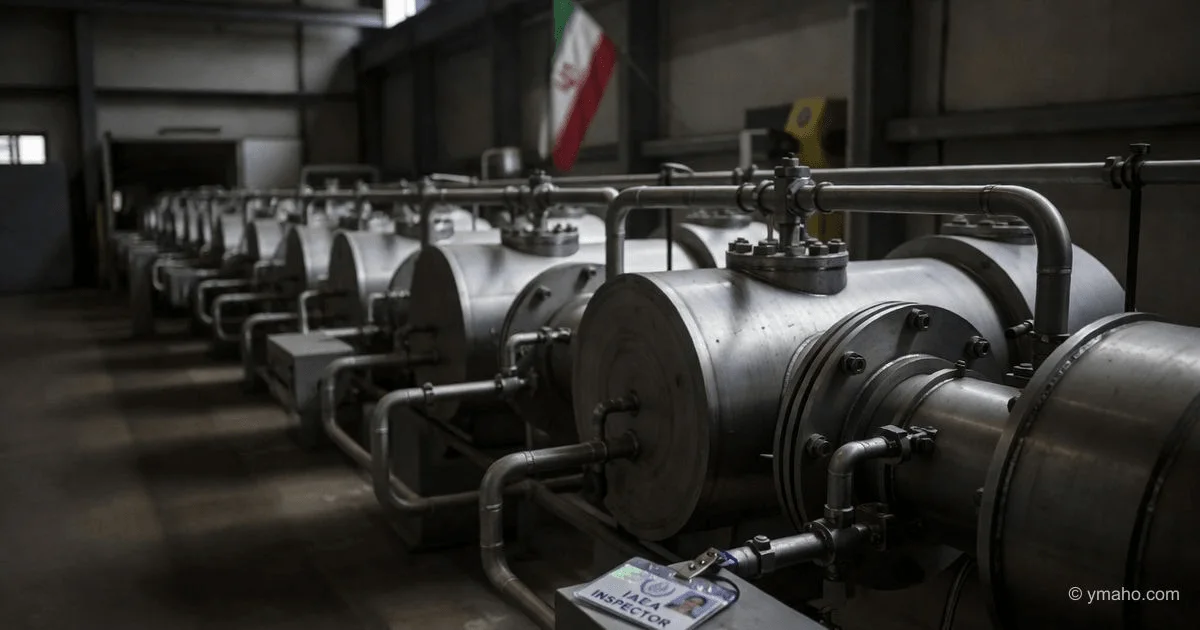
IAEA Demands Iran Disclose Enriched Uranium Stockpile Data
The Board of Governors adopted a resolution demanding "immediate and necessary" declaration of remaining stocks and full access for inspectors.
The Ghost in the Centrifuge: How the IAEA Resolution Will Crash the Uranium Market and Ignite Oil Futures
Author's analysis for those who understand: the "nuclear issue" has long been not about bombs, but about supply shortages across three markets at once.
While Western media rehash the news about the IAEA Board of Governors resolution demanding Iran disclose data on enriched uranium stockpiles, retail investors wonder: "Is this good or bad for gold?" The answer: it has no direct bearing on gold. But it has a direct bearing on uranium, oil, and the dollar. And the connection is like a detonator that has already been pressed—the sound just hasn't reached us yet.
The key point everyone is silent about: the IAEA no longer knows where 972 pounds (about 440 kg) of uranium enriched to 60% are located, which Iran had before the US and Israeli strikes in June 2025. This amount is sufficient to create 10 nuclear warheads. And agency inspectors have not seen this material since June 10, 2025. A year without control. A year of uncertainty.
In this article, I will break down why the IAEA resolution is not a diplomatic démarche but a trigger for three scenarios: a collapse of confidence in uranium ETFs, a new round of oil rally, and a hidden devaluation of the dollar that no one writes about.
[The Core]: What Is Really Happening
On June 10, 2026, the IAEA Board of Governors adopted a resolution demanding that Iran provide "immediate and necessary" disclosure of data on enriched uranium stocks and grant full access to inspectors. The resolution was supported by 21 countries (in favor), 10 abstained, and 3 (Russia, China, Niger) voted against. Formally, this is pressure on Tehran. In reality, it is a confirmation of the fact: the IAEA has lost control.
The situation is absurd from a technical standpoint. Iran still declares that its nuclear program is peaceful. But IAEA inspectors have not been able to verify facilities in Fordow, Isfahan, and Natanz since June 2025, and most importantly, the material itself—uranium enriched to 60%. IAEA Director General Rafael Grossi stated outright in an AP interview: a stockpile of 440 kg is enough for 10 bombs. And he added: "This does not mean Iran has such weapons. But it means we cannot rule it out."
For a financial analyst, this means only one thing: the market is starting to price in a premium for 'nuclear uncertainty'. Previously, this premium was in the price of uranium (as raw material for peaceful nuclear energy). Now it is spilling over into oil (risk of Israeli-American strikes on Iranian infrastructure) and the dollar (flight to safety). Because if 440 kg of uranium has "gone missing," the next step is either they are found at the bottom of the Gulf (worst-case scenario for the environment), or Israel launches a full-scale operation to find and destroy them, which means direct war with Iran.
[Timeline and Context]
The table below shows how the situation with Iran's nuclear program developed from June 2025 to June 2026, and how markets reacted to key milestones.
| Date | Event | Market Reaction | IAEA Control Status |
|---|---|---|---|
| June 2025 | US and Israel strike nuclear facilities in Fordow, Natanz, Isfahan | Brent oil: rise to $120 (short-term) | Inspectors denied access to facilities from this point |
| June 10, 2025 | Last time inspectors saw 440 kg of 60% uranium | Uranium: $90-95 (year peak) | Point of loss of control |
| February 2026 | New US-Israeli military operation against Iran | Uranium: drop to $85 | No access, no verification |
| June 1-3, 2026 | Inspectors visit only Bushehr NPP (Russian uranium 4.5%) | Uranium: $85.70 | Formally "partial access," actually zero |
| June 6, 2026 | US circulates draft resolution to Board of Governors | Uranium: stable at $85 | Escalation expected |
| June 10, 2026 | Resolution adopted: 21 in favor, 10 abstained, 3 against | Gold: drop to $4206 (low since March) | De jure pressure, de facto admission of failure |
Note the last row: gold is falling. This contradicts classical logic (conflict → gold up). Why? Because the market sees the Middle East war becoming "permanent," and the dollar is the only liquid currency for energy settlements. Gold is currently losing to the dollar in the battle for safe haven, as I have written in previous analyses.
[Who Wins and Who Loses]
Winners #1: Uranium Producers Outside Iran (Kazatomprom, Cameco, Orano)
Paradox: loss of control over Iranian uranium is a bullish signal for legitimate producers. Because Western countries (especially the EU and Japan) will now seek to diversify supply sources for their nuclear power plants, reducing any, even theoretical, dependence on the region. Kazakhstan (Kazatomprom) is the main beneficiary: its share of global production is 40%+. Canada (Cameco) and Australia (Paladin) are also in the black. I expect shares of these companies to rise 10-15% in the next 3 months as European utilities begin renegotiating long-term contracts with a premium for "geopolitical reliability."
Winners #2: Traders Playing the Gap Between Physical Uranium and Futures
Physical uranium (U3O8) is currently trading at a discount to long-term contracts because the spot market is sluggish—utilities already bought under contracts in 2024-2025. But if the IAEA announces it cannot verify Iranian stocks, the spot market will "wake up," and the price of physical uranium could jump to $95-100 per pound within 2-3 weeks. Uranium futures (traded on NYMEX) will react faster. The difference between them is arbitrage for hedge funds.
Losers #1: Holders of Long Gold Positions (Short-Term)
Gold is falling to $4206 per ounce—a low since March 23, 2026. The reason is the high probability of a new Fed rate hike. The market prices in over 70% probability of a rate hike by year-end. High rates kill gold because it has no coupon income. The paradox is that the conflict with Iran pushes oil up, oil pushes inflation up, inflation pushes the Fed to raise rates, and rate hikes push gold down. Iran, unwittingly, has become an ally of the Fed hawks.
Losers #2: International Law and the Non-Proliferation Regime
As a financier, I also evaluate this asset. Trust in the IAEA as an institution is an intangible asset that ensures stability in the nuclear fuel market. Now this asset is devalued. If the IAEA cannot verify facilities in Iran for a year, why should other countries (North Korea, possibly Saudi Arabia in the future) maintain transparency? This creates a risk of a chain reaction—other countries will start hiding their programs, leading to fragmentation of the uranium market and growth of "gray" exports.
[What the Media Isn't Saying]
Insight #1: 440 kg of 60% Uranium = 10 Bombs. But Where Are They?
The figure of 440 kg appears in IAEA reports. But this amount was declared by Iran before the strikes. After the strikes in June 2025, inspectors were not allowed into the facilities. Iran stated it had taken "special measures to protect nuclear equipment and materials." What are these measures? Removal? Relocation to underground bunkers? Dispersal among "sleeper cells"? No one knows. Non-proliferation expert Kelsey Davenport from the Arms Control Association told AFP: "It will be difficult, if not impossible, to track all of Iran's 60% uranium stored in small canisters that are easily transportable by car."
For the financial market, this means: physical Iranian uranium becomes a 'shadow' commodity that could surface anywhere and anytime, crashing spot prices. No trader wants to buy uranium at $90 if 440 kg of "unaccounted" material (at current prices about $12 million—not much for the global market, but enough for psychological shock) hits the market tomorrow. The market is frozen in anticipation.
Insight #2: The Resolution Is a Weapon Against Russia and China, Not Just Iran
Note the vote: Russia and China voted against. This is not just solidarity with Iran. It is a market marker: Moscow and Beijing do not recognize the legitimacy of the IAEA's demands, meaning they will not participate in any future sanctions against Iran on the nuclear track. This creates "two camps" in uranium trade: Western (IAEA-controlled, with verification) and Eastern (where Iran can sell its uranium through Russia or China without verification). In effect, this legitimizes a "shadow" uranium market, already priced into the discount of current futures ($85 instead of a potential $100).
Insight #3: Why Isn't the Uranium Price Rising Despite Colossal Risk?
Currently, uranium trades in a narrow range of $85-86 per pound. That is 21% higher than a year ago, but far from historical highs ($148 in 2007). Why is the market reaction so tepid? Because utilities (uranium buyers) have switched to long-term contracts since the start of the Russia-Ukraine war and are not entering the spot market. They don't care what happens in Iran today—they have fixed prices and volumes for 2-3 years ahead. Speculators know this and cannot "ramp up" the market because there is no real demand. The IAEA resolution will not change this structure. Uranium will remain in the $80-95 range until utilities start entering the market for new contracts (expected no earlier than 2027).
[Forecast]: Next 30 Days and 90 Days
30 days (June to mid-July 2026): Uranium—sideways, oil—up, gold—under pressure.
I expect the uranium price (U3O8) to remain in the $84-88 per pound range. No amount of IAEA pressure will force utilities into the spot market early. Brent oil will continue to rise toward $98-102 because the risk of Israeli strikes on Iran in response to "nuclear uncertainty" increases. Gold will remain under pressure in the $4100-4250 range as the market prices in a Fed rate hike with >70% probability. My recommendation: long positions in oil (Brent, WTI) and short gold (GLD) on a 30-day horizon.
90 days (August-September 2026): Resolution as a pretext for escalation.
In the baseline scenario (60% probability), Iran will ignore the resolution or give a formal but incomplete response. The IAEA will declare an "inability to guarantee the peaceful nature of the program," triggering new US sanctions on Iranian exports (a naval blockade is already in place, but sanctions could expand to the financial system). This will not directly affect uranium but will strengthen the dollar (DXY to 103-105) and continue to pressure the euro and yen. In an alternative scenario (25% probability), Israel will launch new strikes on Iran—not on nuclear facilities (they are destroyed), but on Iranian oil terminals and air defenses. Then oil will spike to $115-120 within 2-3 weeks, and the Fed will be forced to raise rates even more aggressively, crashing the US stock market by 5-8%.
Editorial Forecast
Asset: Brent Oil (BZ1! or UKOIL).
Direction: Up in the next 24-72 hours on news of the resolution and risks of new Israeli strikes.
Key Levels: Resistance $95.50, breakout to $98.00. Support $91.00.
Confidence Level: Medium (55-60%). The market has already priced in part of the news in previous days, but Israel's rhetoric ("far from over") and nuclear uncertainty add a premium.
Main Risk: A sudden diplomatic statement from Iran about readiness for full cooperation with the IAEA—unlikely (given the Russia and China "no" vote), but theoretically possible and would cause a 3-4% correction in oil.
— Editorial Team