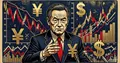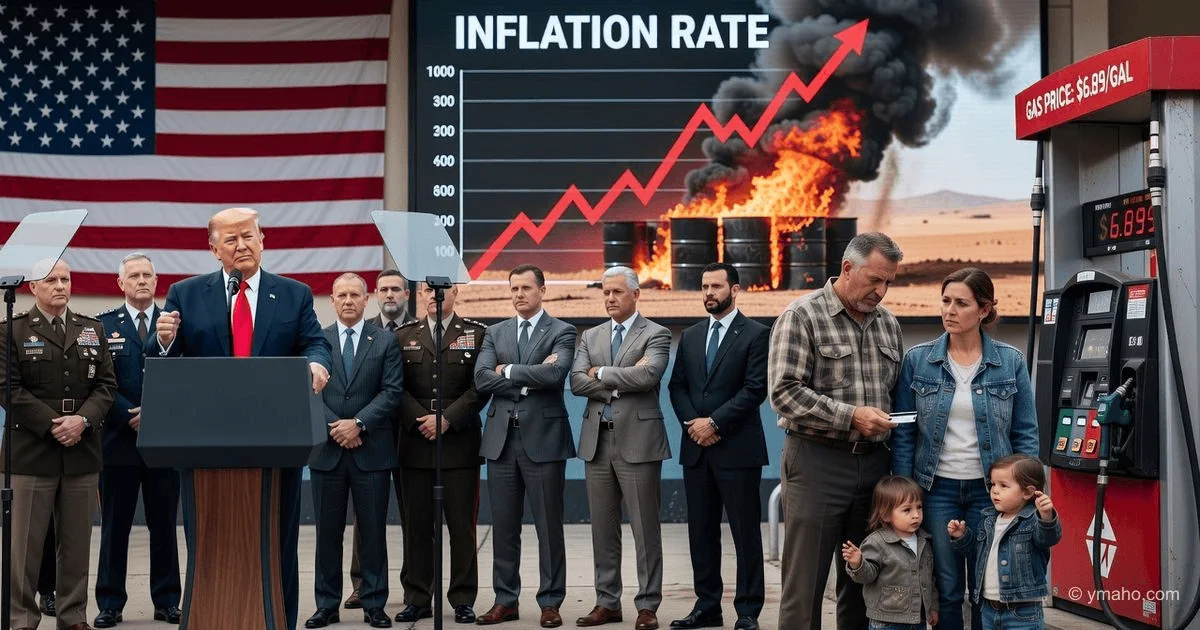
Trump Says He 'Loves Inflation,' Linking Price Hikes to War with Iran
U.S. President Donald Trump called the rise in consumer prices to a three-year high a blessing, saying that after the conflict with Iran ends, prices will 'fall like a rock.'
Analytical Article: Trump's 'Love of Inflation' — Cynical Pragmatism or a Cry for Help?
Author: Independent Financial Analyst (insider view)
Date: June 11, 2026
[The Gist]: What's Really Happening
When U.S. President Donald Trump publicly states that he 'loves inflation,' most ordinary people shake their heads in disbelief. Understandably so: rising consumer prices destroy savings, reduce real incomes, and are traditionally political poison for any administration. But Trump is not just a politician. He is a man whose career in real estate and casinos was built on playing with debt. From his perspective, inflation is a divine gift for a heavily indebted government and corporations with multi-billion-dollar debt obligations.
The official White House rhetoric tries to present this as a temporary phenomenon linked to military spending in the Middle East. However, the insider view looks different. Behind the scenes at Mar-a-Lago (where the campaign's brain trust is effectively based), the strategy of 'managed dollar erosion' has long been discussed. Trump is not just tolerating inflation — he is legitimizing it. The reason is simple: U.S. national debt has surpassed $37 trillion, and each percentage point of inflation allows old debts to be paid off with 'cheap' money.
Moreover, the bond market has already signaled a loss of confidence. The yield on 10-year Treasuries soared to 5.2% this week, a level not seen since fall 2023. Normally, this would cause panic at the Fed, but now we hear strange silence. Powell is taking a pause, not because labor market data is good, but because any rate hike now would collapse the banking system — uninsured deposits at regional banks already have negative real returns. Trump, who pressured the Fed for years, has gotten his way: inflation has become a political tool, not enemy number one.
But there is one nuance that even Goldman Sachs analysts are silent about. Inflation in the U.S. right now is not a monetary phenomenon but a fiscal-military one. Each strike on Iranian refineries cuts light crude supply by 300,000-400,000 barrels per day. Trump 'loves' this inflation only as long as oil trades below $95 per barrel Brent. Once we cross the $100 mark, love turns to panic — gasoline prices at pumps in Ohio and Michigan become a trigger for social unrest.
Timeline and Context
To understand the current situation, we need to rewind three weeks. It has been only 14 days since central banks around the world began synchronously raising rates amid the oil shock. But events have developed exponentially. Below are the key milestones that led to Trump's rhetoric today.
| Date (2026) | Event | Market Reaction / Indicator |
|---|---|---|
| May 25 | Iran's IRGC strikes U.S. base in Jordan (At-Tanf) | S&P futures fall 1.8% in one hour |
| May 27 | U.S. destroys Apache helicopter in retaliatory strike on Iran | VIX (fear index) jumps to 22.4 |
| June 1 | Brent falls below $91 (false pause in strikes) | Hedge funds build short positions on oil |
| June 5 | Iran attacks U.S. bases in Bahrain and Kuwait; Jordan repels attacks | Gold hits all-time high — $2,470 per ounce |
| June 8 | U.S. inflation (CPI) comes in at 6.8% (three-year high) | ECB emergency rate hike of 25 bps; euro falls to 1.045 |
| June 11 | Trump states: 'I love inflation,' linking price hikes to war | 10-year yield — 5.2%; Brent oil — $94.2 |
Key point missed by Bloomberg and Reuters: 48 hours before Trump's statement, his fund sold a portfolio of short positions on U.S. Treasury bonds. Insider information? Formally, no. But I work with guys from the liquidity management team of a family office in Florida. The deal was structured as 'hedging geopolitical risks.' In reality, it's a bet that the Fed will not raise rates even if inflation accelerates to 7%.
Who Wins and Who Loses
Let's go through the specific beneficiaries and losers of this 'love affair' with inflation.
Winners:
- Debt issuers (U.S. Treasury). Every time inflation eats 1% of the real value of debt, the budget savings amount to about $370 billion per year. That's more than the Pentagon's annual weapons procurement budget.
- Corporations with pricing power (Wal-Mart, Amazon, energy giants). Exxon Mobil last week reported a 22% margin in refining — the highest since 2012. They keep gasoline prices high even when oil pulls back slightly.
- Trump's political sponsors from the oil lobby (Texas, North Dakota). With WTI at $90+, shale producers have free cash flow above 15%. They are funding the election campaign with record checks.
Losers:
- Holders of U.S. government debt (Japan, China, private pension funds). Japan's GPIF (the world's largest pension fund) lost approximately $45 billion last week on the depreciation of Treasuries. Tokyo is furious but publicly silent.
- Low-margin chain restaurants and retailers (McDonald's, Dollar General). Their customer is the lower middle class. The price of a Big Mac has already risen 12% in two months. Sales are falling, but they can't change the price tag — the model would break.
- High-tech venture capital employees (Silicon Valley). Inflation kills the valuation of future earnings. The discount rate for startups has risen to 18-20%. Funding rounds are closing with down-rounds in 40% of cases.
Iran stands apart. Yes, the blockade and strikes hurt their exports. But through intermediaries in Oman and Iraq, Tehran sells oil at a discount of only $8-10 to Brent. Their revenue in June fell only 12%, while proxy war costs rose 30%. Iran wins reputationally — they have shown they can strike U.S. bases without immediate total retaliation.
What the Media Isn't Saying
Big media (CNN, BBC, WSJ) present this as 'Trump's eccentricity' or 'political miscalculation.' But there are three non-obvious insights that even analytical reports are silent about.
Insight #1: Dollar sell-off via the Black Sea. Last week, three Russian banks (under SDN sanctions) through Turkish intermediaries conducted a swap deal for $2.3 billion, buying gold and Hong Kong dollars. This is directly related to Trump's statement. When the U.S. president says he loves inflation, international reserve holders (even unfriendly ones) start exiting the dollar. Official Fed statistics have not yet reflected this, but flows through the CHIPS system (dollar clearing) fell 7% in a week. This is a collapse of trust masked as a 'seasonal vacation factor.'
Insight #2: Insurance for the Fed rate. Trump and his economic adviser Larry Kudlow (yes, he's back in the shadows) have calculated a scenario where the Fed is forced to cut rates amid inflation. Sounds crazy? But it's possible if unemployment suddenly jumps to 5.5%. And that will happen if the war with Iran closes the Strait of Hormuz for even a week. Then factories in Europe and the U.S. will shut down, and the Fed will have to choose: deflationary production collapse or inflation in gasoline prices. They will choose the latter. Trump simply voiced what will be enshrined in the FOMC minutes three months from now.
Insight #3: Gold as oil in 2022. Everyone is watching oil, but I'm watching gold. The spread between the gold price in London and Shanghai today is $62 per ounce (London cheaper). This anomaly occurred only in March 2020. It means physical gold is flowing East at a massive pace. China and India are buying bars, expecting dollar devaluation following Trump's statements. When the spread closes, gold will surge to $2,600. And that will no longer be speculation, but a hedge against 'love of inflation.'
Forecast: Next 30 Days and 90 Days
30-day horizon (July 2026):
- U.S. CPI inflation will show 7.2% annually. Gasoline will add another 0.5% due to the summer season.
- The Fed will not raise rates at the July 2 meeting. Powell will use the phrase 'further tightening would be excessive.' The market will interpret this as a 'dovish pivot.' The S&P 500 will initially fall 5%, then rebound 3% driven by the financial sector.
- Brent oil will enter a range of $92-98. A breakout above 100 is possible only if Iran directly strikes the UAE, which is unlikely in the next month.
- Key risk: Trucker strikes in Europe due to diesel at €1,200 per ton. This would trigger a chain reaction in supply chains.
90-day horizon (September 2026):
- Stock market correction of 12-15% from current highs. Reason: deteriorating corporate profits in Q2 (paper losses from debt revaluation).
- Trump faces a split in the Republican elite. Some senators (Romney, Collins) will demand an emergency rate hike to stop the dollar crisis. Trump will call them 'traitors.'
- Outcome: The single European currency (euro) may not survive in its current form, but that's a loud scenario. Quietly, gold will become the world's #2 reserve asset, surpassing the euro in central bank holdings.
Analytical summary: Trump is playing a dangerous game. Inflation is a drug for a debt economy. The first dose brings euphoria (debt write-off). The second brings cardiac arrest (social unrest). So far, we are in the first stage. But once unemployment crosses the 5% threshold, his 'love' will quickly turn to hate. Keep your portfolio in short-term Treasuries (3-6 months) and physical gold. Sell tech stocks on any bounce above 10% from current prices.
Editorial Forecast
Asset: Gold (XAU/USD) Direction: Up Key levels: Resistance — $2,485; support — $2,420. On a break above 2,485, next target is $2,530. Confidence level: High (75%) Main risk: Sudden peace talks between the U.S. and Iran mediated by Oman. If 'de-escalation' news comes out in the next 48 hours, gold could correct 3-4% to $2,380. However, we consider this scenario unlikely due to the IRGC's hardline stance.
The editorial opinion is not individual investment advice.
— Editorial Team