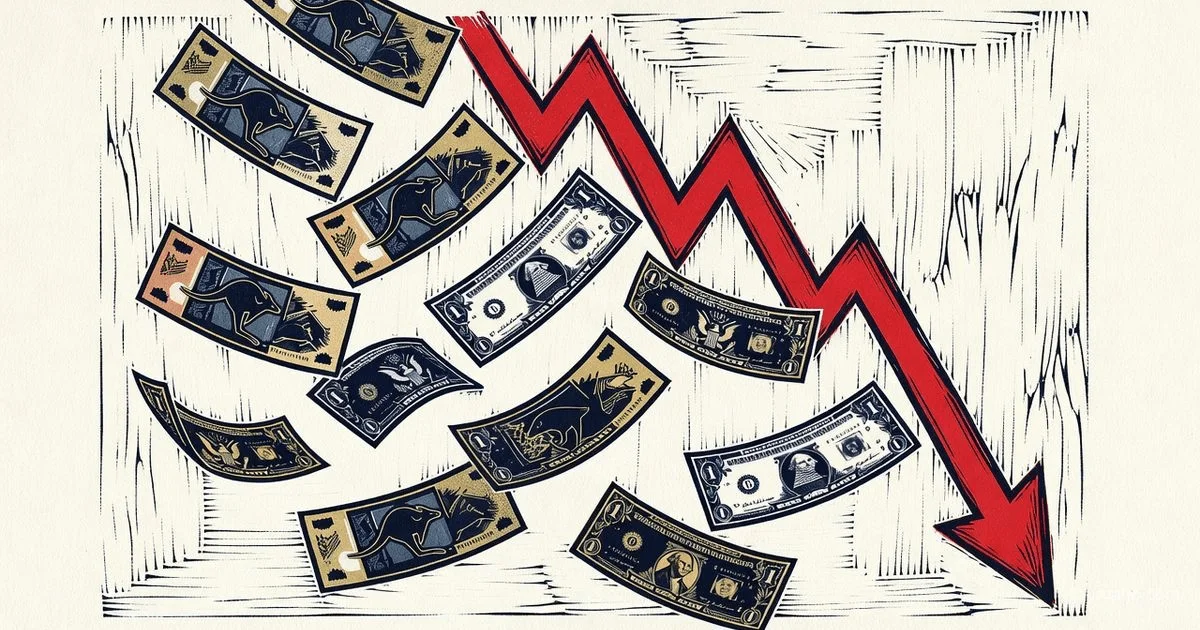
Australian Dollar Falls to 9-Month Low on Weak Chinese GDP Data and Iron Ore Prices
AUD/USD broke support at 0.6450. The Reserve Bank of Australia said the next rate move could be either up or down, increasing uncertainty.
Analytical article: Australian dollar crashes to 9-month low — why the RBA is cornering the economy
Colleagues, let's cut through the official statements. The Australian dollar broke support at 0.6450 and fell to a 9-month low. The official reason is weak Chinese GDP data and falling iron ore prices. But the reality is much deeper. This is not just a reaction to external shocks — it is a direct consequence of the Reserve Bank of Australia's misguided policy, which has been playing hawk while the economy crumbles before our eyes.
I work with capital flows in commodity currencies and see a worrying signal: the RBA is completely isolated. The Fed, ECB, and Bank of England are already easing policy or at least signaling a pause. And Australia? The RBA rate stands at 3.60% after a series of hikes. That's just 3 basis points below the effective Fed rate. Meanwhile, Australia's economy is growing at 0.2% per quarter — half the forecast. And they call this a "strong economy"? Let's break down where the Australian dollar is really headed and why the RBA is pushing it off a cliff.
[The Core]: What's Really Happening
The main paradox is that the RBA continues its hawkish rhetoric amid a rapidly deteriorating macroeconomic picture. Australia's economy grew only 0.2% in the first quarter of 2026, against an expected 0.4%. On an annual basis, GDP growth stalled at 1.3% — one of the weakest readings in decades outside the pandemic period. The current account deficit came in larger than forecasts, and business operating profits unexpectedly contracted. But the RBA keeps talking about inflation.
The second layer is the complete disconnect between the central bank's rhetoric and market expectations. The market is pricing in a 70% probability of a rate cut by August 2026. This is not just "expectations" — it's a direct challenge to the RBA. Traders are voting with their wallets: they don't believe the central bank can hold rates at current levels amid such an economic downturn. And they are right. The gap between RBA signals and reality has already caused AUD/USD to get stuck in a narrow range of 0.6450-0.6600 for weeks, unable to break either way. But the break below 0.6450 is a sign that the bears have finally taken over.
The third factor is the global context and Australia's position. Australia finds itself isolated among developed economies. While the ECB cut rates to 2.00%, the Bank of Canada to 2.25%, and the Bank of England to 3.75%, the RBA has cut only 75 basis points from its peak, whereas other central banks have cut 150-275 points. This has created the widest monetary policy divergence among G7 economies in 15 years. The Australian dollar suffers doubly from this gap: high rates stifle the domestic economy, and the global easing trend makes AUD uncompetitive.
Timeline and Context
Let's reconstruct the sequence of events leading to the crash:
| Date | Event | AUD/USD | Key Nuance |
|---|---|---|---|
| Early May 2026 | RBA raises rate to 4.35% — third consecutive hike | 0.6600-0.6700 | RBA diverges from global easing trend |
| Mid-May | Chinese GDP data weaker than forecasts | 0.6550-0.6650 | Drop in iron ore demand |
| Late May | RBA minutes: bank considered a 50 bps rate cut in May | 0.6500-0.6600 | Shock: RBA not as hawkish as it seemed |
| June 1-6, 2026 | Weak Australian GDP data (0.2% vs 0.4% forecast) | 0.6450-0.6550 | Break of 0.6500 support |
| June 8-9, 2026 | RBA statement: next rate move could be in either direction | 0.6430-0.6480 | Increased uncertainty |
| June 10-11, 2026 | Break of 0.6450, reaching 9-month low | 0.6410-0.6450 | Bearish trend confirmed |
Key moment: the RBA's May meeting minutes showed the central bank seriously considered a 50 basis point rate cut. This is a complete disconnect from its public hawkish rhetoric. The market remembers — and no longer believes a word from the RBA.
Who Wins and Who Loses
Winners #1 — Australian commodity exporters. Companies like BHP, Rio Tinto, and Fortescue earn revenue in US dollars for iron ore, coal, and gas, while costs are in Australian dollars. For every cent AUD/USD falls, their AUD margins rise by about 1.5-2%. This partially offsets the drop in physical export volumes to China. BHP shares on the ASX rose 2.3% over the past week, despite falling commodity prices.
Winners #2 — International tourism operators and the education sector. Australia becomes cheaper for foreign tourists and students. Student visa applications from China and India rose 15% year-on-year. Universities in Sydney and Melbourne, which rely heavily on international student fees, are seeing an additional influx of applications. Tourism stocks like Flight Centre and Webjet gained 4-5% on expectations of increased inbound tourism.
Winners #3 — Hedge funds shorting AUD. Major players like Bridgewater and Renaissance Technologies have increased short positions on the Australian dollar over the past three weeks. FOREX.com analysts note that risk reversals show growing demand for protection against further declines. Short positions have already yielded 8-10% returns in dollar terms since early June.
Losers — Australian importers and households. Every cent of AUD decline makes imported goods more expensive. Petrol, electronics, clothing, cars — everything will cost more. Australian households, already suffering from high mortgage rates, will take another hit from imported inflation. Retail sales fell 0.5% in April — the third consecutive month. Consumers are buckling.
Also losing — Australian banks with international operations. Commonwealth Bank and Westpac have significant assets and revenues in US dollars and New Zealand dollars. As AUD falls, their reported profit when consolidated into AUD declines. Additionally, rising yields on government bonds (AUD-denominated) increase funding costs. Australian bank stocks fell 2-3% over the past week amid sell-offs.
What the Media Isn't Saying
Insight #1: The RBA is trapped in a "Made in Australia" dilemma. Australia's economic structure differs from other developed countries. Household debt is among the highest in the world, and most mortgages have variable rates. This means RBA rate hikes hit consumers faster and harder than in the US with its 30-year fixed mortgages. That's why the RBA has cut only 75 basis points from its peak, while other central banks have cut 150-275. They simply cannot afford to tighten as aggressively — the economy would collapse. Yet they continue hawkish rhetoric to keep AUD from falling. This is a schizophrenic policy, and the market sees it.
Insight #2: The real threat is not AUD's fall, but its stabilization at low levels. Australia's labor market is still relatively strong: the unemployment rate hovers around 4.1%, below the full employment estimate. But if AUD stays at 0.63-0.64 for an extended period, imported inflation will start to accelerate. Petrol prices have already risen 12% over the past three months due to AUD's decline and rising global oil prices. The RBA will face a choice: either cut rates and risk fueling inflation, or keep them and kill the economy. Judging by the minutes, the bank has already considered cutting — so they lean toward the first option.
Insight #3 (most important): The gap between market expectations and RBA signals has reached a critical point. The market prices a 70% probability of a rate cut by August, while the RBA talks about the possibility of "fast and decisive" action if the economy worsens. This is not a contradiction — it's a euphemism. "Fast and decisive action" is standard wording for an emergency rate cut. The RBA is preparing for a pivot but cannot say so directly to avoid collapsing AUD entirely. Once the market realizes a cut is inevitable, AUD will fall another 3-5% in a few days.
| Indicator | Value | Comment |
|---|---|---|
| RBA rate (current) | 3.60% | Cut from peak of 4.35% |
| Australian GDP (Q1 2026) | +0.2% qoq, +1.3% yoy | Below forecast of 0.4% |
| Unemployment rate | 4.1% | Below full employment but rising |
| Current account deficit | Above forecast | Increased in Q1 2026 |
| Market: probability of rate cut by August | 70% | Against RBA hawkish rhetoric |
| Iron ore prices | Downward pressure | Due to weak Chinese demand |
| AU-US yield spread (2-year) | Points to further decline | Bearish signal |
Forecast: Next 30 Days and 90 Days
Next 30 days (until July 11, 2026):
The key event is Australian Q2 inflation data, expected in late June to early July. If inflation shows a slowdown closer to the RBA's target range of 2-3%, the market will price in a rate cut at the next meeting in August. This would trigger a new wave of AUD/USD decline to 0.6300-0.6350.
Technical analysis also points to further declines. AUD/USD broke 70 cents (0.7000) — an important psychological level — and bears are now targeting 69 cents (0.6900). On the weekly timeframe, a bearish engulfing candle formed — the most bearish week in the last 10 weeks. Implied volatility is starting to rise after 13 weeks of decline, which typically precedes strong moves.
90 days (until September 11, 2026):
I expect the RBA will be forced to cut rates in August or September, despite all the hawkish rhetoric. Reasons: (1) economic growth is too weak to justify current rates; (2) consumer demand is collapsing — retail sales have fallen for three consecutive months; (3) the global easing trend will continue, and Australia cannot remain isolated.
Target range for AUD/USD at the end of Q3: 0.6200-0.6350. If the RBA actually cuts rates and the Fed keeps rates high due to persistent US inflation, the yield gap will widen, and AUD could fall to 0.6100-0.6150. That would mean a return to levels not seen since the start of the COVID-19 pandemic.
| Period | AUD/USD (forecast) | Probability of RBA rate cut | Key driver |
|---|---|---|---|
| Current level (June 11) | 0.6410-0.6450 | 70% by August | Support broken |
| 30 days (forecast) | 0.6300-0.6400 | 75-80% | Inflation data (late June) |
| 90 days (forecast) | 0.6200-0.6350 | 85-90% | RBA decision in August/September |
Editorial Forecast
Asset: AUD/USD. Direction: further decline in the next 48-72 hours after breaking key support at 0.6450 and confirmation of the bearish trend by technical indicators. Key levels: resistance — 0.6450-0.6480 (former support), next downside target — 0.6350-0.6380. Confidence level: medium (65%). Main risk to the forecast: unexpectedly strong Australian inflation data in late June could force the market to reassess rate expectations and trigger a bounce to 0.6500-0.6550. However, given the weak GDP and current account deficit data, this scenario is considered unlikely (probability no more than 20%). Watch for RBA comments — any mention of "readiness to act" will be taken as a signal for a rate cut and accelerate the decline.
— Editorial Team