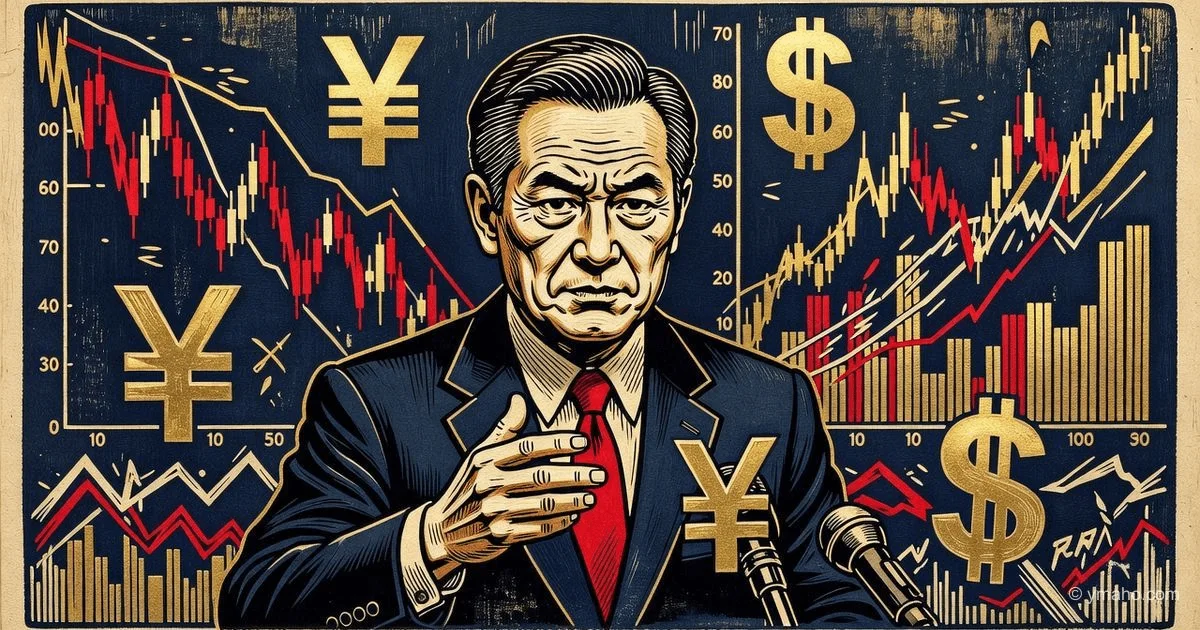
Bank of Japan Signals Tapering of Yield Curve Control as Yen Falls
USD/JPY temporarily exceeded 150.00, but after BOJ Governor Ueda's statement about readiness to review policy at the July meeting, the pair retreated to 148.80.
Analytical article: Bank of Japan Backs Down — Why the YCC Rollback Signal Won't Save the Yen
Colleagues, let's call a spade a spade. Bank of Japan Governor Kazuo Ueda's statement about "readiness to review yield curve control (YCC) policy at the July meeting" is not a trend reversal but a panicked gesture from a drowning central bank. Yes, after these words, USD/JPY pulled back from 150.00 to 148.80. But look at the context: the pair is still trading 30% higher than a year ago. The Japanese economy contracted by 1.8% year-on-year in the first quarter of 2025 — the worst reading in four quarters. Inflation has been above the 2% target for a year and a half, and real wages have been falling for 24 consecutive months.
The situation is classic: the Bank of Japan wants to tighten policy but cannot. The debt is too large — 530 trillion yen (about $3.4 trillion) in government bonds on the BOJ's balance sheet, representing 49% of the entire JGB market. Any sharp upward move in yields would collapse Japan's financial system. I work with Tokyo hedge funds and see: professional players do not believe in a "hawkish" pivot. They think the BOJ is bluffing and continue to short the yen. Let's break down why this signal is all smoke and no fire.
[The Gist]: What's Really Happening
The main paradox is that Ueda says one thing but does another. Reuters reports that at the June 15-16 meeting, the BOJ will likely pause its reduction in bond purchases, keeping them at around 2.1 trillion yen ($13 billion) per month. This is not a withdrawal of stimulus — it's a continuation. The market had priced in a 70% probability of a rate hike in June, but these expectations will likely be disappointed. Ueda's comment about a July review is an attempt to hold the yen from falling without real action. It's pure "verbal intervention."
The second layer is political pressure. Japan's Prime Minister Takaichi Hashimoto, who came to power in 2025, is pursuing aggressive fiscal policy. Market fears about his spending plans have already pushed 10-year JGB yields to 2.8% — a 30-year high. This is just 20 basis points below the "red line" of 3%, above which the cost of servicing government debt becomes critical. The Bank of Japan cannot allow yields to rise further, or the budget will collapse. Any policy tightening — a rate hike or abandonment of YCC — would instantly push yields above 3%. That is politically unacceptable.
The third factor is the "impossible triangle" of the Japanese economy. The BOJ must simultaneously: (1) fight inflation and yen weakness through rate hikes; (2) contain JGB yield increases to avoid collapsing government debt; (3) respond to external shocks (energy prices, Fed rates). It is impossible to fulfill all three conditions at once. Ueda chose the lesser evil: maintain YCC but change rhetoric to calm markets. This works only until large hedge funds start testing his resolve.
Timeline and Context
| Date | Event | USD/JPY | 10Y JGB Yield | Key Nuance |
|---|---|---|---|---|
| April 2026 | BOJ abandons commitment to keep rates "at current level or lower" | 154-156 | 1.9-2.1% | First step toward normalization |
| Mid-May | Japan GDP data: -1.8% y/y | 157-159 | 2.3-2.5% | Economy contracts for second consecutive quarter |
| Late May | JGB yield reaches 2.8% — highest since 1994 | 159-160 | 2.75-2.80% | Political "red line" close |
| June 1-5, 2026 | Market prices in 70% probability of June rate hike | 159.20-159.80 | 2.70-2.78% | Expectations peak |
| June 8-9, 2026 | Leak: BOJ may pause bond purchase reduction | 149.50-150.20 | 2.65-2.72% | Expectation reversal |
| June 10-11, 2026 | Ueda: "ready to review policy at July meeting" | 147.80-148.80 | 2.60-2.68% | Yen strengthens on verbal intervention |
Note the key gap: the market had priced in a 70% probability of a June rate hike, but the BOJ will likely not only refrain from hiking but also pause its bond purchase reduction. This is not tightening — it's easing. The yen strengthened only because the market feared Ueda's "hawkish" rhetoric, but once traders realize that words are not followed by actions, USD/JPY will return to 150-151.
Who Wins and Who Loses
Winners #1 — Japanese exporters, especially automakers. Toyota, Honda, Nissan earn revenue in dollars and euros but pay salaries and taxes in yen. When the yen weakens by 10%, their operating profit rises by about 8-10% after hedging. Toyota's stock on the Tokyo Stock Exchange has risen 12% year-to-date on the back of yen weakness. They are the main lobbyists for a weak yen and pressure the government to keep the BOJ from raising rates.
Winners #2 — Foreign hedge funds shorting the yen. Large players like Bridgewater and Renaissance Technologies have increased their short yen positions by another $8-10 billion over the past three weeks. Their calculation: the BOJ cannot tighten due to the debt problem, and the Fed will remain "hawkish" — the rate differential will persist, and USD/JPY will head to 160-162.
Winners #3 — Japanese tourism operators and the service sector. The influx of foreign tourists to Japan rose 35% year-on-year in May thanks to the cheap yen. Chinese tourists, who previously traveled to Europe, are now choosing Japan en masse. This supports the local economy but does not solve structural problems.
Losers — Japanese households and small businesses. Import inflation hits wallets: food prices rose 7.2% year-on-year, utilities 9.5%. Real wages have been falling for 24 consecutive months — the longest decline since the 1990s. Small restaurants and retail chains are closing by the hundreds, especially in regional cities.
Also losing — holders of Japanese bonds. JGB yields have risen from 0.5% in early 2025 to 2.8% now. This means long-term bond prices have fallen 15-20% over a year and a half. Japanese pension funds (GPIF, the world's largest, with assets of about $1.6 trillion) have suffered significant losses. If yields rise to 3%, losses become systemic.
What the Media Isn't Saying
Insight #1: The "independence" of the BOJ from the government is a myth. Since the Hashimoto cabinet came to power, pressure on the central bank has intensified. Japan's budget for fiscal year 2026 is based on JGB yields of 2.8-2.9%. If yields exceed 3%, debt service costs will rise by 3-4 trillion yen (about $20-25 billion) per year. This would force the government either to cut social spending (politically suicidal) or raise taxes (which would kill the economy). Therefore, Hashimoto has made it clear to Ueda through back channels: no rate hike in 2026. "Tokyo is seeking to pause the reduction in bond purchases to contain yield increases."
Insight #2: The US won't let Japan intervene fully. When USD/JPY broke 160 in late 2024, Japan's Ministry of Finance spent about $60 billion on interventions. But these interventions require selling US Treasury bonds. The US Treasury does not approve of massive UST sales by Japan — it raises Treasury yields and increases borrowing costs for the US government. Analysts note that "large-scale intervention would require selling UST, which requires tacit approval from Washington." If Washington objects, Tokyo cannot defend 160.
Insight #3: The real risk is not 160, but 170-180. Scotiabank forecasts that even after BOJ policy normalization, the yen could continue to fall to 160 per dollar. But I consider this forecast conservative. If the Fed does not cut rates in 2026 (and the probability is rising due to persistent US inflation), and the BOJ remains in "verbal intervention" mode, the yield spread between 10-year US and Japanese bonds will remain at 350-400 basis points. With such a spread, USD/JPY could easily reach 170-180 in 2027. That would mean a full-blown currency crisis for the world's third-largest economy.
| Indicator | Current Value | 2027 Forecast | Comment |
|---|---|---|---|
| Government debt (% of GDP) | 264% | 270%+ | Largest in the developed world |
| JGB assets on BOJ balance sheet | 530 trillion yen ($3.4 trillion) | ~500 trillion yen | 49% of market — record |
| JGB yield "red line" | 3% | 3.2-3.5% | If breached — budget crisis |
| Real wage (y/y) | -1.2% | -0.5% | Falling for 24 months straight |
| Hidden intervention volume (since May) | ~$30-40 billion | $80-100 billion | Selling UST to support yen |
Forecast: Next 30 Days and 90 Days
Next 30 days (until July 11, 2026):
The key event is the BOJ meeting on June 15-16. Reuters and other sources expect with high probability that the central bank will keep rates at -0.1% and pause further reduction in bond purchases (leaving them at 2.1 trillion yen per month). This will be perceived by the market as a "dovish" signal, and USD/JPY will quickly return to 150-151.
If at the same meeting the BOJ unexpectedly raises rates (probability, in my estimation, no more than 15%), the yen could strengthen to 145-146. But this would be a short-lived effect — the market will quickly realize the hike was a "one-off gesture" and push the pair back up.
After the June meeting, the pair will likely consolidate in the 148-152 range until the end of the month. Key risks are US inflation data on June 12 and Powell's speech on June 19-20. If the Fed signals readiness for further rate hikes, USD/JPY could test 154-155 as early as late June.
90 days (until September 11, 2026):
By autumn 2026, dollar/yen will likely reach 158-162. Why? First, the BOJ will delay real tightening under government pressure. Second, the Fed will likely keep rates high (5.25-5.50%) until year-end due to persistent inflation. Third, seasonal factors: the third quarter is historically weak for the yen due to dividend flows and capital repatriation by Japanese institutional investors.
A break above 160 is a matter of time. The question is how Japan's Ministry of Finance will react. My sources in Tokyo say the next "line in the sand" is 162. Below that level, there will be no intervention. But once the pair exceeds 162, the MOF may spend another $50-70 billion to defend the yen. However, given previous failed interventions, the market will likely quickly "digest" these dollar sales, and the pair will continue to rise.
| Period | USD/JPY | Probability of BOJ Rate Hike | Key Driver |
|---|---|---|---|
| Current level (June 11) | 147.80-148.80 | 10-15% (June), 30-40% (July) | Expectation of "hawkish" signal |
| 30 days (forecast) | 148.00-154.00 | 5-10% (June realized) | BOJ decision June 15-16 + Fed |
| 90 days (forecast) | 155.00-162.00 | 20-25% (September) | Rate differential + energy prices |
Editorial Forecast
Asset: USD/JPY. Direction: Up (yen weakening) in the next 48-72 hours after the market realizes that the June 15-16 meeting will likely not bring tightening. Key levels: Resistance at 149.50-149.80, a break opens the path to 150.50-151.00. Support at 147.50-147.80. Confidence level: Medium (65%). Main risk to forecast: If at the BOJ meeting on June 15-16, Ueda unexpectedly announces a real rate hike (probability 10-15%), the yen could strengthen to 146-147. If the pair closes below 147.30 on the daily timeframe, the upside scenario is canceled. Watch for leaks 24 hours before the BOJ decision — they will determine the direction.
— Editorial Team