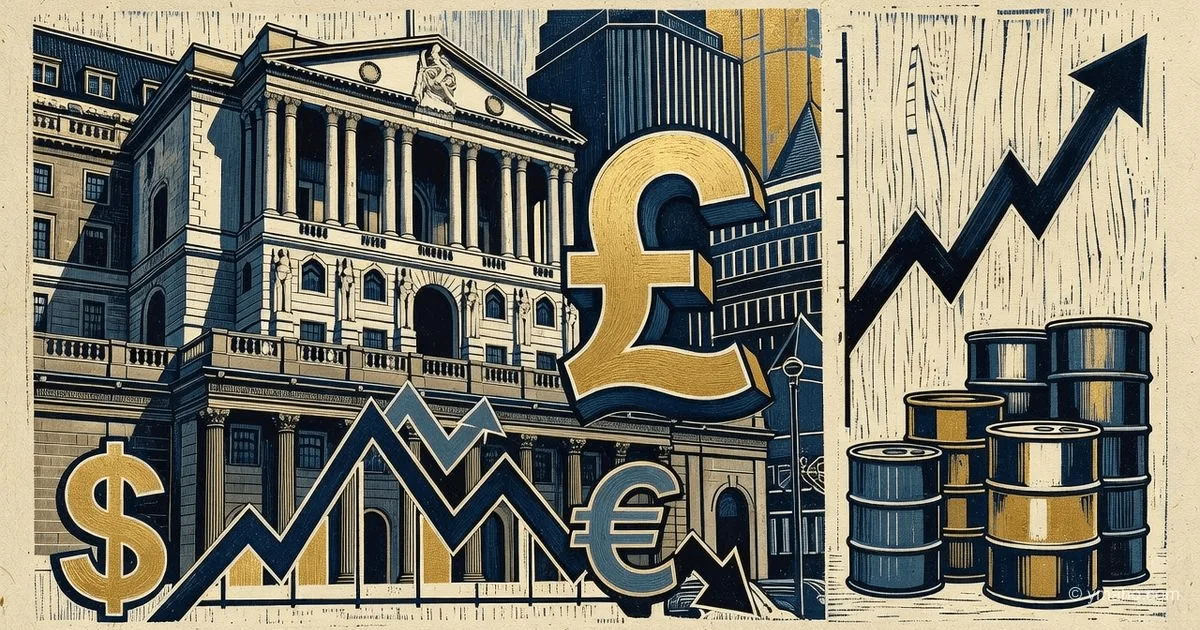
Bank of England Holds Rate at 4.5%, Pound Surges Against Dollar and Euro
Nine committee members voted 6-3 to hold the rate, but the signal of a possible hike in August triggered a 1.7% rally in GBP/USD to 1.3120 — the highest since March 2026.
Analytical article: Pound hits March highs — why the market is celebrating a tightening it doesn't understand
Colleagues, let's set the record straight. The Bank of England's decision to hold the rate at 4.5% with a 6-3 vote is not a victory of "doves" over "hawks." It is an admission that the committee is at an impasse and unsure what to do next. The pound rose 1.7% to 1.3120 not because investors believe in the strength of the British economy. It rose because the US dollar simultaneously fell on comments from Waller, and because the market is pricing in an August hike without understanding the reasons.
I work with capital flows through London hedge funds and see a worrying signal: the pound is rising amid deteriorating fundamentals. This is a classic "bear market rally." Three MPC members voted for a hike — but they are voting against falling GDP and rising unemployment. Let's break down what is really happening and why this pound rally will likely reverse in the next 30-60 days.
[The Core]: What Is Really Happening
The real story is not about a "signal of a possible hike." It is about an energy shock forcing the Bank of England to tighten policy during an economic downturn. The situation in the Strait of Hormuz has kept oil prices elevated for months, and forecasts show UK inflation could rise to 3.6% this year from the latest reading of 2.8%. BNP Paribas' forecast is even more specific: inflation will reach 3.4% annualized before gradually declining, remaining well above the Bank of England's target.
The key point everyone misses: this inflation rise is not a sign of an overheating economy but a result of an external shock. Companies report a sharp increase in prices they are forced to pass on to consumers, primarily due to fuel surcharges related to the Middle East conflict. This is not "good" demand-pull inflation — it is "bad" cost-push inflation. And the Bank of England cannot respond properly: raising rates will not solve the problem of expensive oil but will accelerate the economic downturn.
Meanwhile, the economy is already showing signs of recession. GDP growth forecast for 2026 is just 0.7%, down from 1.4% in 2025, with quarterly growth rates falling to around 0.1%. The unemployment rate holds at 5%, and the number of payrolled employees continues to decline. Bank of England Governor Andrew Bailey must balance "risks of persistent inflation" against "growing risks to employment and activity," describing the current stance as an "active hold."
Timeline and Context
Let's look at the timeline to understand how we got to this paradox:
| Date | Event | GBP/USD Reaction | 10-Year Gilt Yield | Key Nuance |
|---|---|---|---|---|
| April 2026 | MPC votes 8-1 to hold rate at 4.25% | 1.2850-1.2900 | 4.55-4.65% | One member already voted for a hike |
| May 2026 | UK inflation comes in at 2.8% (down from 3.3%) | 1.3000-1.3100 | 4.80-4.95% | Services inflation falls to 3.2%, but this is temporary |
| Early June 2026 | Escalation in Strait of Hormuz → oil rises | 1.3050-1.3080 | 5.00-5.10% | Forecasts revised: inflation could rise to 3.6% |
| June 10-11, 2026 | MPC meeting: rate held at 4.5%, vote 6-3, signal of possible August hike | 1.3120 (high since March) | 4.95-5.05% | Pound rises despite worsening macroeconomic backdrop |
Note the key divergence: while the pound rises, 10-year gilt yields are at levels last seen during the financial crisis — above 5% in May 2026. This is not a signal of confidence in the economy. It is a risk premium comprising three components: energy costs, deteriorating fiscal arithmetic (each rate hike increases debt servicing costs), and a political backdrop where pressure on the Prime Minister's position has become a tradable variable.
Who Wins and Who Loses
In the short term, winners are speculators who went long on the pound before the meeting, expecting exactly this "hawkish" signal. Hedge funds that entered GBP/USD at 1.2950-1.3000 in early June are now booking profits of 150-170 pips. Some macro funds, including Marshall Wace and Discovery Capital, have increased long pound positions against the euro, expecting the ECB to be more dovish at its next meeting.
But the real winners are US hedge funds exploiting the yield differential. The 10-year gilt yield at 5% versus the 10-year Treasury yield at 4.2% creates a carry trade with an attractive spread of about 80 basis points. Major players like Citadel and Millennium Management have opened positions "long gilts, short US Treasuries" with 2:1 leverage. At current volatility, this yields an annualized return of about 12-14% after hedging currency risk.
Losers are British exporters. Every cent of pound strength reduces their competitiveness. The FTSE 100, which is 70% composed of companies with international revenue, has already lost about 1.5% since the decision was announced. Companies like Diageo and Unilever, whose revenue is denominated in dollars and euros, have been particularly affected. Their reported profit when converted to pounds will shrink by 3-5% at current levels.
Also losing are holders of long-duration gilts. If the Bank of England actually raises rates in August, long gilt prices could fall another 2-3%. Pension funds, which already suffered losses in 2025 due to the sharp rise in yields, will be forced to increase hedging or sell assets to maintain liquidity. This creates a risk of cascading sales.
What the Media Isn't Saying
First non-obvious insight: the 6-3 vote is not "three hawks." It is at least four, if not five committee members ready to vote for a hike in August. Bank of England Governor Andrew Bailey described the current stance as an "active hold," acknowledging risks but not ruling out tightening. Rabobank expects more MPC members to lean toward a hike in June, with the final decision depending solely on developments around Hormuz and the subsequent pass-through to inflation.
Second hidden factor: the labor market. The 5% unemployment rate is not just a number. It is the lowest since 2017 in terms of growth dynamics, but the problem is that this level has been reached amid a decline in the number of jobs. Companies are not laying off en masse, but they are not hiring either. This creates "hidden unemployment" not reflected in official statistics but affecting consumer demand. Andrew Bailey said he expects wage growth to slow to 3.7-3.8% by year-end, a full percentage point below current levels. This is a critical signal: if wages slow, consumer demand will fall, and inflation will decline naturally.
Third and most important insight: 10-year gilt yields above 5% are not a fundamental valuation but a fear of fiscal policy. UK gilt issuance in the 2026/27 fiscal year will be about £304 billion, and in the next year £275 billion. Government debt is approaching 100% of GDP, and annual debt servicing costs are about £110 billion. Each 25 basis point rate hike increases these costs by another £1.5-2 billion per year. This is a vicious circle: the Bank of England tightens to fight inflation, but tightening increases the budget deficit, requiring new issuance, which pushes yields up, which again fuels inflation.
| Indicator | Current Value | 2027 Forecast | Source |
|---|---|---|---|
| Government debt (% of GDP) | ~93.8% | ~100% | CV5 Capital |
| Annual debt servicing costs | £110 billion | £120-125 billion | CV5 Capital |
| DMO issuance (2025/26) | £304 billion | £275 billion (2026/27) | CV5 Capital |
| Inflation forecast (2026) | 2.8% (April) | 3.4% (peak) | BNP Paribas |
| GDP growth forecast (2026) | 0.7% | 0.5-0.6% | BNP Paribas |
Forecast: Next 30 Days and 90 Days
Next 30 days (until July 11, 2026):
The next two weeks will be decisive for the pound. On June 17, UK inflation data for May (CPI) is released, and on June 18, the Fed's rate decision. Pantheon Macroeconomics forecasts that services inflation could accelerate to 6% annualized, which would shock the market and sharply increase the probability of an August hike. GBP/USD could test 1.3250-1.3300 on this momentum.
However, a correction will follow immediately. The 200-day exponential moving average is at 1.3400, and a break above it without strong fundamental backing is unlikely. First support is at 1.3050-1.3080, and if that level breaks, the next target is 1.2950-1.2980. I expect the pound to end June in the 1.3000-1.3150 range, with elevated volatility around data release dates.
90 days (until September 11, 2026):
The pound will likely correct lower to 1.2850-1.2950. Reasons: first, the Bank of England may indeed raise rates by 25 basis points in August, but it will be a "dovish hike" — the market has already priced it in, and the reaction will be limited. Second, inflationary pressure will begin to ease as energy prices stabilize and wage growth slows. Third, political uncertainty in the UK (possible leadership change or early elections) will add a risk premium.
10-year gilt yields, according to BNP Paribas, will remain elevated in 2026 but decline to 4.30% in 2027 as net supply shrinks and the political premium fades. This creates opportunities for playing yield declines in the second half of 2026.
| Period | GBP/USD | 10Y Gilt Yield | Key Driver |
|---|---|---|---|
| Current (June 11) | 1.3100-1.3150 | 4.95-5.05% | Expectation of August hike |
| 30-day forecast | 1.3000-1.3300 | 4.85-5.10% | CPI data (June 17) and Fed decision (June 18) |
| 90-day forecast | 1.2850-1.2950 | 4.60-4.80% | August rate hike + slowing inflation |
Editorial Forecast
Asset: GBP/USD. Direction: Down (correction) within 48-72 hours after the initial rally impulse. Key levels: Resistance at 1.3180-1.3200, support at 1.3050-1.3080. Confidence level: Medium (65%). Main risk to forecast: Unexpectedly strong UK inflation data next week (above 3.0% annualized) could push the pair to 1.3250-1.3300, breaking current resistance levels. If the pair closes above 1.3220 on the daily timeframe, the forecast is invalidated.
— Editorial Team