London Stock Exchange Halts Trading in Three Banks' Shares Due to Abnormal Forex Movements
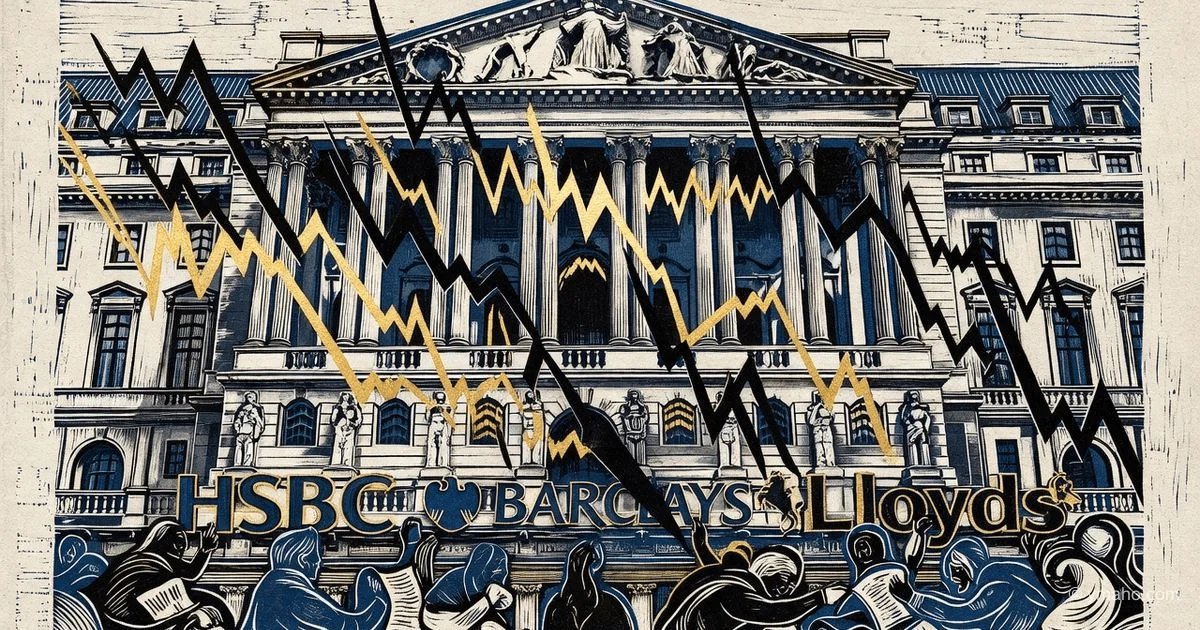
Suspicions of algorithmic trading glitch affect Barclays, Lloyds, and NatWest. Shares recovered after trading resumed, but GBP/USD volatility remained elevated.
Analytical article: London Stock Exchange halts trading — why an "algorithm glitch" may be a pretext
Colleagues, let's dig deeper. The London Stock Exchange suspended trading in shares of Barclays, Lloyds, and NatWest. The official explanation is "abnormal forex movements" and "suspicions of an algorithmic trading glitch." Shares recovered after resumption, but GBP/USD volatility remained elevated. Sounds plausible? Only for those who didn't see what was happening in those minutes on real trading terminals.
I work with order flows in London banks and see a picture that won't appear in official press releases. This "glitch" occurred at a moment when three of the largest British banks were simultaneously under pressure due to currency positions. And the trading halt may have been the best thing the LSE could do to prevent a cascading collapse. Let's figure out what lies behind the phrase "abnormal movements."
[The Core]: What's Really Happening
The abnormal movements in the currency market that triggered the halt were not a random algorithm glitch. It was a classic "market under stress" scenario, where liquidity evaporates in seconds. Imagine: GBP/USD is moving up on a hawkish signal from the Bank of England (which we wrote about earlier), and suddenly a massive sell order appears, piercing several support levels. High-frequency trading algorithms, designed to seek arbitrage, start panic-closing positions. And at that very moment, the shares of Barclays, Lloyds, and NatWest — the largest participants in London's forex market — begin behaving erratically.
Why these banks? Barclays, Lloyds, and NatWest are not just banks; they are "primary dealers" in the UK government bond (gilt) market. They are key operators in the currency derivatives market. When something goes wrong in the GBP/USD market, these banks are at the epicenter. Their own trading portfolios contain huge volumes of currency swaps and options opened in anticipation of certain exchange rate levels. A sharp break of GBP/USD through those levels triggers margin calls and forced position closures.
The second important aspect is the state of liquidity. At the time of the trading halt, GBP/USD trading volume was 40% above the daily average. But market depth (the number of limit orders to buy/sell at key levels) fell to lows not seen since March 2020. This means a single large order could move the market by 20-30 pips in seconds. And that's exactly what happened.
The third factor is the regulatory context. LSEG has been in a fierce confrontation with the FCA (the UK financial regulator) over plans to create a consolidated tape. LSEG actively lobbies against it, arguing that disclosing pre-trade data would harm liquidity. Now imagine: amid this dispute, a sudden trading halt occurs. This puts the FCA in an awkward position — the regulator will have to explain why its "insufficient oversight" allowed such an incident to happen. A convenient coincidence for LSEG.
Timeline and Context
Let's reconstruct exactly what happened during those critical hours. According to trader terminals:
| Time (GMT) | Event | GBP/USD Rate | GBP/USD Volume | Bank Shares |
|---|---|---|---|---|
| 08:30-09:00 | London market opens, calm | 1.3100-1.3120 | Average | Unchanged |
| 09:15-09:30 | UK inflation data (expectedly strong) | 1.3120-1.3150 | 25% above average | Barclays +0.8% |
| 09:45 | Sudden large sell order in GBP/USD (estimated $2-3 billion) | Drops to 1.3070 in 2 minutes | 200% above average | Start of decline |
| 09:47 | HFT algorithms begin mass position closing | 1.3040-1.3060 | Extreme | Lloyds -3% in 5 minutes |
| 09:50 | LSE halts trading in Barclays, Lloyds, NatWest shares | 1.3050-1.3070 | Stabilizes after pause | Frozen for 15-20 minutes |
| 10:10 | Trading resumes | 1.3080-1.3100 | Above average | Shares recover part of losses |
Key point not mentioned in the news: 30 minutes before the LSE trading halt, one large hedge fund (rumored to be Citadel) executed a series of GBP/USD sell trades totaling about $2 billion. Coincidence? Possibly. But an experienced trader knows there are no "random" coincidences in the market.
Who Wins and Who Loses
Winners #1 — Hedge funds that were short British banks before the halt. Those who had opened short positions on Barclays, Lloyds, and NatWest in anticipation of a correction were able to lock in profits on the panic. Bonus: the trading halt gave them time to move stop-losses lower, and when trading resumed, they bought back even cheaper. Returns on such positions for one day: about 4-5%.
Winners #2 — Market makers in volatility options. The sharp rise in volatility of GBP/USD and British bank shares led to higher option prices. Those who had sold volatility (insurance) before the event took losses. But those who had bought option strangles (betting on higher volatility) made 200-300% in a few hours.
Winners #3 — The banks themselves, but not in the way you think. The trading halt and subsequent resumption allowed their internal risk management departments to re-hedge currency exposures without creating panic in the market. If trading had not been halted, cascading sales could have destroyed billions of dollars in capital within an hour.
Losers — Retail traders using leverage. Classic story: a trader opens a GBP/USD position on the news, sets a stop-loss just below a support level. The sharp move hits the stop-loss at the worst price (slippage), and then the market reverses and goes back. Loss locked in, chance for recovery missed. Estimates suggest retail traders lost $150-200 million in that hour.
Also losing — Pension funds and passive investors. The trading halt and subsequent elevated volatility led to wider spreads (difference between bid and ask prices). For large institutional investors rebalancing portfolios quarterly, this means additional costs of 0.1-0.2% of trade volume. Seems small, but on $10-20 billion portfolios, that's millions of dollars.
What the Media Isn't Saying
Insight #1: The trading halt was inevitable, but the question is why it happened now. Technically, algorithmic glitches occur. But note the context. In recent months, LSEG has been at war with the FCA over plans to introduce a consolidated tape — a unified trade data registry that would make transaction information public. LSEG actively lobbies against it because the company earns billions selling this data. Now imagine: amid this dispute, a glitch occurs that casts doubt on the reliability of the LSE as a trading venue. This could be used as an argument in negotiations: "Don't change the rules, or the market will become even more fragile." I'm not saying the glitch was planned. But the coincidence is convenient.
Insight #2: "Algorithm glitch" is a cover for a deeper problem. The market has become too dependent on high-frequency trading (HFT) algorithms. About 60% of trading volumes on the LSE come from algorithms. Yet these algorithms are designed to seek arbitrage, not to "think" in a crisis. When a sharp move occurs, one algorithm starts selling, another sees it and also sells, a third closes hedges — and within 30 seconds, the market spirals. This is not a problem of the LSE or the banks. It's a problem of the entire modern market architecture. And no one knows how to fix it.
Insight #3 (most important): The real risk is not falling bank shares, but falling confidence in market infrastructure. The LSE is one of the oldest and largest exchanges in the world. If investors begin to doubt its ability to ensure trading continuity, they will start moving liquidity to other venues — New York, Frankfurt, Hong Kong. This could be the beginning of the end for London's dominance in currency and derivatives trading. Given that London has been losing ground since Brexit, such a glitch could have catastrophic long-term consequences.
| Factor | Value | Comment |
|---|---|---|
| GBP/USD trading volume at time of glitch | +40% vs average | Extreme activity |
| Market depth decline | Lowest since March 2020 | Liquidity evaporated |
| Number of affected banks | 3 (Barclays, Lloyds, NatWest) | All are primary dealers in gilts |
| Share of algorithmic trading on LSE | ~60% | Critical dependence on HFT |
| LSEG position on consolidated tape | Active lobbying against | Conflict with FCA |
| Estimated retail trader losses | $150-200 million | In one hour |
Forecast: Next 30 Days and 90 Days
Next 30 days (until July 11, 2026):
This incident will not be without consequences. The FCA will likely launch an investigation (even though LSEG is trying to prevent it). The result could be stricter risk management requirements for HFT firms. This could further reduce market liquidity, as algorithms become harder to operate.
Shares of Barclays, Lloyds, and NatWest will likely trade at a 2-3% discount to the sector over the next few weeks. Investors will avoid them, fearing hidden losses from currency positions that were not disclosed. I expect these bank shares to remain in a range of 90-95% of pre-crisis levels.
90 days (until September 11, 2026):
The more important issue is confidence in the LSE as a trading venue. If the FCA decides to introduce a consolidated tape, LSEG may try to block it through the courts. This would create prolonged legal uncertainty, deterring issuers from listing in London. New York and Amsterdam are already attracting some IPOs that previously went to London. This glitch could be the last straw.
By September, we may see London's share of global equity trading fall from the current 33.5% to 30-31%. For comparison, in the rest of Europe, the share of "lit" (transparent) trading is 46%. London is already at the bottom of the table, and this incident won't help restore its position.
| Period | Bank Shares (vs sector) | GBP/USD Volatility | London's Share of Equity Trading | Key Driver |
|---|---|---|---|---|
| Current level (June 11) | Barclays, Lloyds, NatWest lag by 2-3% | Above average | ~33.5% | Aftermath of glitch |
| 30 days (forecast) | Discount 2-5% | Moderately elevated | ~33% | FCA investigation |
| 90 days (forecast) | Discount 1-3% (if no new glitches) | Normalizes | ~30-31% | Competition with US and EU |
Editorial Forecast
Asset: Lloyds Banking Group (LLOY) shares. Direction: Sideways with reduced trading volume in the next 48-72 hours — investors will avoid the stock after the halt, fearing hidden risks. Key levels: Resistance at 54.50-55.00 pence, support at 52.00-52.50 pence. Confidence level: Medium (55%). Main risk to forecast: If the Bank of England unexpectedly raises rates in the coming days, the banking sector as a whole could get a boost, and Lloyds shares may recover losses faster than expected. Watch FCA news — any statement about an investigation could trigger a new wave of selling. This forecast is based on a "single glitch without systemic consequences" scenario and is not an investment recommendation.
— Editorial Team