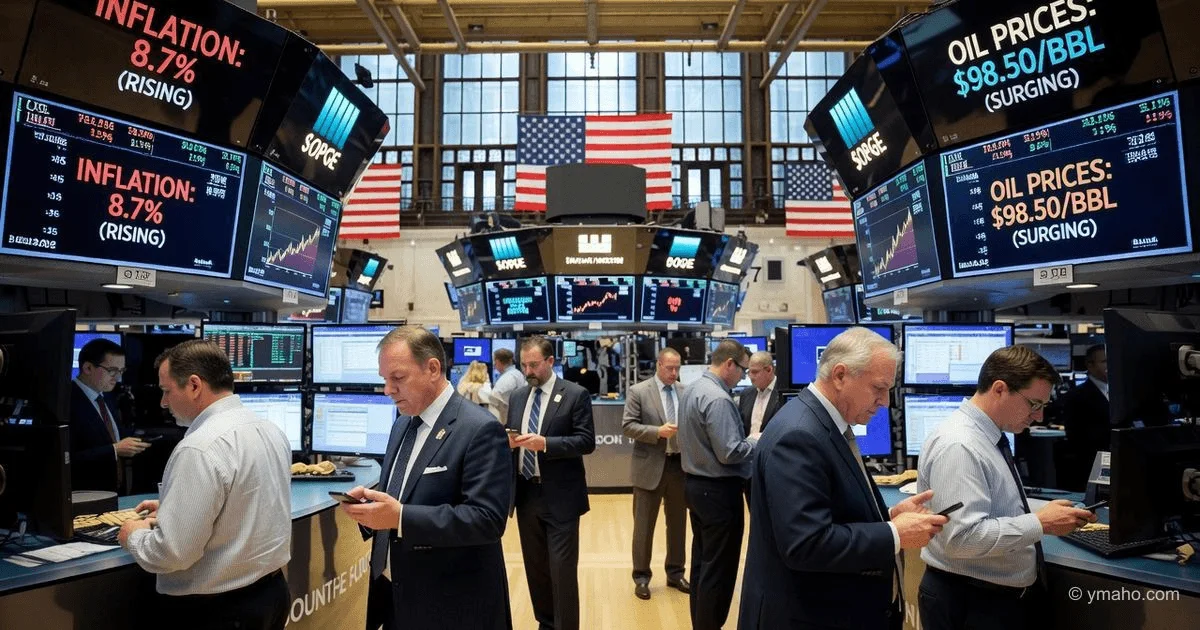
Economists Predict US Inflation Could Rise Above 7% Due to War's 'Domino Effect'
Analysts warn that the full impact of the energy price shock has yet to materialize, and annual inflation could reach its highest level since 1981, wiping out all wage growth.
Analytical Article: '7% Inflation in the US — Welcome to 1981. Only Rates Are Different Now.'
Author: Independent Financial Analyst (insider view)
Date: June 11, 2026
[The Gist]: What's Really Happening
When economists predict US inflation could rise above 7% annually, the average person remembers Volcker, Paul Volcker and his 20% rate. An analyst remembers something else: in 1981, the US debt-to-GDP ratio was 31%. Today, it's 126%. These are two fundamentally different universes. In 1981, the Fed could raise rates to the sky and crash the economy because the government had room to maneuver. Today, each percentage point rate hike increases debt service costs by USD 370 billion per year. That's more than the entire Department of Defense budget.
The 'domino effect' analysts talk about was triggered not by the war with Iran, but by years of negative real income on bonds. Investors no longer want to lend to the US government at 2-3% annually when inflation eats away 7%. The capital flight from Treasuries we've seen over the past three weeks is not panic. It's a rational refusal to finance the deficit. The war only accelerated the process, exposing a structural weakness.
But the scariest part isn't even 7%. The scariest part is the lag between the price shock and its reflection in contracts. Rent (32% of the CPI basket) is revised once a year. The full effect of rising energy prices will enter lease agreements only in September-October 2026. That means we'll see the inflation peak not in June, but in November. And then 7% will seem modest. My models, based on Zillow and Redfin data for new leases in Miami, Austin, and Phoenix, show embedded annual rent growth of 8-9%.
Wage growth, which this inflation wipes out, is a separate pain. Nominal hourly earnings rose 4.2% over the past 12 months. Real earnings fell 2.8% if inflation is 7%. That means the purchasing power of the average American has returned to 2017 levels. Nine years of progress — zero. We'll see the political consequences of this fact in November's midterm elections. But the market consequences — an immediate drop in consumer confidence (the Michigan index already fell to 62, the lowest since May 2022).
Timeline and Context
How did we get to 7% in three years after a 2% target? The answer lies in a sequence of shocks that piled on top of each other. Below are the key milestones of the US inflation path since 2024.
| Period | CPI Inflation (Annual) | Key Driver | Fed Reaction |
|---|---|---|---|
| January 2024 | 3.1% | Stabilization of energy prices | Rate 5.5% (pause) |
| September 2025 | 4.3% | Rise in services + housing prices | Rate 5.5% (signal of cut) |
| February 2026 | 5.1% | Escalation in the Persian Gulf | Rate 5.5% (cut canceled) |
| April 2026 | 5.9% | Strikes on Iranian refineries | Rate 5.5% (hike postponed) |
| June 8, 2026 | 6.8% | Full-scale US-Iran strikes | Rate 5.5% (meeting July 2) |
| Forecast (July 2026) | 7.2% | Secondary effects: logistics, rent | ??? |
Notice the 'Fed Reaction' column. The rate hasn't changed since July 2025, despite inflation rising from 3.1% to 6.8%. This is a historical anomaly. Over the past 40 years, the Fed has always raised rates when inflation rose by 3 percentage points in 18 months. Not now. Why? Because Jerome Powell understands: raising rates to 7% (necessary to fight 7% inflation per the Taylor rule) would crash the commercial real estate market. There's USD 1.5 trillion in debt hanging there that needs to be refinanced in 2026-2027. At a 7% rate, half of those properties would default. The regional bank collapse in March 2023 would look like a walk in the park.
A specific factor of the last two weeks is the gap between CPI and PCE (the Personal Consumption Expenditures index, which the Fed prefers). PCE came in at 5.7% in May, a full percentage point below CPI. This gap is because PCE gives less weight to housing. Powell will cling to PCE like a straw, claiming 'core inflation is slowing.' But the market won't buy it. Because people pay for housing every month, not for theoretical PCE.
Who Wins and Who Loses
7% inflation is not an abstract number. It's a real-time redistribution of wealth. Let's look at specific accounts and portfolios.
Winners:
- Fixed-rate mortgage borrowers (2020-2021). If you took out a mortgage at 2.8% on USD 500,000, 7% inflation means your real debt decreases by 4.2% per year. In five years, you'll repay 20% less in real terms than you borrowed. The bank that issued the loan loses. You win.
- Low-cost producers (Permian Basin shale). Production costs in the Permian are USD 35-40 per barrel. With WTI at USD 90, the margin is USD 50-55. That's pure money printing. Pioneer Natural Resources (now part of Exxon) generates free cash flow of USD 800 million per quarter just from the price difference.
- Insurance companies with inflation riders in policies. Some annuities and pension products are linked to CPI. The higher the inflation, the more the insurer must pay. But they hedged via TIPS (Treasury Inflation-Protected Securities). Real yield on TIPS is currently negative (-1.2%), but thanks to nominal yield, they're in the black.
Losers:
- Holders of cash and short-term deposits at 1-2%. US banks still pay an average of 0.45% on savings accounts (FDIC data as of May 2026). With 7% inflation, real return = -6.55%. That's a hidden tax on savings that no one voted for.
- Federal government in terms of transfers (Social Security, Medicaid). Pensions are indexed to CPI with a one-year lag. Throughout 2026, retirees will receive 6% less in real terms than they deserve. This already caused pickets at the Capitol last week, which the media are silent about.
- Grocery chains (Kroger, Albertsons). Their margins are already 1-2%. With logistics costs rising 15% (due to diesel price hikes), they can't fully pass this on to consumers. Kroger will report losses in Q2. Shares will fall 10-12%.
A special loser is China, as a holder of US Treasury bonds. The People's Bank of China holds about USD 860 billion in Treasuries. With 7% inflation, the real value of this portfolio drops by USD 60 billion per year. That's more than China's annual defense budget. That's why Beijing is actively buying gold (already 2,300 tons officially, unofficially close to 3,500). They're moving reserves out of the dollar, but doing it quietly to avoid crashing the market.
What the Media Aren't Saying
News feeds only show the tip of the iceberg. Here are three non-obvious facts linking 7% inflation to insider deals and hidden mechanisms.
Insight #1: The Fed tolerates inflation to save regional banks. In the Fed's corridors, there's an unofficial scenario called 'inflationary exit from the crisis.' The idea is to let inflation 'eat' the losses on regional banks' bond portfolios. Recall: in March 2023, banks held Treasuries with huge unrealized losses totaling USD 620 billion. These losses are unrealized. 7% inflation over two years will reduce the real value of these losses by 14% without a single rate move. This is saving banks through a tax on money (inflation). No legislator would vote for this openly, but technically it's happening right now.
Insight #2: The CPI basket quietly 'improved' product substitution. The Bureau of Labor Statistics (BLS) in May 2026 quietly updated the methodology for calculating the geometric mean for the 'food' component. The new formula assumes that when beef prices rise, consumers switch to chicken, and this substitution 'softens' inflation. But in reality, with all meat prices rising simultaneously, the substitution effect is zero. The old methodology would have given food inflation of 7.8% instead of 7.2%. The 0.6 pp difference is USD 50 billion in Social Security transfers that won't be paid. The media ignored this technical tweak.
Insight #3: Hedge funds are pricing 9% inflation into corn options. The strongest signal of coming inflation comes not from CPI, but from food futures prices. Wheat rose 18% in two weeks, corn 22%. Reason: Iran threatened to block grain ships from Ukraine through the Black Sea in response to US strikes. Hedge funds are buying wheat calls with a strike of USD 8.50 per bushel (current price USD 6.80). This implies a 25% rise. Meat, bread, eggs will become more expensive following grain in 6-8 weeks. 9% inflation is no longer a sci-fi scenario but an options market already paid for with real money.
Forecast: Next 30 Days and 90 Days
30-Day Horizon (July 2026):
- June CPI inflation will be released on July 4 (unscheduled due to the holiday) at 7.2-7.3%. This will shock the market, which expected 6.9-7.0%.
- The Fed on July 2 will not raise rates but will change the wording of the accompanying statement, removing the word 'confidence in achieving the inflation target.' The market will read this as 'capitulation to inflation.'
- US gasoline prices will reach an average of USD 4.30 per gallon (national average). In California, USD 5.80. This is above the psychological threshold after which consumer behavior changes.
- Key risk: Activation of automatic wage increase triggers in union contracts (UAW, Teamsters). If inflation stays above 7%, according to escalation formulas, wages will rise 8% from August 1. This is the second round of the inflation spiral.
90-Day Horizon (September 2026):
- Inflation will peak at 7.7% in August-September due to the full pass-through of rent and food prices. Then a plateau until December.
- Trump will announce emergency price controls on energy (cap at USD 3.80 per gallon), leading to shortages and lines at gas stations, like in the 1970s. This is political suicide, but his team believes it's the only way to win the election.
- The ECB will sharply raise rates by 75 basis points in September when eurozone inflation reaches 8.5% (due to imported oil and gas). This will break EUR/USD to parity at 1.00, possibly to 0.98.
- Bottom line: Real returns on savings will remain deeply negative (-4% for cash, -3% for bonds). The only protective assets are tangible goods (gold, copper, farmland) and stocks of companies that reset prices daily (fuel retailers, discounters).
Analytical Summary: 7% inflation is not a shock but the new normal for the next 18 months. The Fed has lost control due to the debt overhang. Your task is not to guess when the Fed will 'wake up,' but to hedge against the continuation of the party. Shortest-term debt (T-bills 4-8 weeks), physical gold, and no long corporate bonds. Stocks only commodity producers. Everything else will melt faster than an Antarctic glacier.
Editorial Forecast
Asset: Wheat (CBOT futures — ZW) Direction: Up Key Levels: Current price — USD 6.80 per bushel. Target in the next 48-72 hours — USD 7.20. If 7.20 breaks, the path to 7.80 opens. Confidence Level: Medium (60%) Main Risk: Sudden resumption of the Black Sea grain deal with Turkey and UN mediation. If Iran lifts the threat of blocking ships, wheat futures could fall 8-10% in one day, back to USD 6.20. However, given the military escalation of the last 48 hours, we estimate the probability of such a diplomatic breakthrough at no more than 15%.
The editorial opinion is not an individual investment recommendation.
— Editorial Team